Peter Schubert - Böcker
Visar alla böcker från författaren Peter Schubert. Handla med fri frakt och snabb leverans.
11 produkter
11 produkter
1 797 kr
Skickas inom 5-8 vardagar
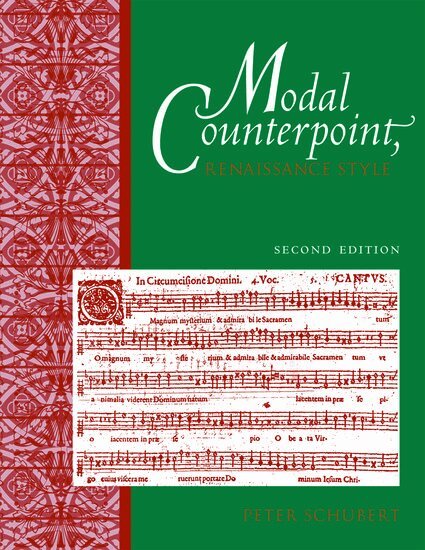
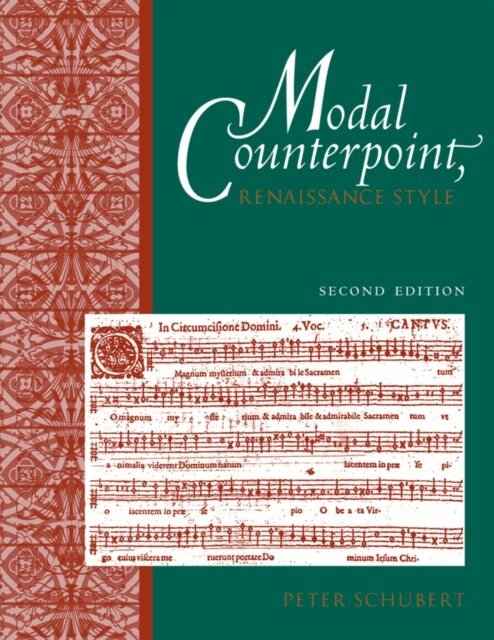
An exceptional text for undergraduate and graduate music students, Modal Counterpoint, Renaissance Style uses a wide variety of carefully graded exercises to present guidelines for writing and analyzing 16th-century music. The only species counterpoint text that draws directly on Renaissance treatises, it provides a conceptual framework to guide students through composition and analysis as it teaches them general structural principles. With stylistically diverse examples including not only motets and mass movements but also French chansons, German chorale settings, English canzonets, Italian madrigals, and Spanish organ hymns, villancicos, and ricercars, the book gives students a "real-life" feel for the subject. It distinguishes between technical requirements ("hard" rules) and stylistic guidelines ("soft" rules), and includes coordinated exercises that allow students to develop their skills systematically. The concluding chapters provide the formal and conceptual building blocks for longer pieces and encourage students to understand analysis and composition as complementary activities. By the end of the book, students are writing real compositions, not just drill exercises. The text also features progressively graded exercises, historical asides that explain important topics and issues of the period, and some notes in the preface on using the book in the classroom. Combining the historical accuracy of "style-oriented" texts with the more systematic species counterpoint approach, this book offers a unique alternative to other methods.Now in its second edition, Modal Counterpoint, Renaissance Style integrates improvisation activities and new repertoire examples into many chapters; revises the chapter on three-part writing (Chapter 14) so that it pays more attention to rules and strategies; reworks the chapters on cadences (Chapter 10) and on writing two parts in mixed values (Chapter 11) to make them more accessible to students; incorporates clarified instructions throughout; and includes a summary of rules.
939 kr
Skickas inom 3-6 vardagar
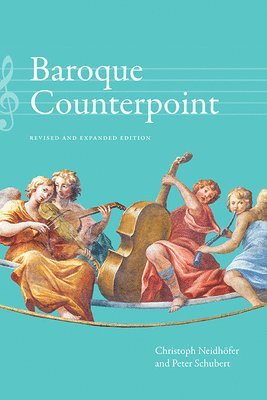
The classic text on Baroque Counterpoint, enlarged and revised, drawing from the master composers of the era.This book teaches Baroque compositional techniques through writing and improvisation exercises and analysis of repertoire examples. It provides readers with a historical outlook by focusing largely on principles taught in treatises from the period 1680–1780. This expanded edition includes new sections with keyboard exercises that provide training in Partimento performance as it was practiced at the time, helping students master Baroque style from the inside. While the focus of the book is on fugue, it also treats chorale preludes, stylized dances, inventions, and trio sonatas. The volume is divided into two parts-basic and advanced- which could be taught in a two-semester sequence. There are various options to introduce material from Part II into Part I for a one-semester course.
545 kr
Skickas inom 3-6 vardagar
799 kr
Skickas inom 5-8 vardagar
In connection with the recent treatment of radium and the actinides, the Gmelin Institute is carrying out the description of thorium and its compounds. The Supplement Volumes A 2, A 3, A 4, and A 5 with the history, isotopes, uses, the recovery of thorium and general properties of thorium atom and ions, the thermodynamics of its compounds and solutions, spectroscopic data and analytical chemistry, biological behavior, health protection and safety control have already been published. The Supplement Volumes C 1, C 2 and C 3 describing the compounds with the noble gases, hydrogen, oxygen compounds and nitrogen compounds are also available; also have been published Supplement Volumes C 5 and C 7 describing the compounds with sulfur, selenium, tellurium, and boron, carbonates, thiocynates, alkoxides, and carboxylates. The Supplement Volumes D 1, D 2, and D 3 describing the properties of thorium ions in solution and the solvent extraction of thorium as well as Supplement Volume E describing the coordination compounds also have been published. The present volume begins, in a summary fashion, with a description of the natural occurrence of the element Th. Especially stressed are those facts that are most important in understanding its geological distribution on Earth (as, e.g., mode of occurrence and distribution among minerals) and its behavior in minerals (as, e.g., mode of occurrence and distribution among minerals) and its behavior in minerals (as, e.g., diadochy and metamictization of minerals). Attached is a tabulation of the highest reported Th or ThO2 content in minerals that normally (by their crystal-chemical formula) do not contain Th. The main part of the present volume describes the minerals of Th. As can be seen from the crystal-chemical formulas, there are, in addition to a few minerals containing Th as the sole cation, a number of minerals that contain Th as an additional cation or as a diadochic element. In the case of diadochic substitution the mineral mayrepresent a Th-rich end member of a solid-solution series and, therefore, is described as a separate Th mineral, or may only sporadically contain higher amounts of Th (no mineral description is given). The mineral descriptions, in this volume including oxides, carbonates and phosphates/siliconphosphates of Th, comprise the following topics: occurence; chemistry; crystal form and structure; optical and other physical properties; and chemical and thermal behavior. The silicates of Th and the deposits of Th will be described in the volume "Thorium" Suppl. Vol. A 1b, that also contains a mineral index for both volumes.
128 kr
Skickas inom 3-6 vardagar
179 kr
Skickas inom 3-6 vardagar
184 kr
Skickas inom 3-6 vardagar
128 kr
Skickas inom 3-6 vardagar
184 kr
Skickas inom 3-6 vardagar
352 kr
Skickas inom 3-6 vardagar
753 kr
Skickas inom 3-6 vardagar
Studying improvised music is always a challenge, due to its volatility and unpredictability. But what about studying musical improvisation from before the age of sound recordings? In this book, three experts give their view on aspects of musical improvisation in the late medieval, renaissance, and early baroque periods. Historical sources show us how improvisation was an integral part of music education and how closely improvisation and composition were linked. This gives new insights into the way music was played in its original historical context and a new way to look at written scores from the past. Improvising Early Music will appeal to anyone interested in the historical background of our written musical heritage and to musicians who want to gain a deeper insight in the way this music was created. Contributors: Johannes Menke (Schola Cantorum Basiliensis, Basel), Peter Schubert (Schulich School of Music, McGill University, Montreal), Robert C. Wegman (Princeton University)