Peter Van der Sijde – författare
Visar alla böcker från författaren Peter Van der Sijde. Handla med fri frakt och snabb leverans.
14 produkter
14 produkter
Del 5 - New Technology-based Firms in the New Millennium
New Technology-Based Firms in the New Millennium
Inbunden, Engelska, 2006
2 244 kr
Skickas inom 5-8 vardagar
This book consists of selected papers from the Annual High Technology Small Firms (HTSFs). The conference is acknowledged by experts in the field to be a particularly useful and authoritative record of the evolution of HTSF research since the inception of the series in 1993. It addresses strategic growth for small firms. It discusses how to harness external resources to promote growth (i.e., government and/or larger firms) while maintaining a win-win. It includes discussion of "spin off" the transformation from a non-profit making entity to a competitive business world.
Del 6 - New Technology-based Firms in the New Millennium
New Technology-Based Firms in the New Millennium
Inbunden, Engelska, 2008
1 603 kr
Skickas inom 5-8 vardagar
Ward et al., examine the question of whether providing work experience within courses of study in higher education affects entrepreneurial attitudes and behaviour, important given government imperatives to foster entrepreneurship through the education system. They consider two dimensions: self-efficacy, which broadly relates to confidence in ability; and, entrepreneurial intent which relates to positive attitudes towards engaging in risk taking or firm start-up. Their sample is of 158 undergraduates who engaged in a summer work placement linked to their study. Their key finding is that positive effects on self-efficacy and entrepreneurial intent depends on the nature of the experience, being fostered by performing well in the face of difficulty and the closeness of the placement activity to their studies. Such experience appears more common when undertaking a placement in a small firm. Van der Sijde et al., consider the extent to which University start ups which are global as opposed to being domestically focussed differ in the extent of their business networks, using a sample comprising five technology-based firms of each type. They establish that global start-ups do have more extensive networks in terms of number of actors and global actors in the network at start-up, although their networks do not expand thereafter significantly more than domestic start-ups. They also have significantly more sources of capital.
Del 8 - New Technology-based Firms in the New Millennium
New Technology-Based Firms in the New Millennium
Funding: An Enduring Problem
Inbunden, Engelska, 2010
1 219 kr
Skickas inom 5-8 vardagar
"The New Technology-Based Firms in the New Millenium" series provides up to date research on a variety of aspects of High Technology Small Firm formation and growth (HTSFs) from a range of interdisciplinary perspectives and from national contexts throughout the world. This edited book series reflects on and shapes currently popular national government policies insofar as they relate to HTSFs. It is the only international publication specifically dealing with HTSF formation and growth and it uniquely provides an uninterrupted record of research in this area since 1993. This latest volume is a collection of the best papers presented at the HTSF Conference held in the United Kingdom at Manchester Business School in June 2007. Three major themes have emerged. Six particularly strong chapters of this volume are devoted to the critical problems of HTSF financing, comprising two contributions from the United Kingdom and individual chapters from Sweden, the Irish Republic, Italy, and Belgium. A further four papers are concerned with aspects of strategic development in HTSFs, and a final group of three papers deal with HTSF marketing problems, often in a 'born global' strategic context.
E-bok
PDF, Engelska, 20101 224 kr
Läs direkt efter köp
"The New Technology-Based Firms in the New Millenium" series provides up to date research on a variety of aspects of High Technology Small Firm formation and growth (HTSFs) from a range of interdisciplinary perspectives and from national contexts throughout the world. This edited book series reflects on and shapes currently popular national government policies insofar as they relate to HTSFs. It is the only international publication specifically dealing with HTSF formation and growth and it uniquely provides an uninterrupted record of research in this area since 1993. This latest volume is a collection of the best papers presented at the HTSF Conference held in the United Kingdom at Manchester Business School in June 2007. Three major themes have emerged. Six particularly strong chapters of this volume are devoted to the critical problems of HTSF financing, comprising two contributions from the United Kingdom and individual chapters from Sweden, the Irish Republic, Italy, and Belgium. A further four papers are concerned with aspects of strategic development in HTSFs, and a final group of three papers deal with HTSF marketing problems, often in a ''born global'' strategic context.
Del 9 - New Technology-based Firms in the New Millennium
New Technology-Based Firms in the New Millennium
Strategic and Educational Options
Inbunden, Engelska, 2012
1 318 kr
Skickas inom 5-8 vardagar
This volume is the latest edition of an international edited book series based on the formation and growth problems of High Technology Small Firms (HTSFs) begun in 1993. This body of work is unique, and maps the evolution of research in this area through almost two decades of academic research and government policy towards a sector that is the key to future prosperity of developed and developing notational economies throughout the world. In this the latest Volume, there is one major and two subsidiary themes that have emerged from the best papers to be presented at the HTSF Conference held at the University of Twente at Enshede in May 2008. Following a contextual introduction by the editors, seven of the chapter are concerned with the key issue of strategy, which is always a key concern for HTSFs as they seek to find the best way to getting their products to the market. Indeed, a further two papers are concerned with the requirements of international marketing, while a final three papers deal with aspects of education for HTSF founders.
E-bok
PDF, Engelska, 20121 383 kr
Läs direkt efter köp
This volume is the latest edition of an international edited book series based on the formation and growth problems of High Technology Small Firms (HTSFs) begun in 1993. This body of work is unique, and maps the evolution of research in this area through almost two decades of academic research and government policy towards a sector that is the key to future prosperity of developed and developing notational economies throughout the world. In this the latest Volume, there is one major and two subsidiary themes that have emerged from the best papers to be presented at the HTSF Conference held at the University of Twente at Enshede in May 2008. Following a contextual introduction by the editors, seven of the chapter are concerned with the key issue of strategy, which is always a key concern for HTSFs as they seek to find the best way to getting their products to the market. Indeed, a further two papers are concerned with the requirements of international marketing, while a final three papers deal with aspects of education for HTSF founders.
Del 10 - New Technology-based Firms in the New Millennium
New Technology-based Firms in the New Millennium
Inbunden, Engelska, 2013
1 402 kr
Skickas inom 5-8 vardagar
This volume is the latest edition of an international edited book series based on the formation and growth problems of High Technology Small Firms (HTSFs) begun in 1993. This body of work is unique, and maps the evolution of research in this area through almost two decades of academic research and government policy towards a sector that is the key to future prosperity of developed and developing notational economies throughout the world.
E-bok
Engelska, 20131 459 kr
Läs direkt efter köp
This volume is the latest edition of an international edited book series based on the formation and growth problems of High Technology Small Firms (HTSFs) begun in 1993. This body of work is unique, and maps the evolution of research in this area through almost two decades of academic research and government policy towards a sector that is the key to future prosperity of developed and developing notational economies throughout the world.
E-bok
Engelska, 20151 421 kr
Läs direkt efter köp
The latest edition of this international edited book series, based on the formation and growth problems of High Technology Small Firms (HTSF), contains the best papers presented at the 2011 and 2013 conferences, both held at Manchester Business School. This volume remains true to the initial mission of the HTSF Conference, established in 1993, to advance our knowledge of high-technology entrepreneurship and to advocate the need for more and better designed policy to promote such entrepreneurship. The need is as great as ever it was, not least given the continued economic stagnation of the European economy in the wake of the Financial Crisis and the Euro crisis. These papers address key themes relating to improving our understanding of the processes involved in high-technology entrepreneurship and of the design of effective policy to promote this research. The first two groups of papers examine the start-up and commercialization processes and the internationalization processes, which are often important for new high-technology businesses. Other papers examine topics like entrepreneurship clusters, inter-firm collaboration, and growth strategy for high-technology small firms.
Del 11 - New Technology-based Firms in the New Millennium
New Technology-Based Firms in the New Millennium
Inbunden, Engelska, 2015
1 318 kr
Skickas inom 5-8 vardagar
The latest edition of this international edited book series, based on the formation and growth problems of High Technology Small Firms (HTSF), contains the best papers presented at the 2011 and 2013 conferences, both held at Manchester Business School. This volume remains true to the initial mission of the HTSF Conference, established in 1993, to advance our knowledge of high-technology entrepreneurship and to advocate the need for more and better designed policy to promote such entrepreneurship. The need is as great as ever it was, not least given the continued economic stagnation of the European economy in the wake of the Financial Crisis and the Euro crisis. These papers address key themes relating to improving our understanding of the processes involved in high-technology entrepreneurship and of the design of effective policy to promote this research. The first two groups of papers examine the start-up and commercialization processes and the internationalization processes, which are often important for new high-technology businesses. Other papers examine topics like entrepreneurship clusters, inter-firm collaboration, and growth strategy for high-technology small firms.
E-bok
PDF, Engelska, 20081 558 kr
Läs direkt efter köp
Ward et al., examine the question of whether providing work experience within courses of study in higher education affects entrepreneurial attitudes and behaviour, important given government imperatives to foster entrepreneurship through the education system. They consider two dimensions: self-efficacy, which broadly relates to confidence in ability; and, entrepreneurial intent which relates to positive attitudes towards engaging in risk taking or firm start-up. Their sample is of 158 undergraduates who engaged in a summer work placement linked to their study. Their key finding is that positive effects on self-efficacy and entrepreneurial intent depends on the nature of the experience, being fostered by performing well in the face of difficulty and the closeness of the placement activity to their studies. Such experience appears more common when undertaking a placement in a small firm. Van der Sijde et al., consider the extent to which University start ups which are global as opposed to being domestically focussed differ in the extent of their business networks, using a sample comprising five technology-based firms of each type. They establish that global start-ups do have more extensive networks in terms of number of actors and global actors in the network at start-up, although their networks do not expand thereafter significantly more than domestic start-ups. They also have significantly more sources of capital.
Inbunden, Engelska, 2008
1 060 kr
Skickas inom 10-15 vardagar
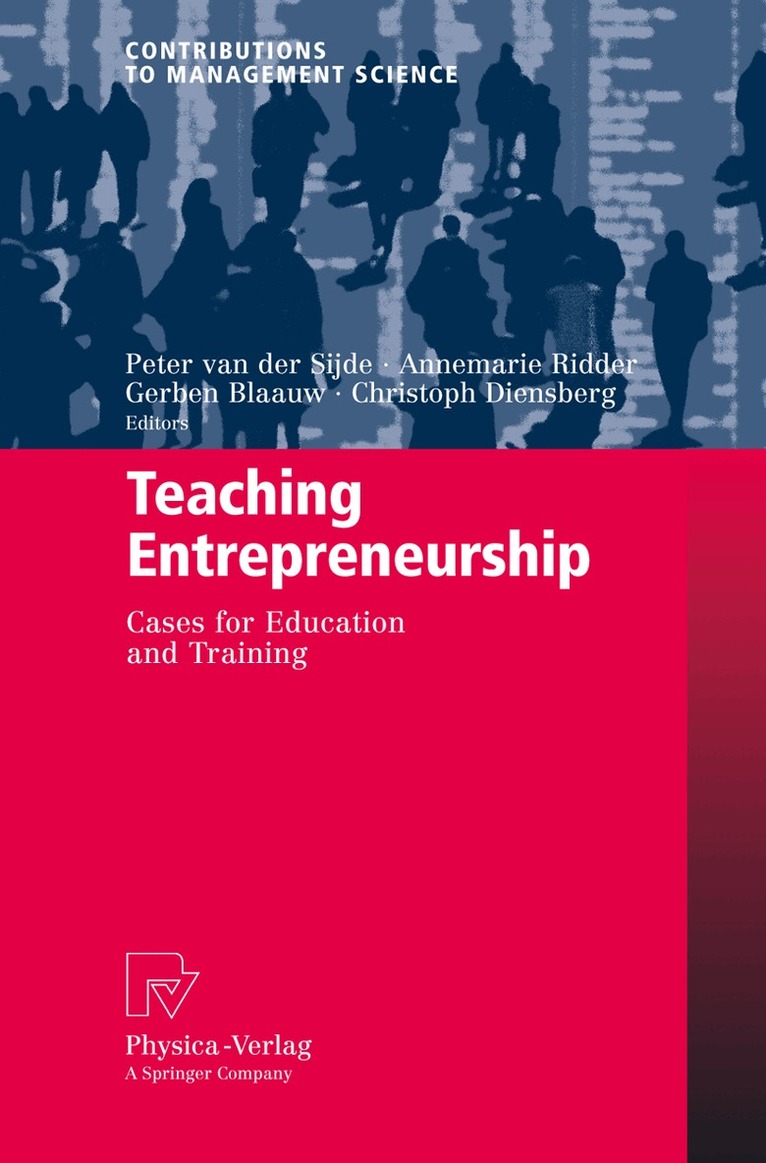
“Entrepreneurship that is something you learn in practice”. “Entreprene- ship is learning by doing”. This is often heard when you tell others that you teach entrepreneurship, but maybe entrepreneurship is more “doing by learning”. Nevertheless, in entrepreneurship practice and theory are int- woven. For this reason the Learning Cycle introduced by Kolb (1984) is an often used teaching approach. According to this Learning Cycle there are four phases (“cycle”) that are connected: 1. Concrete experience (“doing”, “experiencing”) 2. Reflection (“reflecting on the experience”) 3. Conceptualization (“learning from the experience”) 4. Experimentation (“bring what you learned into practice”) In teaching you can enter this cycle at any stage, depending on the students. And that brings us to the different types of students. Based on Hills et al. (1998) a plethora of student groups can be distinguished (of course this list is not exhaustive), e.g: Ph.D. students, who do a doctoral programme in Entrepreneurship; the emphasis is on theory/science. DBA students, who do a doctoral programme that is, in comparison to the Ph.D. more practice oriented. MBA students, who take entrepreneurship as one of the courses in their programme. Most of the time MBA students are mature students, who after some work experience return to the university; the programme is practice oriented.
E-bok
PDF, Engelska, 20081 377 kr
Läs direkt efter köp
“Entrepreneurship that is something you learn in practice”. “Entreprene- ship is learning by doing”. This is often heard when you tell others that you teach entrepreneurship, but maybe entrepreneurship is more “doing by learning”. Nevertheless, in entrepreneurship practice and theory are int- woven. For this reason the Learning Cycle introduced by Kolb (1984) is an often used teaching approach. According to this Learning Cycle there are four phases (“cycle”) that are connected: 1. Concrete experience (“doing”, “experiencing”) 2. Reflection (“reflecting on the experience”) 3. Conceptualization (“learning from the experience”) 4. Experimentation (“bring what you learned into practice”) In teaching you can enter this cycle at any stage, depending on the students. And that brings us to the different types of students. Based on Hills et al. (1998) a plethora of student groups can be distinguished (of course this list is not exhaustive), e.g: Ph.D. students, who do a doctoral programme in Entrepreneurship; the emphasis is on theory/science. DBA students, who do a doctoral programme that is, in comparison to the Ph.D. more practice oriented. MBA students, who take entrepreneurship as one of the courses in their programme. Most of the time MBA students are mature students, who after some work experience return to the university; the programme is practice oriented.
Häftad, Engelska, 2010
1 060 kr
Skickas inom 10-15 vardagar
“Entrepreneurship that is something you learn in practice”. “Entreprene- ship is learning by doing”. This is often heard when you tell others that you teach entrepreneurship, but maybe entrepreneurship is more “doing by learning”. Nevertheless, in entrepreneurship practice and theory are int- woven. For this reason the Learning Cycle introduced by Kolb (1984) is an often used teaching approach. According to this Learning Cycle there are four phases (“cycle”) that are connected: 1. Concrete experience (“doing”, “experiencing”) 2. Reflection (“reflecting on the experience”) 3. Conceptualization (“learning from the experience”) 4. Experimentation (“bring what you learned into practice”) In teaching you can enter this cycle at any stage, depending on the students. And that brings us to the different types of students. Based on Hills et al. (1998) a plethora of student groups can be distinguished (of course this list is not exhaustive), e.g: Ph.D. students, who do a doctoral programme in Entrepreneurship; the emphasis is on theory/science. DBA students, who do a doctoral programme that is, in comparison to the Ph.D. more practice oriented. MBA students, who take entrepreneurship as one of the courses in their programme. Most of the time MBA students are mature students, who after some work experience return to the university; the programme is practice oriented.