Petri Mahonen – författare
Visar alla böcker från författaren Petri Mahonen. Handla med fri frakt och snabb leverans.
3 produkter
3 produkter
E-bok
PDF, Engelska, 20121 977 kr
Läs direkt efter köp
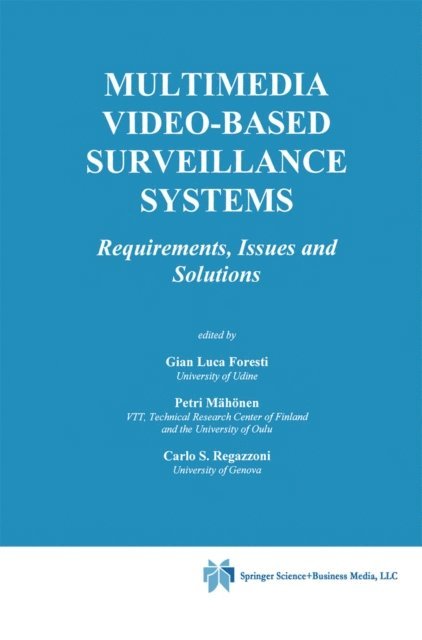
Multimedia surveillance systems is an emerging field that includes signal and image processing, communications, and computer vision. Multimedia Video-Based Surveillance Systems: Requirements, Issues and Solutions, combines the most recent research results from these areas for use by engineers and end-users involved in the design of surveillance systems in the fields of transportation and services. The book covers emerging surveillance requirements, including new digital sensors for real-time acquisition of surveillance data, low-level image processing algorithms, and event detection methods. It also discusses problems related to knowledge representation in surveillance systems, wireless and wired multimedia networks, and a new generation of surveillance communication tools. Timely information is presented on digital watermarking, broadband multimedia transmission, legal use of surveillance systems, performance evaluation criteria, and other new and emerging topics, along with applications for transports and pedestrian monitoring. The information contained in Multimedia Video-Based Surveillance Systems: Requirements, Issues and Solutions, bridges the distance between present practice and research findings, and the book is an indispensable reference tool for professional engineers.
E-bok
PDF, Engelska, 20072 822 kr
Läs direkt efter köp
About IFMBE The International Federation for Medical and Biological Engineering (IFMBE) was established in 1959 to provide medical and biological engineering with a vehicle for international collaboration in research and practice of the profession. The F- eration has a long history of encouraging and promoting international cooperation and collaboration in the use of science and engineering for improving health and quality of life. The IFMBE is an organization with membership of national and transnational societies and an International Academy. At present there are 52 national members and 5 transnational members representing a total membership in excess of 120 000 worldwide. An observer category is provided to groups or organizations considering formal affiliation. Personal membership is possible for individuals living in countries without a member society The International Academy includes individuals who have been recognized by the IFMBE for their outstanding contributions to biomedical engineering. Objectives The objectives of the International Federation for Medical and Biological Engineering are scientific, technological, literary, and educational. Within the field of medical, clinical and biological engineering it’s aims are to encourage research and the application of knowledge, and to disseminate information and promote collaboration.
E-bok
PDF, Engelska, 2008708 kr
Läs direkt efter köp
Today it is almost impossible to remember what life was like with no computer, no mobile phone, and no Internet for accessing information, performing tra- actions or exchanging emails and data. New technology is bringing wave after wave of new bene?ts to daily life: organisations are doing business with each other via the Internet; people are ?lling in tax declarations online and booking their next vacation through the Internet. In general we are all progressively - ing (and dependent on) software and services running on computers, connecting mobile phones and other devices, and exchanging information on the Internet. People like to shop around and exercise choice. So do businesses and public administrations. Today they can buy a complete software package that best suits their needs, even though they may never use some of the tools it o?ers, or other desirable tools are not available. In the future they may no longer have to compromise on choice. Alternative approaches like “Software as a Service” and “Computing Resources as a Service” are emerging. Software is provided on-line as a service when and where it is needed, and the same for computing resources needed to run software. Such an approach allows individuals and organisations totapintoande?ectivelyharnesstheimmensewealthofinformation,knowledge and analytical resources when they need them, paying only for what they use. Customersareboundtobene?twhenthereisasu?cientlyrichchoiceofservices.