1 973 kr
Läs direkt efter köp
1 973 kr
Läs direkt efter köp
1 274 kr
Läs direkt efter köp
1 274 kr
Läs direkt efter köp
1 968 kr
Skickas inom 3-6 vardagar
1 593 kr
Skickas inom 5-8 vardagar
1 593 kr
Skickas inom 5-8 vardagar
Entropy Beyond the Second Law presents a coherent formulation of all aspects of thermodynamics and statistical mechanics with entropy as the unifying theme. This includes formulating equilibrium theory and explaining the role of the Second Law in establishing the equilibrium state. It also establishes the foundations of non-equilibrium theory by generalizing the concept of entropy in an appropriate way. Finally, it addresses the relationship between classical and quantum statistical mechanics by invoking the collapse of the wave function into entropy states. A secondary purpose is to increase the understanding of entropy and the Second Law, and to correct misapprehensions and errors that have arisen over the years.
413 kr
Skickas inom 5-8 vardagar
413 kr
Skickas inom 5-8 vardagar
1 928 kr
Skickas inom 5-8 vardagar
Quantum and classical results are often presented as being dependent upon separate postulates as if the two are distinct and unrelated, and there is little attempt to show how the quantum implies the classical. The transformation to classical phase space gives researchers access to a range of algorithms derived from classical statistical mechanics that promise results on much more favourable numerical terms. Quantum Statistical Mechanics in Classical Phase Space offers not just a new computational approach to condensed matter systems, but also a unique conceptual framework for understanding the quantum world and collective molecular behaviour. A formally exact transformation, this revolutionary approach goes beyond the quantum perturbation of classical condensed matter to applications that lie deep in the quantum regime. It offers scalable computational algorithms and tractable approximations tailored to specific systems. Concrete examples serve to validate the general approach and demonstrate new insights. For example, the computer simulations and analysis of the λ-transition in liquid helium provide a new molecular-level explanation of Bose-Einstein condensation and a quantitative theory for superfluid flow. The intriguing classical phase space formulation in this book offers students and researchers a range of new computational algorithms and analytic approaches. It offers not just an efficient computational approach to quantum condensed matter systems, but also an exciting perspective on how the classical world that we observe emerges from the quantum mechanics that govern the behaviour of atoms and molecules. The applications, examples, and physical insights foreshadow new discoveries in quantum condensed matter systems.
413 kr
Skickas inom 5-8 vardagar
1 928 kr
Skickas inom 5-8 vardagar
Entropy is fundamental to the physical universe, and its applications beyond the Second Law of Thermodynamics to classical time-dependent systems and to quantum condensed matter lie at the frontiers of science.
413 kr
Skickas inom 5-8 vardagar
1 795 kr
Skickas inom 10-15 vardagar
808 kr
Skickas inom 10-15 vardagar
1 000 kr
Läs direkt efter köp
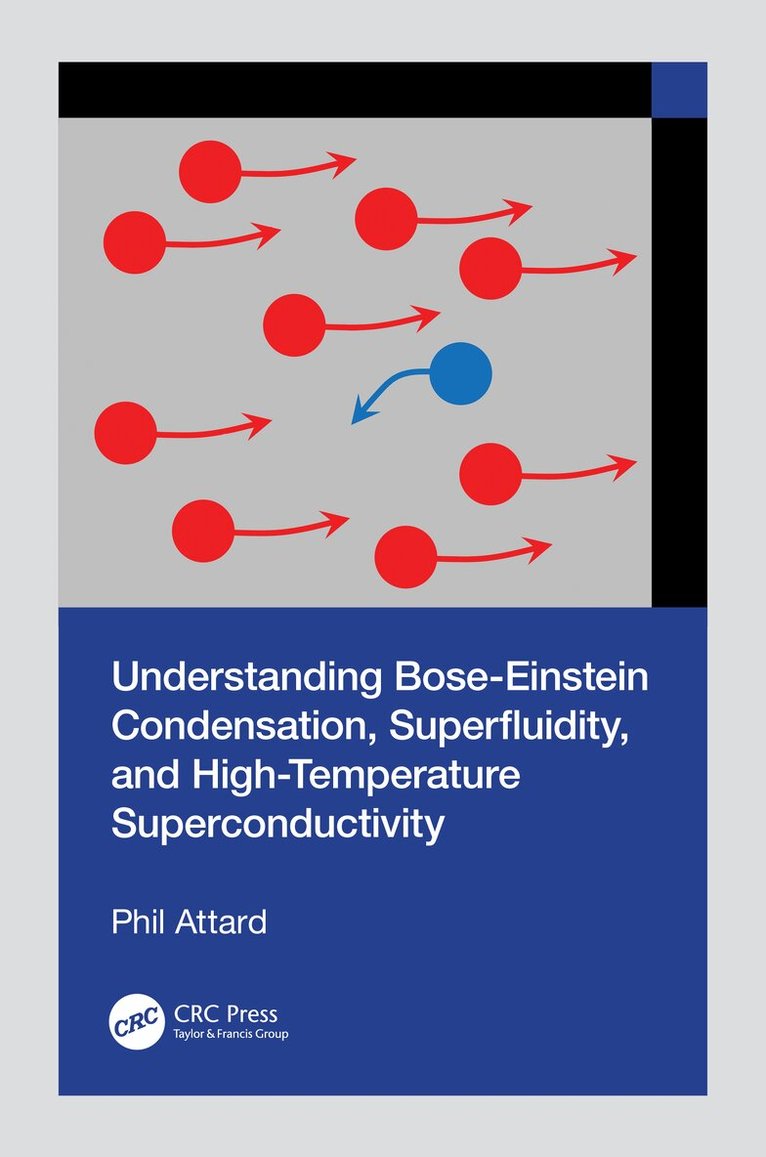
Bose-Einstein condensation, superfluidity, and superconductivity are quantum mechanics made visible. They mark the boundary between the classical and the quantum worlds, and they show the macroscopic role of quantum mechanics in condensed matter.
This book presents these phenomena in terms of particles, their positions, and their momenta, giving a concrete visualisation and description that is not possible with traditional wave functions. A single approach that bridges the classical-quantum divide provides new insight into the role of particle interactions in condensation, the nature of collisions in superfluid flow, and the physical form of Cooper pairs in high-temperature superconductors.
High-temperature superconductivity is explored with quantum statistical mechanics, which links it to Bose-Einstein condensation. Identifying a new mechanism for Cooper pairing, this explains the differences between the low- and high-temperature superconducting regimes and the role of the molecular structure of the conductor.
The new perspective offered by this book on Bose-Einstein condensation, superfluidity, and high-temperature superconductivity gives particle-based explanations as well as mathematical and computational methods for these macroscopic quantum phenomena so that readers understand the role of particle interactions and structure in the physics of these phenomena.
This book will appeal to undergraduate and graduate students, lecturers, academics, and scientific researchers in the fields of Bose-Einstein condensation and condensates, superfluidity, and superconductivity. It will also be of interest to those working with thermodynamics, statistical mechanics, statistical physics, quantum mechanics, molecular dynamics, materials science, condensed matter physics, and theoretical chemistry.
Key Features:
· Explores Bose-Einstein condensation with new evidence for multiple condensed states and novel Monte Carlo simulations for interacting bosons
· Establishes the thermodynamic nature of condensed bosons from an analysis of fountain pressure measurements, including that they carry energy and entropy, and the thermodynamic principle of superfluid flow
· Derives equations of motion for condensed bosons, and performs molecular dynamics simulations of the viscosity with molecular trajectories that give rise to superfluidity
· Identifies the mechanism for electron pairing in high-temperature superconductivity
992 kr
Läs direkt efter köp
Bose-Einstein condensation, superfluidity, and superconductivity are quantum mechanics made visible. They mark the boundary between the classical and the quantum worlds, and they show the macroscopic role of quantum mechanics in condensed matter.
This book presents these phenomena in terms of particles, their positions, and their momenta, giving a concrete visualisation and description that is not possible with traditional wave functions. A single approach that bridges the classical-quantum divide provides new insight into the role of particle interactions in condensation, the nature of collisions in superfluid flow, and the physical form of Cooper pairs in high-temperature superconductors.
High-temperature superconductivity is explored with quantum statistical mechanics, which links it to Bose-Einstein condensation. Identifying a new mechanism for Cooper pairing, this explains the differences between the low- and high-temperature superconducting regimes and the role of the molecular structure of the conductor.
The new perspective offered by this book on Bose-Einstein condensation, superfluidity, and high-temperature superconductivity gives particle-based explanations as well as mathematical and computational methods for these macroscopic quantum phenomena so that readers understand the role of particle interactions and structure in the physics of these phenomena.
This book will appeal to undergraduate and graduate students, lecturers, academics, and scientific researchers in the fields of Bose-Einstein condensation and condensates, superfluidity, and superconductivity. It will also be of interest to those working with thermodynamics, statistical mechanics, statistical physics, quantum mechanics, molecular dynamics, materials science, condensed matter physics, and theoretical chemistry.
Key Features:
· Explores Bose-Einstein condensation with new evidence for multiple condensed states and novel Monte Carlo simulations for interacting bosons
· Establishes the thermodynamic nature of condensed bosons from an analysis of fountain pressure measurements, including that they carry energy and entropy, and the thermodynamic principle of superfluid flow
· Derives equations of motion for condensed bosons, and performs molecular dynamics simulations of the viscosity with molecular trajectories that give rise to superfluidity
· Identifies the mechanism for electron pairing in high-temperature superconductivity
1 973 kr
Läs direkt efter köp
1 274 kr
Läs direkt efter köp
1 274 kr
Läs direkt efter köp
1 968 kr
Skickas inom 3-6 vardagar
1 593 kr
Skickas inom 5-8 vardagar
1 593 kr
Skickas inom 5-8 vardagar
Entropy Beyond the Second Law presents a coherent formulation of all aspects of thermodynamics and statistical mechanics with entropy as the unifying theme. This includes formulating equilibrium theory and explaining the role of the Second Law in establishing the equilibrium state. It also establishes the foundations of non-equilibrium theory by generalizing the concept of entropy in an appropriate way. Finally, it addresses the relationship between classical and quantum statistical mechanics by invoking the collapse of the wave function into entropy states. A secondary purpose is to increase the understanding of entropy and the Second Law, and to correct misapprehensions and errors that have arisen over the years.
413 kr
Skickas inom 5-8 vardagar
413 kr
Skickas inom 5-8 vardagar
1 928 kr
Skickas inom 5-8 vardagar
Quantum and classical results are often presented as being dependent upon separate postulates as if the two are distinct and unrelated, and there is little attempt to show how the quantum implies the classical. The transformation to classical phase space gives researchers access to a range of algorithms derived from classical statistical mechanics that promise results on much more favourable numerical terms. Quantum Statistical Mechanics in Classical Phase Space offers not just a new computational approach to condensed matter systems, but also a unique conceptual framework for understanding the quantum world and collective molecular behaviour. A formally exact transformation, this revolutionary approach goes beyond the quantum perturbation of classical condensed matter to applications that lie deep in the quantum regime. It offers scalable computational algorithms and tractable approximations tailored to specific systems. Concrete examples serve to validate the general approach and demonstrate new insights. For example, the computer simulations and analysis of the λ-transition in liquid helium provide a new molecular-level explanation of Bose-Einstein condensation and a quantitative theory for superfluid flow. The intriguing classical phase space formulation in this book offers students and researchers a range of new computational algorithms and analytic approaches. It offers not just an efficient computational approach to quantum condensed matter systems, but also an exciting perspective on how the classical world that we observe emerges from the quantum mechanics that govern the behaviour of atoms and molecules. The applications, examples, and physical insights foreshadow new discoveries in quantum condensed matter systems.
413 kr
Skickas inom 5-8 vardagar
1 928 kr
Skickas inom 5-8 vardagar
Entropy is fundamental to the physical universe, and its applications beyond the Second Law of Thermodynamics to classical time-dependent systems and to quantum condensed matter lie at the frontiers of science.
413 kr
Skickas inom 5-8 vardagar
1 795 kr
Skickas inom 10-15 vardagar
808 kr
Skickas inom 10-15 vardagar
1 000 kr
Läs direkt efter köp
Bose-Einstein condensation, superfluidity, and superconductivity are quantum mechanics made visible. They mark the boundary between the classical and the quantum worlds, and they show the macroscopic role of quantum mechanics in condensed matter.
This book presents these phenomena in terms of particles, their positions, and their momenta, giving a concrete visualisation and description that is not possible with traditional wave functions. A single approach that bridges the classical-quantum divide provides new insight into the role of particle interactions in condensation, the nature of collisions in superfluid flow, and the physical form of Cooper pairs in high-temperature superconductors.
High-temperature superconductivity is explored with quantum statistical mechanics, which links it to Bose-Einstein condensation. Identifying a new mechanism for Cooper pairing, this explains the differences between the low- and high-temperature superconducting regimes and the role of the molecular structure of the conductor.
The new perspective offered by this book on Bose-Einstein condensation, superfluidity, and high-temperature superconductivity gives particle-based explanations as well as mathematical and computational methods for these macroscopic quantum phenomena so that readers understand the role of particle interactions and structure in the physics of these phenomena.
This book will appeal to undergraduate and graduate students, lecturers, academics, and scientific researchers in the fields of Bose-Einstein condensation and condensates, superfluidity, and superconductivity. It will also be of interest to those working with thermodynamics, statistical mechanics, statistical physics, quantum mechanics, molecular dynamics, materials science, condensed matter physics, and theoretical chemistry.
Key Features:
· Explores Bose-Einstein condensation with new evidence for multiple condensed states and novel Monte Carlo simulations for interacting bosons
· Establishes the thermodynamic nature of condensed bosons from an analysis of fountain pressure measurements, including that they carry energy and entropy, and the thermodynamic principle of superfluid flow
· Derives equations of motion for condensed bosons, and performs molecular dynamics simulations of the viscosity with molecular trajectories that give rise to superfluidity
· Identifies the mechanism for electron pairing in high-temperature superconductivity
992 kr
Läs direkt efter köp
Bose-Einstein condensation, superfluidity, and superconductivity are quantum mechanics made visible. They mark the boundary between the classical and the quantum worlds, and they show the macroscopic role of quantum mechanics in condensed matter.
This book presents these phenomena in terms of particles, their positions, and their momenta, giving a concrete visualisation and description that is not possible with traditional wave functions. A single approach that bridges the classical-quantum divide provides new insight into the role of particle interactions in condensation, the nature of collisions in superfluid flow, and the physical form of Cooper pairs in high-temperature superconductors.
High-temperature superconductivity is explored with quantum statistical mechanics, which links it to Bose-Einstein condensation. Identifying a new mechanism for Cooper pairing, this explains the differences between the low- and high-temperature superconducting regimes and the role of the molecular structure of the conductor.
The new perspective offered by this book on Bose-Einstein condensation, superfluidity, and high-temperature superconductivity gives particle-based explanations as well as mathematical and computational methods for these macroscopic quantum phenomena so that readers understand the role of particle interactions and structure in the physics of these phenomena.
This book will appeal to undergraduate and graduate students, lecturers, academics, and scientific researchers in the fields of Bose-Einstein condensation and condensates, superfluidity, and superconductivity. It will also be of interest to those working with thermodynamics, statistical mechanics, statistical physics, quantum mechanics, molecular dynamics, materials science, condensed matter physics, and theoretical chemistry.
Key Features:
· Explores Bose-Einstein condensation with new evidence for multiple condensed states and novel Monte Carlo simulations for interacting bosons
· Establishes the thermodynamic nature of condensed bosons from an analysis of fountain pressure measurements, including that they carry energy and entropy, and the thermodynamic principle of superfluid flow
· Derives equations of motion for condensed bosons, and performs molecular dynamics simulations of the viscosity with molecular trajectories that give rise to superfluidity
· Identifies the mechanism for electron pairing in high-temperature superconductivity