Philip Fisher - Böcker
Visar alla böcker från författaren Philip Fisher. Handla med fri frakt och snabb leverans.
5 produkter
5 produkter
890 kr
Skickas inom 5-8 vardagar
American culture has often been described in terms of paradigmatic images--the wilderness, the Jeffersonian landscape of family farms, the great industrial cities at the turn of the 19th century. But underlying these cultural ideals are less happy paradoxes. Settling the land meant banishing the Indians and destroying the wilderness; Jeffersonian landscapes were created with the help of the new country's enslaved citizens; and economic opportunities in the citieswere purchased at the high price of self-commercialization. In this study of the popular 19th- and early 20th-century American novel, Philip Fisher demonstrates how such works as Dreiser's SisterCarrie and An American Tragedy, Stowe's Uncle Tom's Cabin and Cooper's The Deerslayer worked to make these three "hard facts" of the 19th-century American experience familiar and tolerable--or familiar and intolerable--to their wide audience of readers. His perceptive analysis proves that the most important cultural "work" was accomplished not by novels generally taken to be at the core of the American literary canon--those of Hawthorne, Melville, orTwain--but rather by books which never abandoned the ambition to be widely read.
Chronic Pain Management Manual
A guide for those who suffer and those who treat pain
Häftad, Engelska, 2002
292 kr
Skickas inom 3-6 vardagar
428 kr
Skickas inom 10-15 vardagar
In this bold reinterpretation of American culture, Philip Fisher describes generational life as a series of renewed acts of immigration into a new world. Along with the actual flood of immigrants, technological change brings about an immigration of objects and systems, ways of life and techniques for the distribution of ideas.A provocative new way of accounting for the spirit of literary tradition, Still the New World makes a persuasive argument against the reduction of literature to identity questions of race, gender, and ethnicity. Ranging from roughly 1850 to 1940, when, Fisher argues, the American cultural and economic system was set in place, the book reconsiders key works in the American canon--from Emerson, Whitman, and Melville, to Twain, James, Howells, Dos Passos, and Nathanael West, with insights into such artists as Winslow Homer and Thomas Eakins. With striking clarity, Fisher shows how these artists created and recreated a democratic poetics marked by a rivalry between abstraction, regionalism, and varieties of realism--and in doing so, defined American culture as an ongoing process of creative destruction.
337 kr
Skickas inom 7-10 vardagar
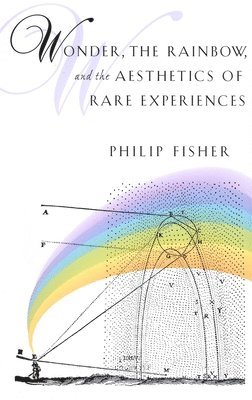
Why pause and study this particular painting among so many others ranged on a gallery wall? Wonder, which Descartes called the first of the passions, is at play; it couples surprise with a wish to know more, the pleasurable promise that what is novel or rare may become familiar. This is a book about the aesthetics of wonder, about wonder as it figures in our relation to the visual world and to rare or new experiences.In three instructive instances--a pair of paintings by Cy Twombly, the famous problem of doubling the area of a square, and the history of attempts to explain rainbows--Philip Fisher examines the experience of wonder as it draws together pleasure, thinking, and the aesthetic features of thought. Through these examples he places wonder in relation to the ordinary and the everyday as well as to its opposite, fear. The remarkable story of how rainbows came to be explained, fraught with errors, half-knowledge, and incomplete understanding, suggests that certain knowledge cannot be what we expect when wonder engages us. Instead, Fisher argues, a detailed familiarity, similar to knowing our way around a building or a painting, is the ultimate meeting point for aesthetic and scientific encounters with novelty, rare experiences, and the genuinely new.

376 kr
Skickas inom 7-10 vardagar
Breaking off the ordinary flow of experience, the passions create a state of exception. In their suddenness and intensity, they map a personal world, fix and qualify our attention, and impel our actions. Outraged anger drives us to write laws that will later be enforced by impersonal justice. Intense grief at the death of someone in our life discloses the contours of that life to us. Wonder spurs scientific inquiry. The strong current of Western thought that idealizes a dispassionate world has ostracized the passions as quaint, even dangerous. Intense states have come to be seen as symptoms of pathology. A fondness for irony along with our civic ideal of tolerance lead us to prefer the diluted emotional life of feelings and moods. Demonstrating enormous intellectual originality and generosity, Philip Fisher meditates on whether this victory is permanent-and how it might diminish us. From Aristotle to Hume to contemporary biology, Fisher finds evidence that the passions have defined a core of human nature no less important than reason or desire.Traversing the Iliad, King Lear, Moby Dick, and other great works, he discerns the properties of the high-spirited states we call the passions. Are vehement states compatible with a culture that values private, selectively shared experiences? How do passions differ from emotions? Does anger have an opposite? Do the passions give scale, shape, and significance to our experience of time? Is a person incapable of anger more dangerous than someone who is irascible? In reintroducing us to our own vehemence, Fisher reminds us that it is only through our strongest passions that we feel the contours of injustice, mortality, loss, and knowledge. It is only through our personal worlds that we can know the world.