Philip J. Harold - Böcker
Visar alla böcker från författaren Philip J. Harold. Handla med fri frakt och snabb leverans.
3 produkter
3 produkter
859 kr
Skickas inom 10-15 vardagar
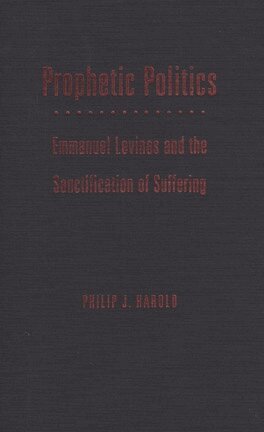
In Prophetic Politics, Philip J. Harold offers an original interpretation of the political dimension of Emmanuel Levinas's thought. Harold argues that Levinas's mature position in Otherwise Than Being breaks radically with the dialogical inclinations of his earlier Totality and Infinity and that transformation manifests itself most clearly in the peculiar nature of Levinas's relationship to politics.Levinas's philosophy is concerned not with the ethical per se, in either its applied or its transcendent forms, but with the source of ethics. Once this source is revealed to be an anarchic interruption of our efforts to think the ethical, Levinas's political claims cannot be read as straightforward ideological positions or principles for political action. They are instead to be understood "prophetically," a position that Harold finds comparable to the communitarian critique of liberalism offered by such writers as Alasdair MacIntyre and Charles Taylor. In developing this interpretation, which runs counter to formative influences from the phenomenological tradition, Harold traces Levinas's debt to phenomenological descriptions of such experiences as empathy and playfulness.Prophetic Politics will highlight the relevance of the phenomenological tradition to contemporary ethical and political thought—a long-standing goal of the series—while also making a significant and original contribution to Levinas scholarship.
1 276 kr
Skickas inom 10-15 vardagar
Today’s wholesale lack of trust in our institutions is a problem with deep roots in liberalism, and it cannot be solved by tweaking a liberal paradigm in which different conceptions of the good create conflict that is resolved by a sovereign state without reference to a nonexclusive common good. Ultimately, the essence of liberalism is contained in the language of values which serve as wedges to divide people. Philip J. Harold takes this problem head-on with a thoroughgoing survey, reaching back to the early modern era, to uncover the nature of liberalism’s basic assumptions and diagnose its breakdown. As opposed to traditional liberal denial of a good superior to individual interest, Harold proposes a postliberal political philosophy able to understand the common good as friendship and social trust built up by loyalty. While critiquing values language, Harold also addresses the concept of sovereignty and the invention of morality as its supplement, the inappropriate distinction between the empirical and the transcendental, the true nature of the secular and the sacred, the necessarily symbolic expression of the common good, and the false conceptualization of religion and politics.
434 kr
Skickas inom 10-15 vardagar
Today’s wholesale lack of trust in our institutions is a problem with deep roots in liberalism, and it cannot be solved by tweaking a liberal paradigm in which different conceptions of the good create conflict that is resolved by a sovereign state without reference to a nonexclusive common good. Ultimately, the essence of liberalism is contained in the language of values which serve as wedges to divide people. Philip J. Harold takes this problem head-on with a thoroughgoing survey, reaching back to the early modern era, to uncover the nature of liberalism’s basic assumptions and diagnose its breakdown. As opposed to traditional liberal denial of a good superior to individual interest, Harold proposes a postliberal political philosophy able to understand the common good as friendship and social trust built up by loyalty. While critiquing values language, Harold also addresses the concept of sovereignty and the invention of morality as its supplement, the inappropriate distinction between the empirical and the transcendental, the true nature of the secular and the sacred, the necessarily symbolic expression of the common good, and the false conceptualization of religion and politics.