Philip S. Khoury - Böcker
Visar alla böcker från författaren Philip S. Khoury. Handla med fri frakt och snabb leverans.
2 produkter
2 produkter
314 kr
Skickas inom 7-10 vardagar
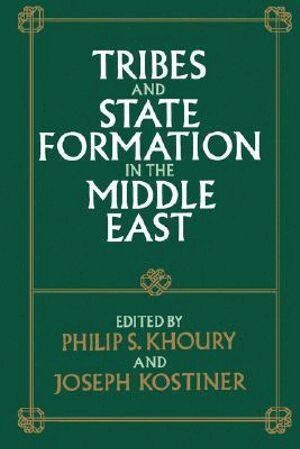
Tribes and State Formation is the first effort to bring together the disciplines of history, anthropology, and political science around a major topic that none of these alone is adequately equipped to address. How and why did certain tribal societies metamorphose over time into states? Scholars concerned with general questions of theory and methodology and the interaction of anthropology and history, as well as political scientists and sociologists concerned with concepts of the state in the Middle East and other developing regions, will be well served by this innovative work. The articles by an array of distinguished scholars cover a wide range of topics: the relationship of ideology to tribal and state power, comparisons between different regional patterns of tribe-state interaction, historical case studies from North Africa, the Arabian Peninsula, and Iran extending to the contemporary period; theoretical and methodological inquiries, and systematic reviews of the literature on tribes and states.The articles argue against a unilinear approach to the study of tribes and state formation by emphasizing that states often existed alongside tribes and even created tribes for their own purposes. Some case studies emphasize the incompatibility of states and tribalism, while others illustrate the many areas in which tribes actually enhanced rather than impeded state formation.
Del 3 - Cambridge Middle East Library
Urban Notables and Arab Nationalism
The Politics of Damascus 1860-1920
Häftad, Engelska, 2003
441 kr
Skickas inom 7-10 vardagar
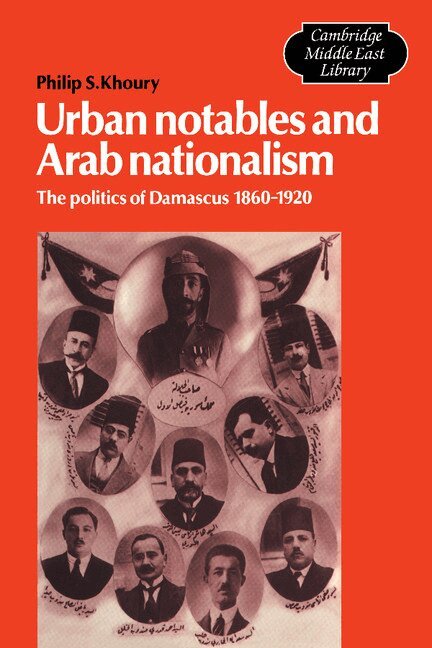
No idea has captured the imagination or expressed the hopes of Arabs in the twentieth century as has Arab nationalism, and perhaps no subject has received so much attention from historians of the Middle East. But, while many historians have explored its intellectual sources, few have considered the social and political environment in which Arab nationalism evolved as an ideological movement. This study attempts to correct the imbalance and, in the process, provides a fascinating interpretation of the rise of the ideology of nationalism within the Arab world. The book focuses on the social and political life of the great notable families of Ottoman Damascus, who, before World War I, played a crucial part in translating the idea into political action. Dr Khoury explains how such long-term factors as the Ottoman reformation, European economic expansion and agrarian commercialization in Syria encouraged rival and socially differentiated networks of influential families to merge into a cohesive upper class. Under the umbrella of a reinvigorated Ottoman central authority, this class of landowners and bureaucrats produced a new urban leadership, which dominated local politics after 1860.