Philippe Bonnet – författare
Visar alla böcker från författaren Philippe Bonnet. Handla med fri frakt och snabb leverans.
5 produkter
5 produkter
E-bok
PDF, Engelska, 2002880 kr
Läs direkt efter köp
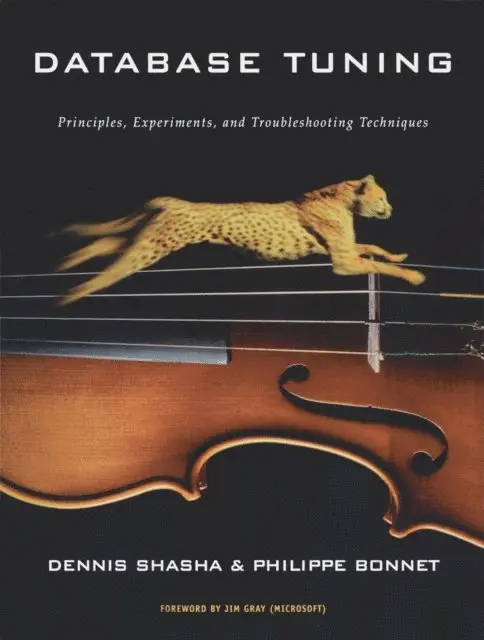
Tuning your database for optimal performance means more than following a few short steps in a vendor-specific guide. For maximum improvement, you need a broad and deep knowledge of basic tuning principles, the ability to gather data in a systematic way, and the skill to make your system run faster. This is an art as well as a science, and Database Tuning: Principles, Experiments, and Troubleshooting Techniques will help you develop portable skills that will allow you to tune a wide variety of database systems on a multitude of hardware and operating systems. Further, these skills, combined with the scripts provided for validating results, are exactly what you need to evaluate competing database products and to choose the right one.- Forward by Jim Gray, with invited chapters by Joe Celko and Alberto Lerner- Includes industrial contributions by Bill McKenna (RedBrick/Informix), Hany Saleeb (Oracle), Tim Shetler (TimesTen), Judy Smith (Deutsche Bank), and Ron Yorita (IBM)- Covers the entire system environment: hardware, operating system, transactions, indexes, queries, table design, and application analysis- Contains experiments (scripts available on the author''s site) to help you verify a system''s effectiveness in your own environment- Presents special topics, including data warehousing, Web support, main memory databases, specialized databases, and financial time series- Describes performance-monitoring techniques that will help you recognize and troubleshoot problems
Häftad, Engelska, 2002
828 kr
Skickas inom 10-15 vardagar
Tuning your database for optimal performance means more than following a few short steps in a vendor-specific guide. For maximum improvement, you need a broad and deep knowledge of basic tuning principles, the ability to gather data in a systematic way, and the skill to make your system run faster. This is an art as well as a science, and Database Tuning: Principles, Experiments, and Troubleshooting Techniques will help you develop portable skills that will allow you to tune a wide variety of database systems on a multitude of hardware and operating systems. Further, these skills, combined with the scripts provided for validating results, are exactly what you need to evaluate competing database products and to choose the right one.
Häftad, Franska, 2019
323 kr
Skickas inom 5-8 vardagar
Inbunden, Engelska, 2024
506 kr
Skickas inom 10-15 vardagar
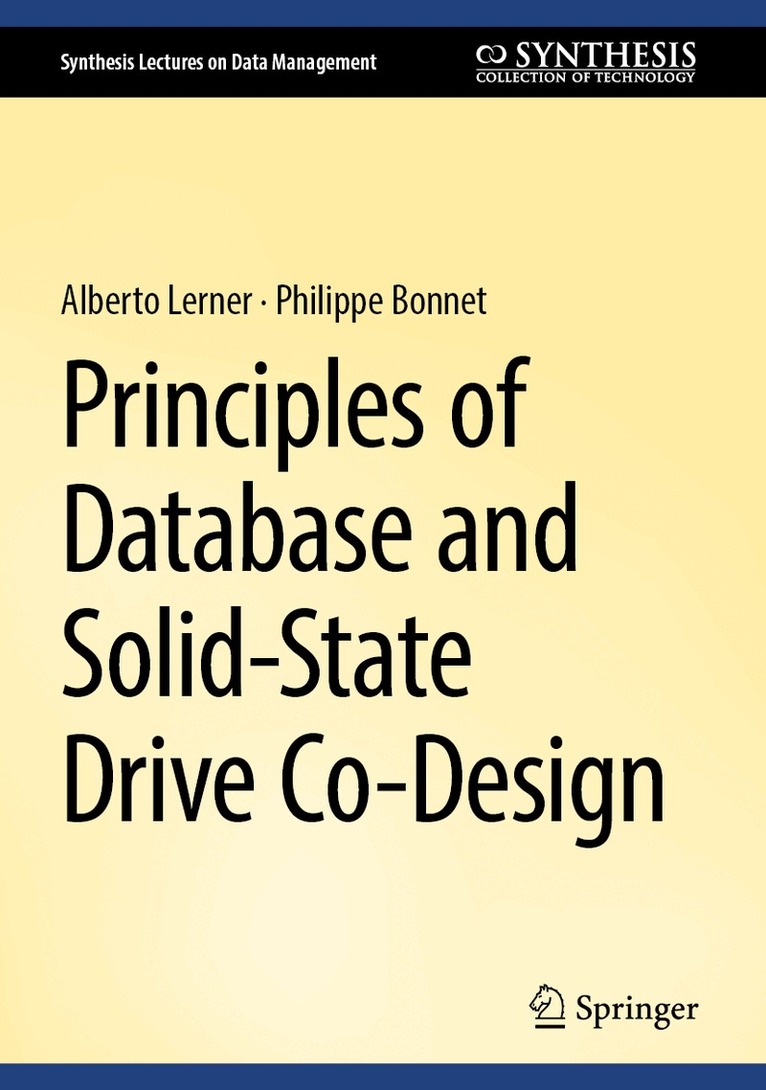
This book offers a comprehensive resource on Solid-State Drives (SSD) as the field undergoes a radical evolution characterized by the incredible variety of SSD forms and their rapid diversification. It proposes a new classification system to help readers navigate the SSD landscape. For years, the evolution of SSDs was obscured by the unchanging abstractions of block devices and POSIX I/O, but it is apparent that these abstractions have become a problematic hinderance to performance and also fail to reduce software complexity. The book explores how such a state of affairs impacts the database community in at least two ways. First, it considers how using SSDs through legacy interfaces that hide internal mechanisms invariably results in erratic performance. While the blame often goes to the notoriously expensive garbage collection of SSDs, the authors argue that in truth, several other complex processes result in nonlinear effects on latency and bandwidth. The book describes these processes and how they are implemented in modern devices, knowledge that will help system designers better choose SSDs and shape database workloads to match their performance characteristics. Second, the book explores how the inadequacy of the traditional I/O abstractions opens up an entire research field focused on the co-design of database management systems and SSD. Such research aims at devising mechanisms and policies coupling the storage manager of database and SSD internals, e.g., placing an SSD FTL under the control of database, changing SSD sub-systems in response to the workload, or executing logic within an SSD on a database’s behalf. The book introduces these principles of DBMS/SSD co-design and argues that a more seamless integration of databases and storage solutions as well as the study of SSD variations adapted to database computations are central to the development of the next generation of database systems.
E-bok
Engelska, 2024652 kr
Läs direkt efter köp
This book offers a comprehensive resource on Solid-State Drives (SSD) as the field undergoes a radical evolution characterized by the incredible variety of SSD forms and their rapid diversification. It proposes a new classification system to help readers navigate the SSD landscape. For years, the evolution of SSDs was obscured by the unchanging abstractions of block devices and POSIX I/O, but it is apparent that these abstractions have become a problematic hinderance to performance and also fail to reduce software complexity. The book explores how such a state of affairs impacts the database community in at least two ways. First, it considers how using SSDs through legacy interfaces that hide internal mechanisms invariably results in erratic performance. While the blame often goes to the notoriously expensive garbage collection of SSDs, the authors argue that in truth, several other complex processes result in nonlinear effects on latency and bandwidth. The book describes these processes and how they are implemented in modern devices, knowledge that will help system designers better choose SSDs and shape database workloads to match their performance characteristics. Second, the book explores how the inadequacy of the traditional I/O abstractions opens up an entire research field focused on the co-design of database management systems and SSD. Such research aims at devising mechanisms and policies coupling the storage manager of database and SSD internals, e.g., placing an SSD FTL under the control of database, changing SSD sub-systems in response to the workload, or executing logic within an SSD on a database’s behalf. The book introduces these principles of DBMS/SSD co-design and argues that a more seamless integration of databases and storage solutions as well as the study of SSD variations adapted to database computations are central to the development of the next generation of database systems.