Phillip Good – författare
Visar alla böcker från författaren . Handla med fri frakt och snabb leverans.
14 produkter
14 produkter
Häftad, Engelska, 2019
622 kr
Skickas inom 10-15 vardagar
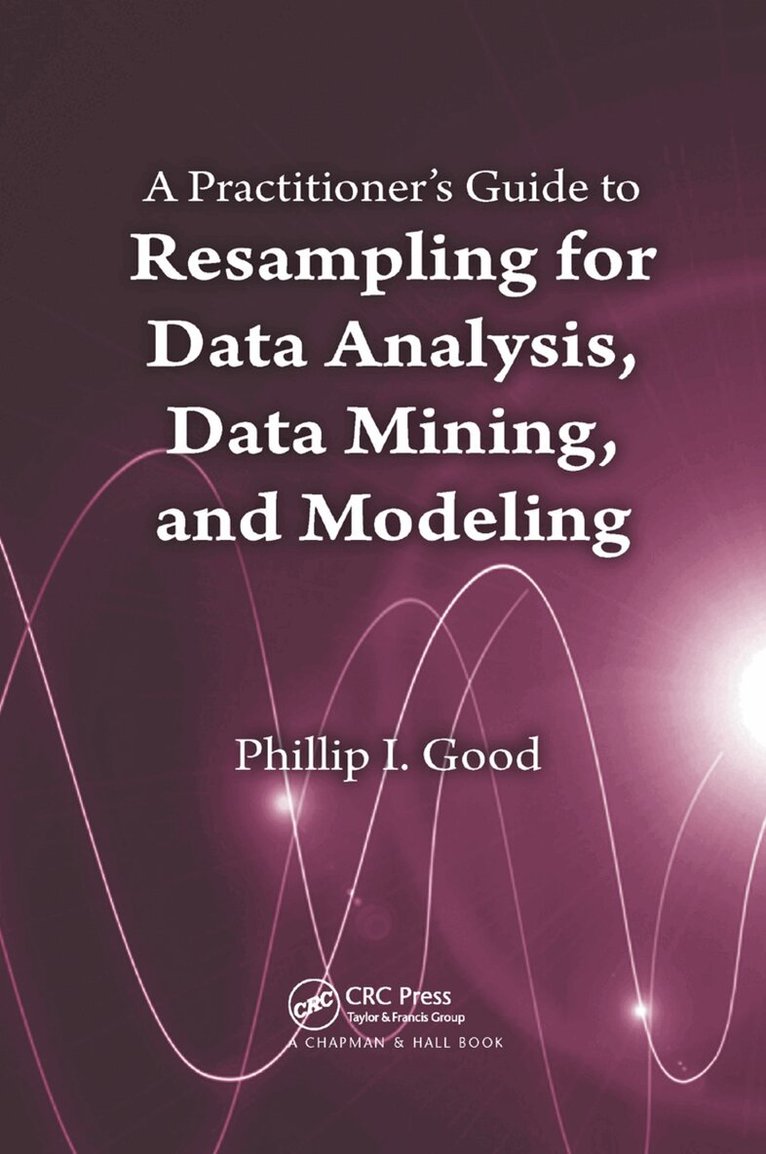
Distribution-free resampling methods—permutation tests, decision trees, and the bootstrap—are used today in virtually every research area. A Practitioner’s Guide to Resampling for Data Analysis, Data Mining, and Modeling explains how to use the bootstrap to estimate the precision of sample-based estimates and to determine sample size, data permutations to test hypotheses, and the readily-interpreted decision tree to replace arcane regression methods.Highlights Each chapter contains dozens of thought provoking questions, along with applicable R and Stata codeMethods are illustrated with examples from agriculture, audits, bird migration, clinical trials, epidemiology, image processing, immunology, medicine, microarrays and gene selectionLists of commercially available software for the bootstrap, decision trees, and permutation tests are incorporated in the textAccess to APL, MATLAB, and SC code for many of the routines is provided on the author’s websiteThe text covers estimation, two-sample and k-sample univariate, and multivariate comparisons of means and variances, sample size determination, categorical data, multiple hypotheses, and model building Statistics practitioners will find the methods described in the text easy to learn and to apply in a broad range of subject areas from A for Accounting, Agriculture, Anthropology, Aquatic science, Archaeology, Astronomy, and Atmospheric science to V for Virology and Vocational Guidance, and Z for Zoology.Practitioners and research workers and in the biomedical, engineering and social sciences, as well as advanced students in biology, business, dentistry, medicine, psychology, public health, sociology, and statistics will find an easily-grasped guide to estimation, testing hypotheses and model building.
Häftad, Engelska
295 kr
Skickas inom 3-6 vardagar
Häftad, Engelska
282 kr
Skickas inom 3-6 vardagar
Häftad, Engelska
295 kr
Skickas inom 3-6 vardagar
Häftad, Engelska
194 kr
Skickas inom 3-6 vardagar
Inbunden, Engelska, 2011
1 183 kr
Skickas inom 10-15 vardagar
Distribution-free resampling methods—permutation tests, decision trees, and the bootstrap—are used today in virtually every research area. A Practitioner’s Guide to Resampling for Data Analysis, Data Mining, and Modeling explains how to use the bootstrap to estimate the precision of sample-based estimates and to determine sample size, data permutations to test hypotheses, and the readily-interpreted decision tree to replace arcane regression methods.Highlights Each chapter contains dozens of thought provoking questions, along with applicable R and Stata codeMethods are illustrated with examples from agriculture, audits, bird migration, clinical trials, epidemiology, image processing, immunology, medicine, microarrays and gene selectionLists of commercially available software for the bootstrap, decision trees, and permutation tests are incorporated in the textAccess to APL, MATLAB, and SC code for many of the routines is provided on the author’s websiteThe text covers estimation, two-sample and k-sample univariate, and multivariate comparisons of means and variances, sample size determination, categorical data, multiple hypotheses, and model building Statistics practitioners will find the methods described in the text easy to learn and to apply in a broad range of subject areas from A for Accounting, Agriculture, Anthropology, Aquatic science, Archaeology, Astronomy, and Atmospheric science to V for Virology and Vocational Guidance, and Z for Zoology.Practitioners and research workers and in the biomedical, engineering and social sciences, as well as advanced students in biology, business, dentistry, medicine, psychology, public health, sociology, and statistics will find an easily-grasped guide to estimation, testing hypotheses and model building.
E-bok
PDF, Engelska, 20131 136 kr
Läs direkt efter köp
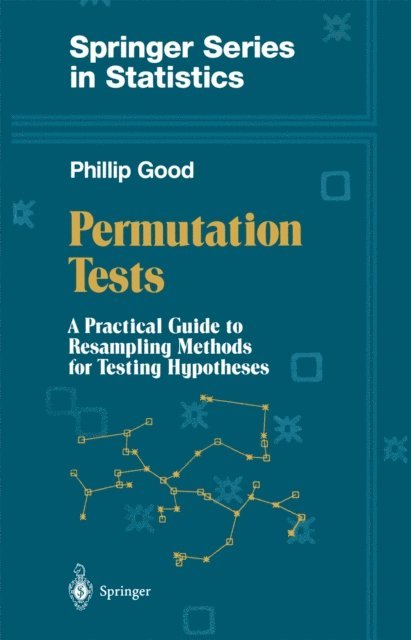
Permutation tests permit us to choose the test statistic best suited to the task at hand. This freedom of choice opens up a thousand practical applications, including many which are beyond the reach of conventional parametric sta tistics. Flexible, robust in the face of missing data and violations of assump tions, the permutation test is among the most powerful of statistical proce dures. Through sample size reduction, permutation tests can reduce the costs of experiments and surveys. This text on the application of permutation tests in biology, medicine, science, and engineering may be used as a step-by-step self-guiding reference manual by research workers and as an intermediate text for undergraduates and graduates in statistics and the applied sciences with a first course in statistics and probability under their belts. Research workers in the applied sciences are advised to read through Chapters 1 and 2 once quickly before proceeding to Chapters 3 through 8 which cover the principal applications they are likely to encounter in practice. Chapter 9 is a must for the practitioner, with advice for coping with real life emergencies such as missing or censored data, after-the-fact covariates, and outliers. Chapter 10 uses practical applications in archeology, biology, climatology, education and social science to show the research worker how to develop new permutation statistics to meet the needs of specific applications. The practitioner will find Chapter 10 a source of inspiration as well as a practical guide to the development of new and novel statistics.
E-bok
PDF, Engelska, 20131 140 kr
Läs direkt efter köp
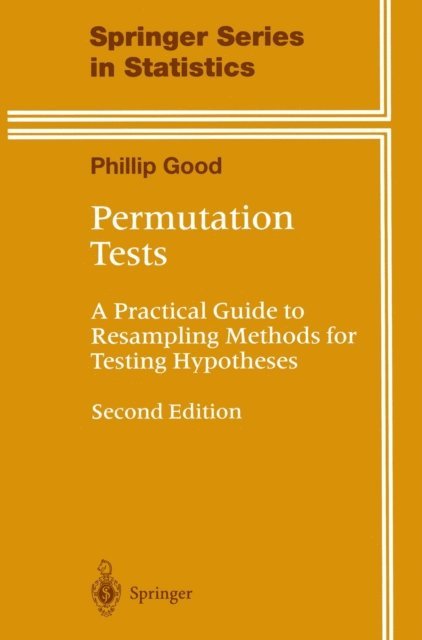
In 1982, I published several issues of a samdizat scholarly journal called Random ization with the aid of an 8-bit, I-MH personal computer with 48K of memory (upgraded to 64K later that year) and floppy disks that held 400 Kbytes. A decade later, working on the first edition of this text, I used a 16-bit, 33-MH computer with 1 Mb of memory and a 20-Mb hard disk. This preface to the second edition comes to you via a 32-bit, 300-MH computer with 64-Mb memory and a 4-Gb hard disk. And, yes, I paid a tenth of what I paid for my first computer. This relationship between low-cost readily available computing power and the rising popularity of permutation tests is no coincidence. Simply put, it is" faster today to compute an exact p-value than to look up an approximation in a table of the not-quite-appropriate statistic. As a result, more and more researchers are using Permutation Tests to analyze their data. Of course, some of the increased usage has also come about through the increased availability of and improvements in off-the-shelf software, as can be seen in the revisions in this edition to Chapter 12 (Publishing Your Results) and Chapter 13 (Increasing Computation Efficiency).
Häftad, Engelska
206 kr
Skickas inom 3-6 vardagar
Häftad, Engelska
257 kr
Skickas inom 3-6 vardagar
Häftad, Engelska
200 kr
Skickas inom 3-6 vardagar
Häftad, Engelska
205 kr
Skickas inom 3-6 vardagar
Häftad, Engelska
199 kr
Skickas inom 3-6 vardagar
Häftad, Engelska
196 kr
Skickas inom 3-6 vardagar