Piet Kommers – författare
Visar alla böcker från författaren Piet Kommers. Handla med fri frakt och snabb leverans.
19 produkter
19 produkter
Inbunden, Engelska, 2014
2 079 kr
Skickas inom 10-15 vardagar
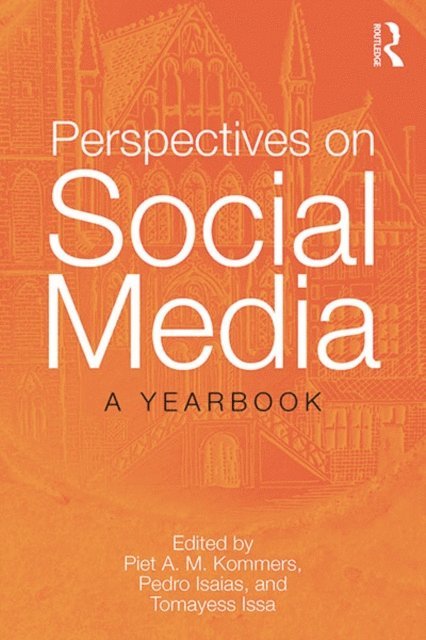
Perspectives on Social Media presents the most current research on the effectiveness of social media across sectors. Progress in finding better applications for social media relies on the difficult task of integrating media technologies into fields such as engineering, marketing, health, learning, art, tourism, and the service industry. This book is based on cutting-edge creative work among top international researchers and renowned designers and provides readers with a preview of the most visionary outcomes in the field of social media. Some of the major topics that the book discusses are: New social media design Sense of community in web applications App design and development for mobile devices. Perspectives on Social Media uniquely builds on recent disputes among the top scholars around the world, thus including the dynamics of knowledge-sharing and cross-fertilization that one would expect to happen on the web but that are rarely found in a book.
Häftad, Engelska, 2014
739 kr
Skickas inom 10-15 vardagar
Perspectives on Social Media presents the most current research on the effectiveness of social media across sectors. Progress in finding better applications for social media relies on the difficult task of integrating media technologies into fields such as engineering, marketing, health, learning, art, tourism, and the service industry. This book is based on cutting-edge creative work among top international researchers and renowned designers and provides readers with a preview of the most visionary outcomes in the field of social media. Some of the major topics that the book discusses are: New social media design Sense of community in web applications App design and development for mobile devices. Perspectives on Social Media uniquely builds on recent disputes among the top scholars around the world, thus including the dynamics of knowledge-sharing and cross-fertilization that one would expect to happen on the web but that are rarely found in a book.
Inbunden, Engelska, 2013
2 342 kr
Skickas inom 5-8 vardagar
Inbunden, Engelska, 2014
2 566 kr
Skickas inom 5-8 vardagar
Inbunden, Engelska, 2014
2 971 kr
Skickas inom 5-8 vardagar
Inbunden, Engelska, 2017
2 656 kr
Skickas inom 5-8 vardagar
Inbunden, Engelska, 2020
1 817 kr
Skickas inom 10-15 vardagar
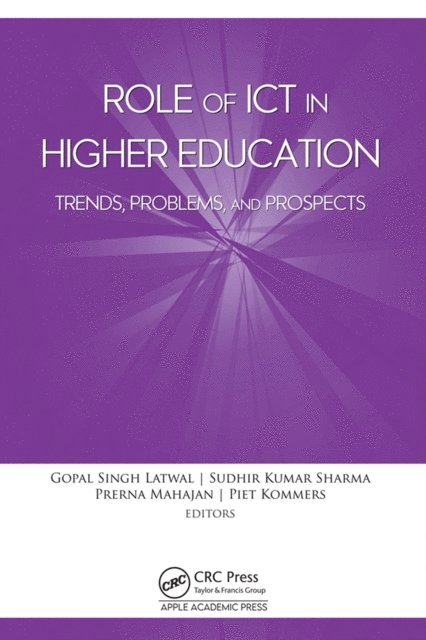
This new volume provides an informative collection of chapters on ICT and data analytics in education, helping to lead the digital revolution in higher education. The chapters emphasize skill development through ICT, artificial intelligence in education, policies for integrating ICT in higher education, and more. The book focuses mainly on technological advancements in ICT in education, the perceived role of ICT in the teaching-learning transaction, pedagogy for teaching-learning in the 21st century, student-centered learning based on ICT, learning analytics, online technologies learning, tools for technology enhanced learning, distance education and learning, the effective use of ICT in management education, experiences in ICT for technology-enhanced learning, influence of ICT in research development in higher education, role of teachers in direct classroom teaching in web-based education system, and role of ICT in innovation capacity building. The case studies help to illustrate the ideas and concepts discussed in the chapters.
Häftad, Engelska, 2022
1 154 kr
Skickas inom 10-15 vardagar
This new volume provides an informative collection of chapters on ICT and data analytics in education, helping to lead the digital revolution in higher education. The chapters emphasize skill development through ICT, artificial intelligence in education, policies for integrating ICT in higher education, and more. The book focuses mainly on technological advancements in ICT in education, the perceived role of ICT in the teaching-learning transaction, pedagogy for teaching-learning in the 21st century, student-centered learning based on ICT, learning analytics, online technologies learning, tools for technology enhanced learning, distance education and learning, the effective use of ICT in management education, experiences in ICT for technology-enhanced learning, influence of ICT in research development in higher education, role of teachers in direct classroom teaching in web-based education system, and role of ICT in innovation capacity building. The case studies help to illustrate the ideas and concepts discussed in the chapters.
Inbunden, Engelska, 2021
2 566 kr
Skickas inom 5-8 vardagar
Inbunden, Engelska, 2019
1 358 kr
Skickas inom 10-15 vardagar
This book presents research on the effects and effectiveness of ICT applications in lifelong learning in relation to digital competences of educators. It sketches recent and future evolutions in higher education, explores whether universities have adjusted policies and business models in line with the rapid development of ICT technologies, and analyses whether the adjustments made are merely cosmetic or truly future-proof. The book specifically deals with such topics as digital competencies of teaching staff, the development and implementation of MOOCs and other E-learning tools, virtual classrooms, online tutoring, and collaborative learning. It presents case studies of innovative master’s programmes, projects and methods, and processes of standardization and validation used in various countries as illustrations. The book explains the rapid transition of the knowledge society to the "society of global competence" and shows the necessity of an active implementation of innovative formsand effective methods of education, and above all, distance learning at all levels of education.
Inbunden, Engelska, 2022
1 150 kr
Skickas inom 10-15 vardagar
This textbook evolves from the intersection between ‘Research’, ‘Educational Information Technologies’ and recent ‘Best Practices’. It offers diplomacy and erudite rhetoric in order to harvest from innovation projects and see how new professional needs for teachers are emerging day by day. The volume launches the compact background for the 21st century education that every teacher faces after being in charge for 3 or 6 years after pre-service training. ‘Sources for a better education’ refers to the deep understanding and to the incentives for encouraging teachers to leave the comfort zone and experiment the next steps into a further sophisticated professionalism, without the threat of feeling in a ‘Dilemma’.The first candidate for extending one’s teaching effectiveness is to tailor one’s teaching to the test to be expected. ‘Teaching to the Test’ is an understandable tactic, however it endangers the students’ full understanding of underlying concepts and analogies. The second candidate for professionalism is the deeper layer of knowledge on how curricular domains are related. In simpler terms: better teachers know how to ‘bridge’ topics and subjects so that students develop a deeper understanding on the patterns and structure in knowledge. The 21st century education prioritizes higher degrees of flexible-, divergent and abstract thinking, so that creative problem solving comes into reach. ICT tools for making prior knowledge explicit is a major example on how learners harvest upon prior knowledge, thinking and intuition. The third source for a better education is the courage to envisage one’s meta knowledge in order to see patterns in learning and understanding. The more conscious prior knowledge gets decompiled into genetic metaphors; the better future learning can be anticipated. The fourth asset for meta-cognitive skills is the wide spectrum of tools that the web offers for building knowledge infra-structures so that knowledge becomes transformed into problem solving skills; the availability of knowledge is no longer sufficient for finding creative and authentic solutions in future situations. This is the case for both students and teachers. By tradition, the bottom-up strategy from reproductive factual learning up to the levels of problem solving and creative thinking has been favoured. The ‘one-click away’ access to information on the web asks a more strategic attitude from learners and practitioners to cope with the periphery between known and unknown, so that a more effective meta-cognition develops. The fifth stimulus for more effective learning is the expanding impact of social media. Social media tend to intimidate learners with incomplete understanding to jump on biases as delivered through political and conspiracy agendas. This books aims at the challenge to build upon learners’ existential needs and developing interest for a longer-term learning perspective.“Renaissance man and philosopher Piet Kommers presentsus with an interesting question: What makes education exciting? His book covers a range of lessons learnt through research and practice, covering philosophies and paradoxes, ranging from learning to learn to machine learning for learning. In 35 chapters he takes us on an exciting, comprehensive journey of just about every conceivable aspect of technology and education. This is a must-have for every 21st Century bookshelf!” By: Johannes Cronjé, professor of Digital Teaching and Learning in the Department of Information Technology at the Cape Peninsula University of Technology, South Africa.“Piet Kommers has in 400 pages provided an overview of teaching based on practical experience. It is not a summary of pedagogic models, but a guide to important factors in how to motivate students and thus improve their learning. New technologies changes teaching, and we need to understand how application of such technologies can improve the learning. This book provides such knowledge and I wish I had it when I started teaching at university many years ago.” By: Jan Frick, Professor Business School, University of Stavanger, Norway."Piet Kommers delivers a very thorough book with a holistic perspective on Learning Technologies. This book is a result of many years of experience that the author has in Higher Education. It comprises lessons learned from the author´s professional career, including inputs from European Union research projects, as well as diversified interactions with a wide range of Peoples and Cultures. The result is a unique perspective that is a must-read for anyone interested in Learning Technologies, past, present, and future!" By: Pedro Isaias, associate professor at the Information Systems & Technology Management School of The University of New South Wales (UNSW – Sydney), Australia. “Distinguished Professor and Thinker Dr. Piet Kommers presents the academic community with a new horizon on education that reflects thecurrent and future technology trends in the e-Learning and Fast Internet ubiquity. The Book discusses the current and most recent advances in research and application of most effective learning methods in conjunction with the future directions in machine learning in support of learning. The Book's 35 chapters present cutting-edge technologies and state-of-the-art learning methods in support of best educational practices and the student's best learning experience. The Book is most valuable asset to educator's community pursuing the mission of excellence in the Third Millennium!” By: Eduard Babulak, Professor, Computational Sciences, Liberty University, Lynchburg, USA."Well-known scientist, (e-)learning expert and philosopher Piet Kommers presents us with an interesting question: What makes education exciting? His book covers a range of lessons learnt through research and practice, covering philosophies and paradoxes, ranging from ‘learning to learn’ to ‘machine learning for learning’. In 35 chapters he takes us on an exciting, comprehensive journey of just about every conceivable aspect of technology and education. This is an interesting and useful publication for all educators as well as learners and must-have for every 21st Century bookshelf!" By: Eugenia Smyrnova-Trybulska, Dr. hab., associate professor, Institute of Pedagogy, Faculty of Art and Sciences of Education, University of Silesia in Katowice, Poland.“The book presents a mosaic of assets reflecting the vast international experience in research and realization of learning technologies of the author, honourable professor of the UNESCO Chair in New information technologies in education for all, Piet Kommers. Describing various aspects of learning strategies, approaches, techniques and technologies in a concise way, he engages the readers into the mental construction of a "big picture" and makes them reconsider routine processes of teaching and learning. Exciting and thought-provoking reading for educators, researchers, and devoted learners.” By: professor Volodymyr Gritsenko, Director of the International Research and Training Centre for Information Technologies and Systems, National Academy of Sciences and Ministry of Education and Science of Ukraine, Head of the UNESCO Chair.
Häftad, Engelska, 2023
834 kr
Skickas inom 5-8 vardagar
This textbook evolves from the intersection between ‘Research’, ‘Educational Information Technologies’ and recent ‘Best Practices’. It offers diplomacy and erudite rhetoric in order to harvest from innovation projects and see how new professional needs for teachers are emerging day by day. The volume launches the compact background for the 21st century education that every teacher faces after being in charge for 3 or 6 years after pre-service training. ‘Sources for a better education’ refers to the deep understanding and to the incentives for encouraging teachers to leave the comfort zone and experiment the next steps into a further sophisticated professionalism, without the threat of feeling in a ‘Dilemma’.The first candidate for extending one’s teaching effectiveness is to tailor one’s teaching to the test to be expected. ‘Teaching to the Test’ is an understandable tactic, however it endangers the students’ full understanding of underlying concepts and analogies. The second candidate for professionalism is the deeper layer of knowledge on how curricular domains are related. In simpler terms: better teachers know how to ‘bridge’ topics and subjects so that students develop a deeper understanding on the patterns and structure in knowledge. The 21st century education prioritizes higher degrees of flexible-, divergent and abstract thinking, so that creative problem solving comes into reach. ICT tools for making prior knowledge explicit is a major example on how learners harvest upon prior knowledge, thinking and intuition. The third source for a better education is the courage to envisage one’s meta knowledge in order to see patterns in learning and understanding. The more conscious prior knowledge gets decompiled into genetic metaphors; the better future learning can be anticipated. The fourth asset for meta-cognitive skills is the wide spectrum of tools that the web offers for building knowledge infra-structures so that knowledge becomes transformed into problem solving skills; the availability of knowledge is no longer sufficient for finding creative and authentic solutions in future situations. This is the case for both students and teachers. By tradition, the bottom-up strategy from reproductive factual learning up to the levels of problem solving and creative thinking has been favoured. The ‘one-click away’ access to information on the web asks a more strategic attitude from learners and practitioners to cope with the periphery between known and unknown, so that a more effective meta-cognition develops. The fifth stimulus for more effective learning is the expanding impact of social media. Social media tend to intimidate learners with incomplete understanding to jump on biases as delivered through political and conspiracy agendas. This books aims at the challenge to build upon learners’ existential needs and developing interest for a longer-term learning perspective.“Renaissance man and philosopher Piet Kommers presentsus with an interesting question: What makes education exciting? His book covers a range of lessons learnt through research and practice, covering philosophies and paradoxes, ranging from learning to learn to machine learning for learning. In 35 chapters he takes us on an exciting, comprehensive journey of just about every conceivable aspect of technology and education. This is a must-have for every 21st Century bookshelf!” By: Johannes Cronjé, professor of Digital Teaching and Learning in the Department of Information Technology at the Cape Peninsula University of Technology, South Africa.“Piet Kommers has in 400 pages provided an overview of teaching based on practical experience. It is not a summary of pedagogic models, but a guide to important factors in how to motivate students and thus improve their learning. New technologies changes teaching, and we need to understand how application of such technologies can improve the learning. This book provides such knowledge and I wish I had it when I started teaching at university many years ago.” By: Jan Frick, Professor Business School, University of Stavanger, Norway."Piet Kommers delivers a very thorough book with a holistic perspective on Learning Technologies. This book is a result of many years of experience that the author has in Higher Education. It comprises lessons learned from the author´s professional career, including inputs from European Union research projects, as well as diversified interactions with a wide range of Peoples and Cultures. The result is a unique perspective that is a must-read for anyone interested in Learning Technologies, past, present, and future!" By: Pedro Isaias, associate professor at the Information Systems & Technology Management School of The University of New South Wales (UNSW – Sydney), Australia. “Distinguished Professor and Thinker Dr. Piet Kommers presents the academic community with a new horizon on education that reflects thecurrent and future technology trends in the e-Learning and Fast Internet ubiquity. The Book discusses the current and most recent advances in research and application of most effective learning methods in conjunction with the future directions in machine learning in support of learning. The Book's 35 chapters present cutting-edge technologies and state-of-the-art learning methods in support of best educational practices and the student's best learning experience. The Book is most valuable asset to educator's community pursuing the mission of excellence in the Third Millennium!” By: Eduard Babulak, Professor, Computational Sciences, Liberty University, Lynchburg, USA."Well-known scientist, (e-)learning expert and philosopher Piet Kommers presents us with an interesting question: What makes education exciting? His book covers a range of lessons learnt through research and practice, covering philosophies and paradoxes, ranging from ‘learning to learn’ to ‘machine learning for learning’. In 35 chapters he takes us on an exciting, comprehensive journey of just about every conceivable aspect of technology and education. This is an interesting and useful publication for all educators as well as learners and must-have for every 21st Century bookshelf!" By: Eugenia Smyrnova-Trybulska, Dr. hab., associate professor, Institute of Pedagogy, Faculty of Art and Sciences of Education, University of Silesia in Katowice, Poland.“The book presents a mosaic of assets reflecting the vast international experience in research and realization of learning technologies of the author, honourable professor of the UNESCO Chair in New information technologies in education for all, Piet Kommers. Describing various aspects of learning strategies, approaches, techniques and technologies in a concise way, he engages the readers into the mental construction of a "big picture" and makes them reconsider routine processes of teaching and learning. Exciting and thought-provoking reading for educators, researchers, and devoted learners.” By: professor Volodymyr Gritsenko, Director of the International Research and Training Centre for Information Technologies and Systems, National Academy of Sciences and Ministry of Education and Science of Ukraine, Head of the UNESCO Chair.
Inbunden, Engelska, 2022
1 462 kr
Skickas inom 10-15 vardagar
This book is about the most significant developments in the field of microlearning in the teaching of programming. These critical component of microlearning represent a significant contribution both in fulfilling individual project objectives and in improving computer programming education in general.
Häftad, Engelska, 2023
1 046 kr
Skickas inom 10-15 vardagar
This book is about the most significant developments in the field of microlearning in the teaching of programming. In particular, the book covers the creation of content and the use of microlearning activities for automatically evaluating programming assignments. These critical component of microlearning represent a significant contribution both in fulfilling individual project objectives and in improving computer programming education in general. The book is interdisciplinary, examining both computer science and education. Specific topics explored include: development of distance courses, creating microcourses, fostering interdisciplinary knowledge, IT, management, and theoretical, methodological and practical aspects of the implementation of microlearning. Additionally, comprehensive analysis of the scientific literature (monographs, articles, proceedings) on the subject of the project and conducted research is provided.
Inbunden, Engelska, 2025
1 877 kr
Skickas inom 10-15 vardagar
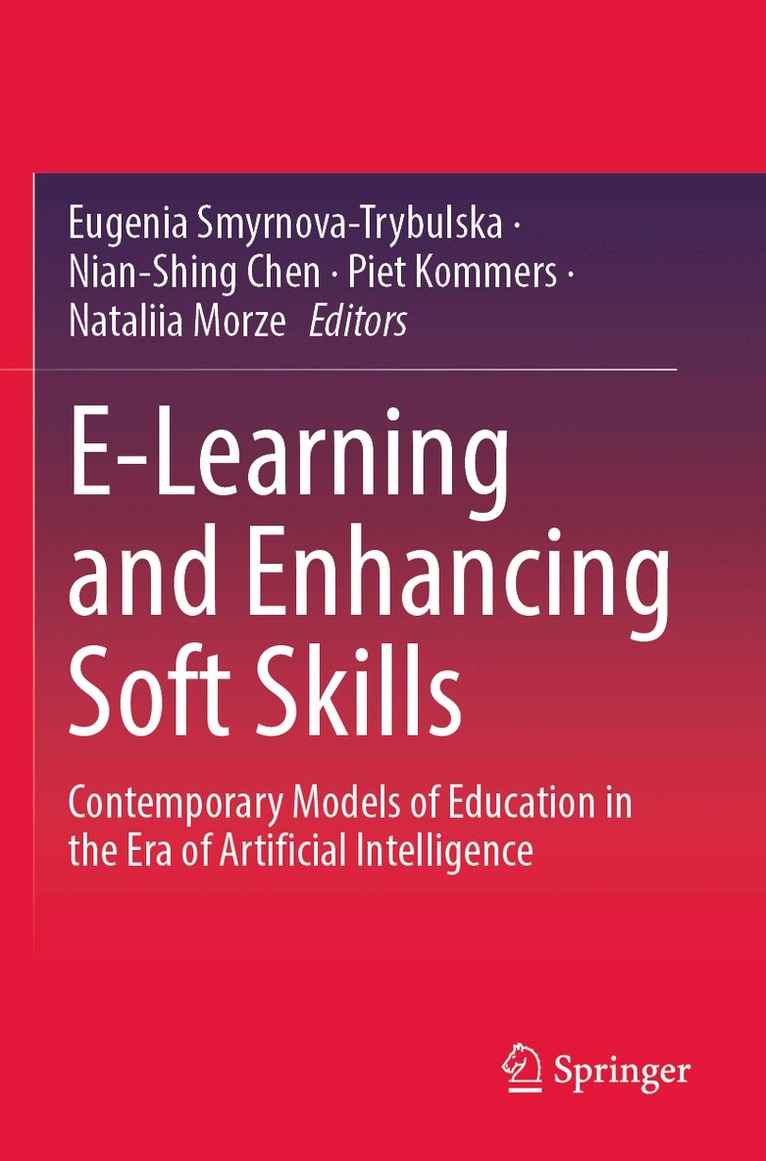
This volume E-Learning and Enhancing Soft Skills is a collection of articles by participants of the 16th annual scientific international conference “Theoretical and Practical Aspects of Distance Learning: E-Learning and Enhancing of Soft Skills. This conference, held on the 14th and 15th October 2024 in hybrid mode, is organized by the Faculty of Arts and Educational Sciences in Cieszyn, the Faculty of Social Sciences, the Institute of Pedagogy, the Faculty of Science and Technology, the Institute of Computer Science, University of Silesia in Katowice, Poland. Co-organizers and partners included: University of Ostrava (UO), Czech Republic, Silesian University in Opava (SU), Czech Republic, Constantine the Philosopher University in Nitra (UKF) Slovakia, University of Extremadura (UEx), Spain, University of Twente (UT), The Netherlands, Lisbon Lucíada University (LU), Portugal, Curtin University in Perth (CU), Australia, Borys Grinchenko Kyiv University (BGKU), Ukraine, Dniprovsk State Technical University (DSTU), Ukraine, IADIS - International Association for Development, of the Information Society, a non-profit association, Polish Pedagogical Society, Branch in Cieszyn, Polish Scientific Society for Internet Education, Association of Academic E-learning, Poland.Experts on e-learning from different countries provide insights into their studies, present their recent research results and discuss their further scientific work. The authors include experts, well-known scholars, young researchers, highly trained academic lecturers with long experience in the field of e-learning, AI and robotics in education, MOOCs, teacher training an area digutak and soft skills, m-learning, smart technologies, VR/AR; PhD students, distance course developers, authors of multimedia teaching materials, designers of websites and digital educational resources. This monograph therefore describes the theoretical, methodological and practical issues in the field of e-learning and the developing of key competencies and soft skills, contemporary models of education in the era of artificial intelligence, proposing solutions to important problems and showing the road to further research in this field.Built from the findings of an international retinue of scholars, this work will be of particular interest to academic researchers, educators, courseware designers, corporate trainers, and educational technology practitioners.
Häftad, Engelska, 2026
1 150 kr
Skickas inom 10-15 vardagar
This edited volume explores how artificial intelligence is reshaping education through interdisciplinary, creative, and ethically grounded practices. Drawing on the EduSimSTEAM and EduAI projects, this book offers educators practical insights into integrating AI tools across the teaching cycle, from lesson design to student engagement and assessment. With a strong focus on conceptual thinking, thematic learning, and STEAM principles, it empowers teachers to foster critical thinking, authentic problem-solving, and inclusive learning methods. Backed by empirical research and visionary frameworks, this volume is essential for educators, curriculum designers, and policymakers as they work toward an AI-augmented future for Learning.
Inbunden, Engelska, 2015
1 046 kr
Skickas inom 10-15 vardagar
The present work is intended to assist academics, researchers and proponents of online learning and teaching. Academics will be able to share the findings presented in this book, and the Social Networking and Education Model (SNEM), with their students (i.e. Masters and PhD). It is envisaged that this book will assist researchers and anyone interested in online learning to understand the opportunities and risks associated with the use of Social Networking in the education sector, and assist them to implement SN by means of the new SNEM model. The reader will benefit from our examinations of the risks and opportunities associated with the use of Social Networking in the education sector in various regions around the world: Asia-Pacific, Europe, Mediterranean, America, Middle East and the Caribbean. In addition, a Social Networking and Education Model (SNEM) will be developed to promote and implement Social Networking in the education sector.
Häftad, Engelska, 2016
1 046 kr
Skickas inom 10-15 vardagar
In addition, a Social Networking and Education Model (SNEM) will be developed to promote and implement Social Networking in the education sector.
Häftad, Engelska, 1996
558 kr
Skickas inom 10-15 vardagar
This volume contains a thoroughly refereed collection of revised full papers selected from the presentations at the First East-West International Conference on Multimedia, Hypermedia, and Virtual Reality, MHVR'94, held in Moscow, Russia, in September 1994.The 22 full papers presented in the book were selected from a total of 76 initial submissions and have been carefully updated for publication. Also included are two invited papers and summaries by the session chairpersons. The volume is organized in chapters on hypermedia models and architectures, enhancing multimedia support, new technologies for virtual reality, hypermedia and multimedia for group collaboration, hypermedia and multimedia for learning, and personalized hypermedia.