Pietro Nastasi – författare
Visar alla böcker från författaren Pietro Nastasi. Handla med fri frakt och snabb leverans.
4 produkter
4 produkter
Del 29 - Science Networks. Historical Studies
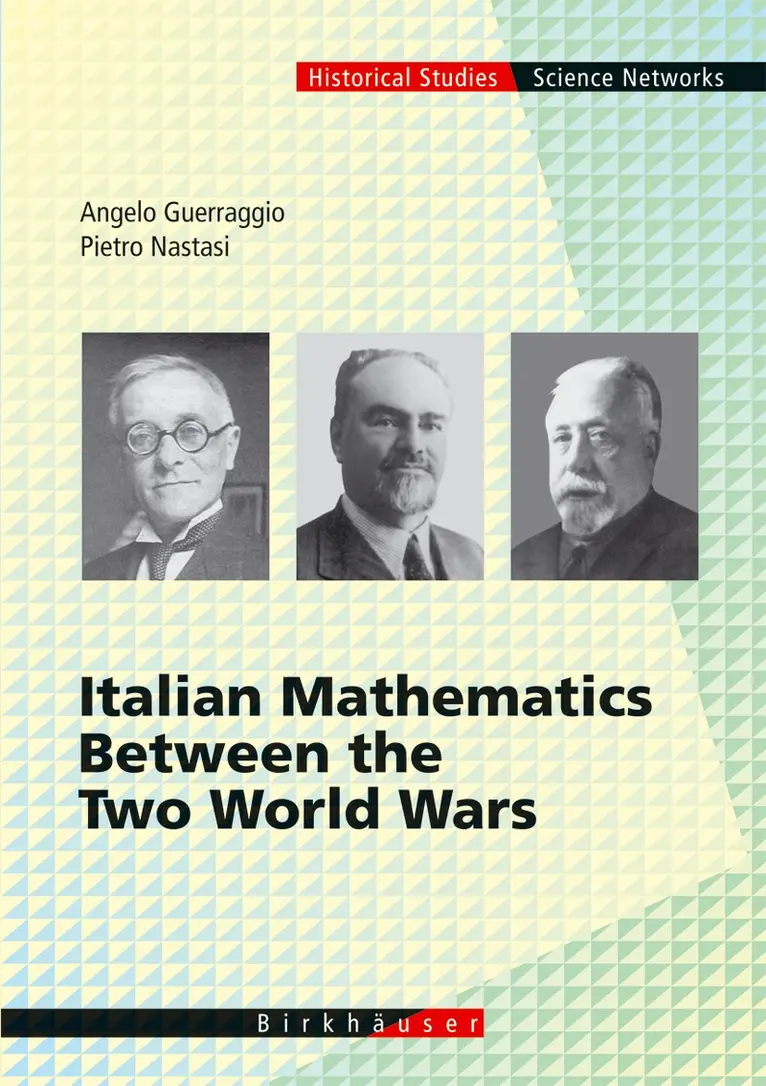
Italian Mathematics Between the Two World Wars
Inbunden, Engelska, 2005
1 082 kr
Skickas inom 10-15 vardagar
This book describes Italian mathematics in the period between the two World Wars. We analyze its development by focusing on both the interior and the external influences. Italian mathematics in that period was shaped by a colorful array of strong personalities who concentrated their efforts on a select number of fields and won international recognition and respect in an incredibly short time. Consequently, Italy was considered a third "mathematical power" after France and Germany, and qualified Italian universities became indispensable stops on the "tour", organized for the improvement of young foreign mathematicians. At that time, Italy was also dominated by a fascist regime. This political situation and the social and academic structure of Italian society are included in the analysis as influences external to mathematics itself. The authors have provided a fascinating study of a most difficult time in the history of the world and of mathematics.
E-bok
PDF, Engelska, 20061 367 kr
Läs direkt efter köp
During the first decades of the last century Italian mathematics was considered to be the third national school due to its importance and the high level of its numerous - searchers. The decision to organize the 1908 International Congress of Mathematicians in Rome (after those in Paris and Heidelberg) confirmed this position. Qualified Italian universities were permanently included in the tour organized for young mathematicians’ improvement. Even in the years after the First World War, Rome (together with Paris and Göttingen) remained an important mathematical center according to the American ma- ematician G. D. Birkhoff. Now, after almost a century, we can state that the golden age of Italian mathem- th th ics reduces to the decades between the 19 and the 20 century. In the centre of interest stood the algebraic geometry school with Guido Calstelnuovo, Federico Enriques and Francesco Severi acting as key figures. Their work led to an almost complete systema- zation of the theory of curves to the complete classification of the surfaces and to the bases of a general theory of algebraic varieties. Other important contributions came from the Italian school of analysis. Its main representative was Vito Volterra – an outstanding analyst with a strong interest in mathematical physics – who produced important results in real analysis and the theory of integral equations and contributed to the initiation of functional analysis.
Häftad, Italienska, 2000
200 kr
Skickas inom 10-15 vardagar
Il numero 3-4 delle Note è dedicato a Felix Klein. Pietro Nastasi, storico della matematica e docente all'Università di Palermo ha tradotto in italiano le "Conferenze americane" che Klein tenne nel 1893 (dopo l'"Esposizione" di Chicago e il Congresso Internazionale di Matematica). Il testo delle Conferenze è accompagnato dall'autobiografia che Klein redasse nel 1923, anch'essa tradotta per la prima volta in italiano. Il numero delle Note si apre con un saggio in cui Nastasi illustra l'importanza delle Conferenze americane e l'attualità di alcune tematiche (scientifiche, didattiche, istituzionali) in quelle che possono essere considerate una delle ultime sintesi della Matematica dell'800, prima che Hilbert aprisse a Parigi il nuovo secolo.
Häftad, Italienska, 2002
17 kr
Skickas inom 10-15 vardagar
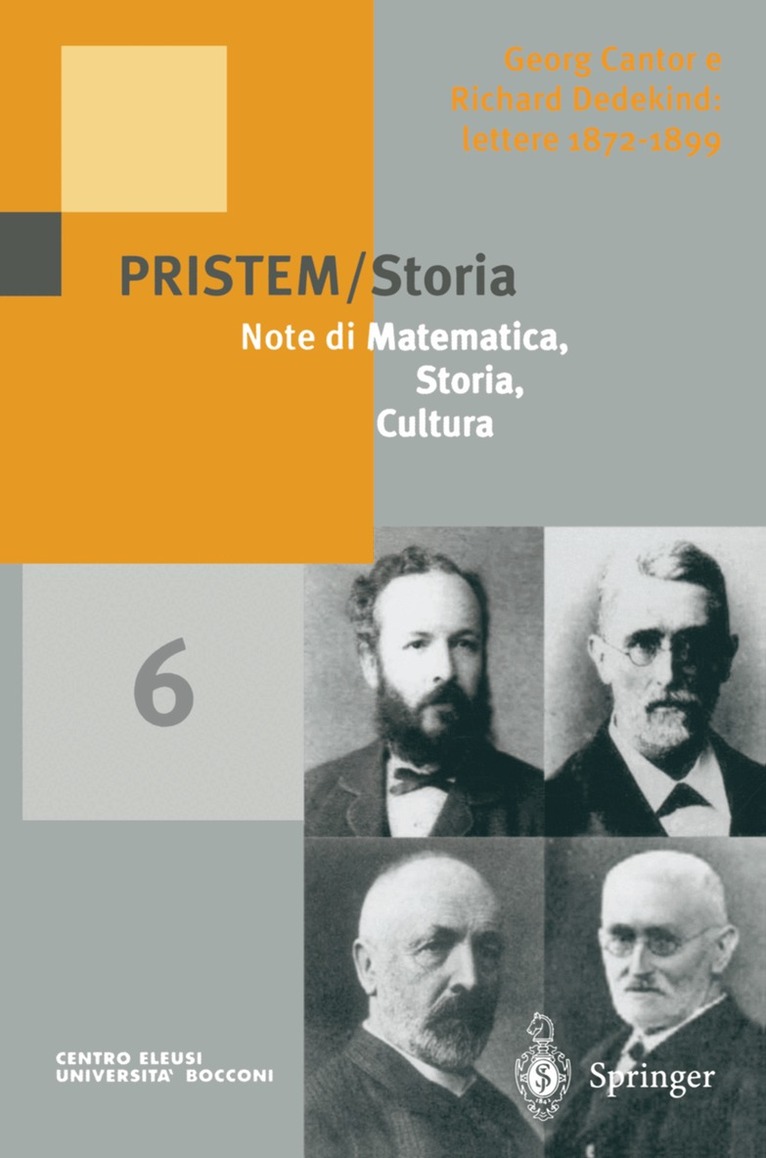
Questo volume raccoglie lo scambio epistolare tra Cantor e Dedekind, finora edito parte in tedesco e parte in francese. Sarà la prima edizione italiana completa di questo fondamentale carteggio, in cui si vedono nascere la nozione di cardinale e ordinale transfiniti, in cui si dimostra la non numerabilità dell'insieme dei numeri reali R e si leggono i primi tentativi e le correzioni alla costruzione di una biiezione tra R e R2, e le discussioni fra Cantor e Dedekind sull'invarianza della nozione di dimensione. "Pochi scritti matematici possono competere - scrive Pietro Nastasi nell'Introduzione - con questa corrispondenza nell'evidenziare il complesso intreccio psicologico che presiede all'invenzione matematica. E nessun lavoro storiografico potrebbe far emergere, meglio di queste lettere, la differenza fra le due personalità implicate: focosa e fantasiosa quella di Cantor, pacata e critica quella del più anziano amico".