Piotr Artiemjew – författare
Visar alla böcker från författaren Piotr Artiemjew. Handla med fri frakt och snabb leverans.
7 produkter
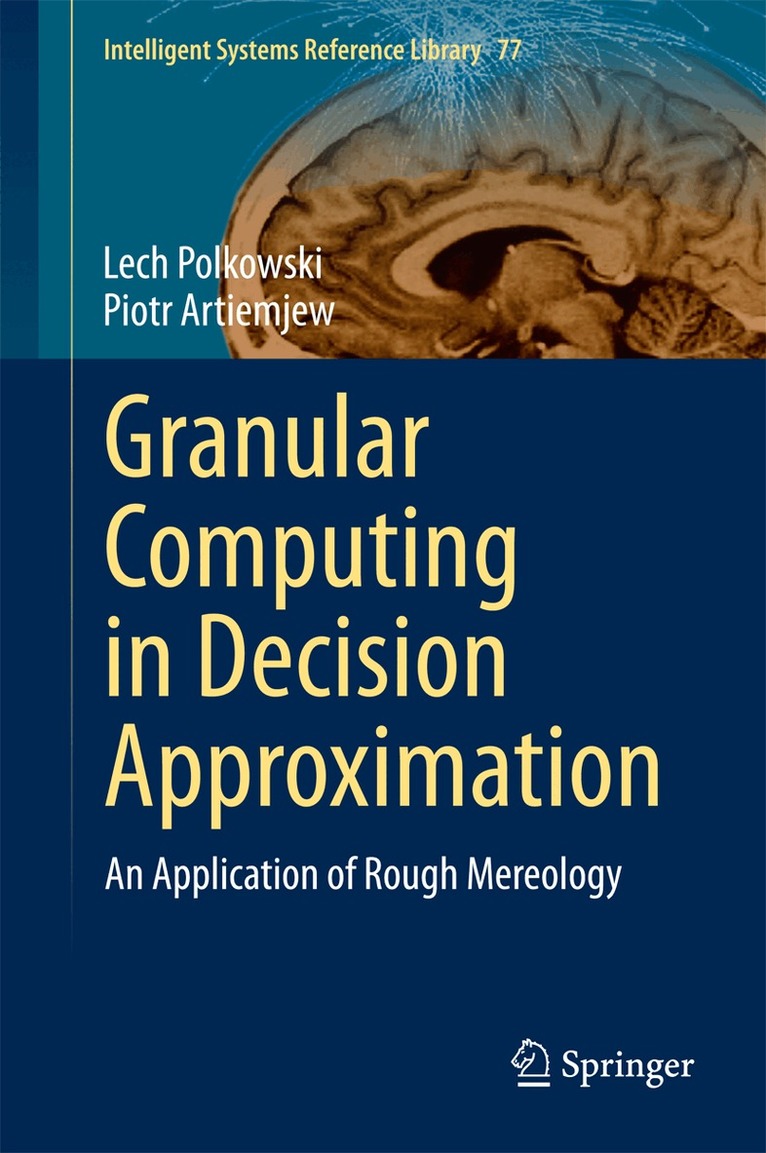
Granular Computing in Decision Approximation
An Application of Rough Mereology
Av Lech Polkowski, Piotr Artiemjew
Inbunden, 2015
1129 kr
Lägg i varukorg
This book presents a study in knowledge discovery in data with knowledge understood as a set of relations among objects and their properties. Relations in this case are implicative decision rules and the paradigm in which they are induced is that of computing with granules defined by rough …
Granular Computing in Decision Approximation
An Application of Rough Mereology
Av Piotr Artiemjew, Lech Polkowski
E-bok, 2015
1502 kr
Lägg i varukorg
This book presents a study in knowledge discovery in data with knowledge understood as a set of relations among objects and their properties. Relations in this case are implicative decision rules and the paradigm in which they are induced is that of computing with granules defined by rough …
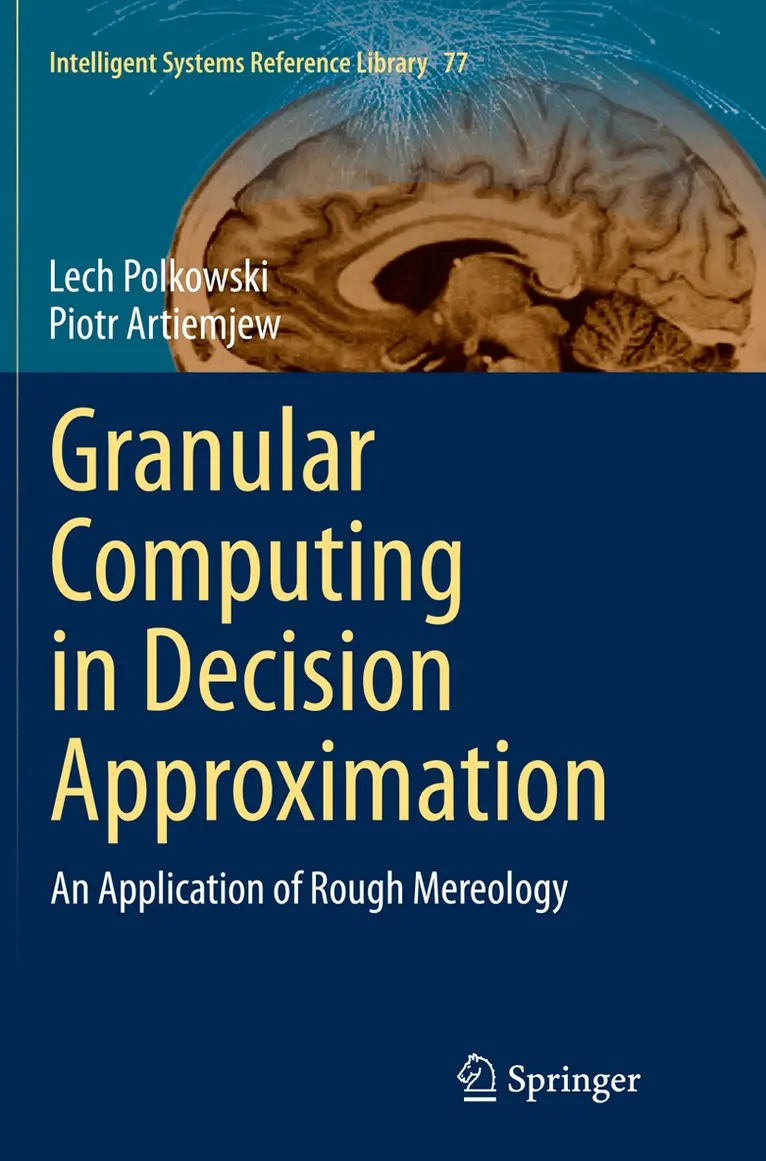
Granular Computing in Decision Approximation
An Application of Rough Mereology
Av Lech Polkowski, Piotr Artiemjew
Häftad, 2016
1129 kr
Lägg i varukorg
This book presents a study in knowledge discovery in data with knowledge understood as a set of relations among objects and their properties. Relations in this case are implicative decision rules and the paradigm in which they are induced is that of computing with granules defined by rough …
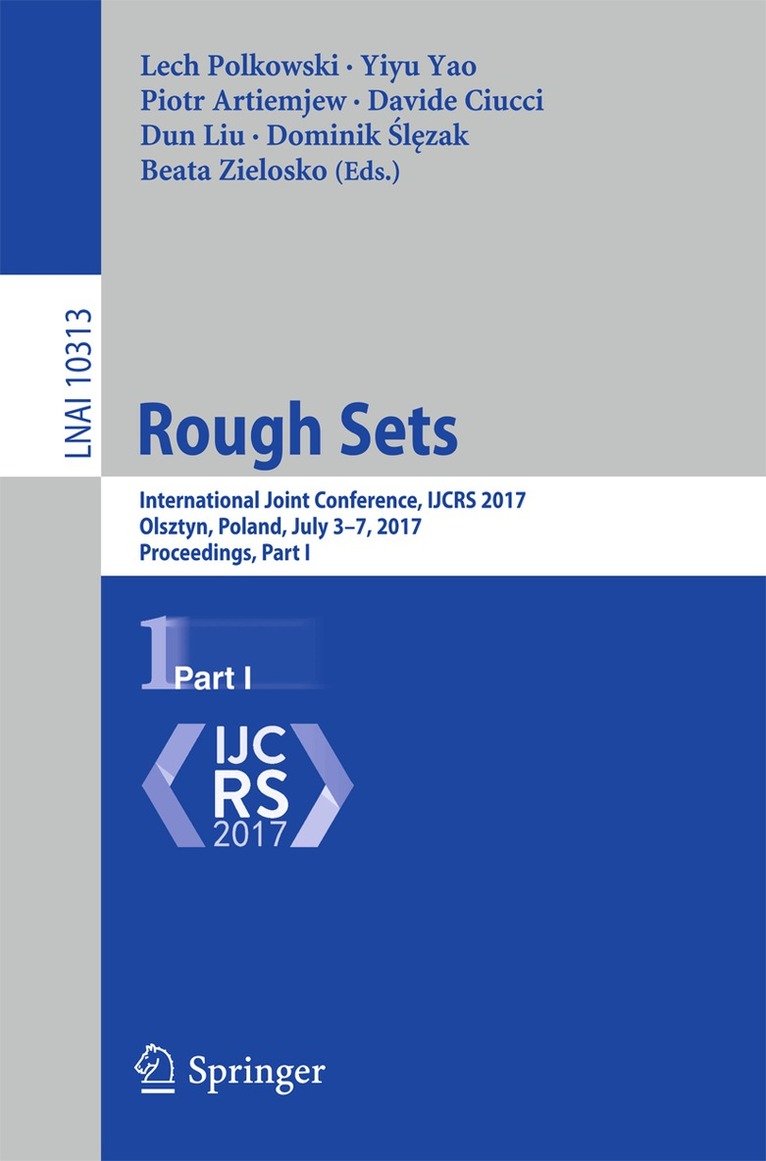
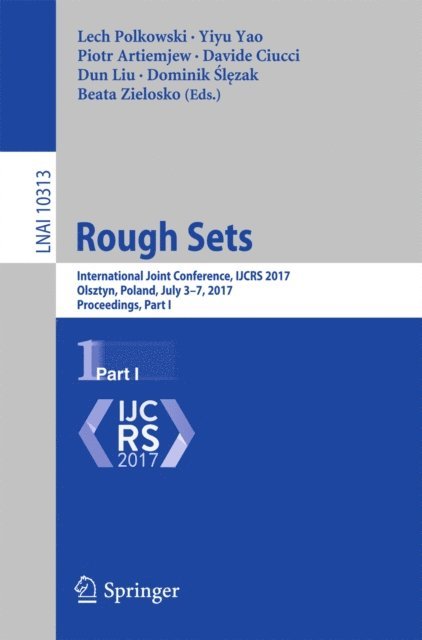
Rough Sets
International Joint Conference, IJCRS 2017, Olsztyn, Poland, July 3–7, 2017, Proceedings, Part I
Av Lech Polkowski, Yiyu Yao m. fl.
Häftad, 2017
568 kr
Lägg i varukorg
This two-volume set LNAI 10313 and LNAI 10314 constitutes the proceedings of the International Joint Conference on Rough Sets, IJCRS 2017, held in Olsztyn, Poland, in July 2017.The 74 revised full papers presented together with 16 short papers and 16 invited talks, were carefully reviewed and …
Rough Sets
International Joint Conference, IJCRS 2017, Olsztyn, Poland, July 3–7, 2017, Proceedings, Part I
Av Beata Zielosko, Dominik Slezak m. fl.
E-bok, 2017
739 kr
Lägg i varukorg
This two-volume set LNAI 10313 and LNAI 10314 constitutes the proceedings of the International Joint Conference on Rough Sets, IJCRS 2017, held in Olsztyn, Poland, in July 2017. The 74 revised full papers presented together with 16 short papers and 16 invited talks, were carefully reviewed and …
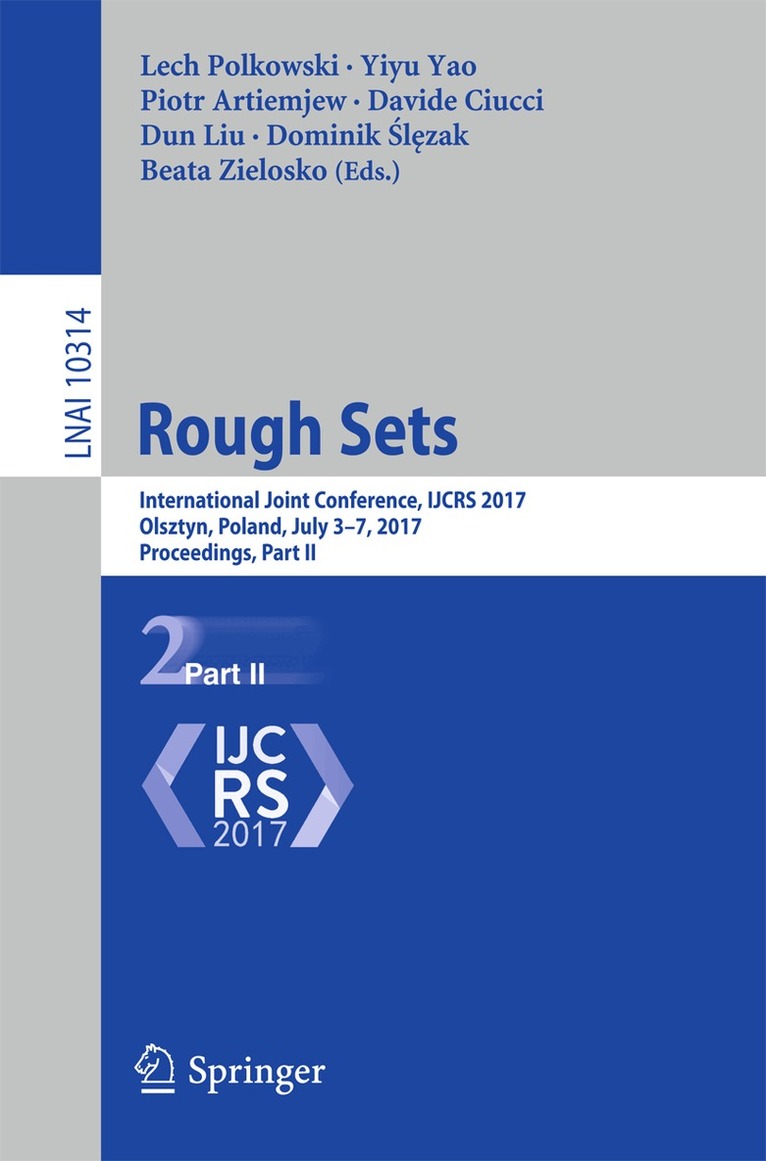
Rough Sets
International Joint Conference, IJCRS 2017, Olsztyn, Poland, July 3–7, 2017, Proceedings, Part II
Av Lech Polkowski, Yiyu Yao m. fl.
Häftad, 2017
568 kr
Lägg i varukorg
This two-volume set LNAI 10313 and LNAI 10314 constitutes the proceedings of the International Joint Conference on Rough Sets, IJCRS 2017, held in Olsztyn, Poland, in July 2017. The 74 revised full papers presented together with 16 short papers and 16 invited talks, were carefully reviewed and …
Rough Sets
International Joint Conference, IJCRS 2017, Olsztyn, Poland, July 3–7, 2017, Proceedings, Part II
Av Beata Zielosko, Dominik Slezak m. fl.
E-bok, 2017
739 kr
Lägg i varukorg
This two-volume set LNAI 10313 and LNAI 10314 constitutes the proceedings of the International Joint Conference on Rough Sets, IJCRS 2017, held in Olsztyn, Poland, in July 2017. The 74 revised full papers presented together with 16 short papers and 16 invited talks, were carefully reviewed and …