P.J. Hager – författare
Visar alla böcker från författaren P.J. Hager. Handla med fri frakt och snabb leverans.
3 produkter
3 produkter
Inbunden, Engelska, 1994
1 082 kr
Skickas inom 10-15 vardagar
The general view of Russell's work amongst philosophers has been that repeat edly, during his long and distinguished career, crucial changes of mind on fun damental points were significant enough to cause him to successively adopt a diversity of radically new philosophical positions. Thus Russell is seen to have embraced and then abandoned, amongst others, neo-Hegelianism, Platonic re alism, phenomenalism and logical atomism, before settling finally on a form of neutral monism that philosophers have generally found to be incredible. This view of Russell is captured in C. D. Broad's famous remark that "Mr. Russell pro duces a different system of philosophy every few years . . . " (Muirhead, 1924: 79). Reflecting this picture of Russell continually changing his position, books and papers on Russell's philosophy have typically belonged to one of two kinds. Either they have concentrated on particular periods of his thought that are taken to be especially significant, or, accepting the view of his successive conversion to dis tinctly different philosophical positions, they have provided some account of each of these supposedly disconnected periods of his thought. While much good work has been done on Russell's philosophy, this framework has had its limitations, the main one being that it conceals the basic continuity behind his thought.
Del 50 - Nijhoff International Philosophy Series
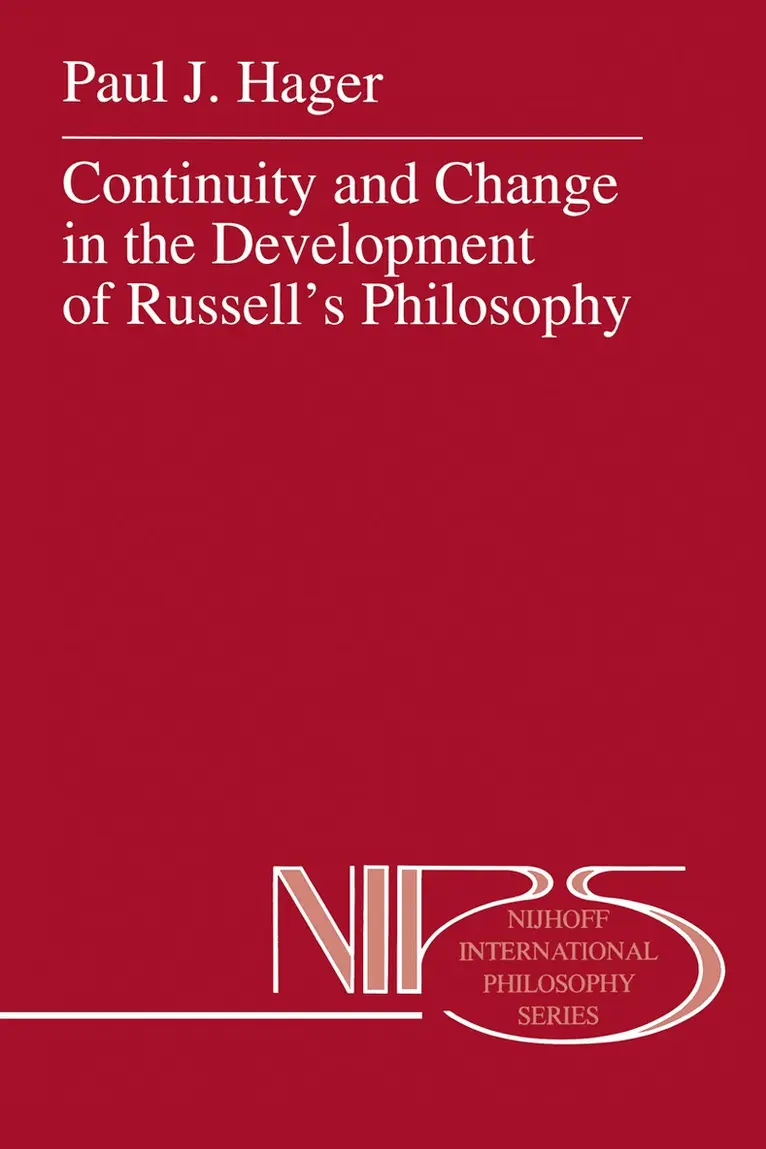
Continuity and Change in the Development of Russell’s Philosophy
Häftad, Engelska, 2012
1 091 kr
Skickas inom 10-15 vardagar
The general view of Russell's work amongst philosophers has been that repeat edly, during his long and distinguished career, crucial changes of mind on fun damental points were significant enough to cause him to successively adopt a diversity of radically new philosophical positions. Thus Russell is seen to have embraced and then abandoned, amongst others, neo-Hegelianism, Platonic re alism, phenomenalism and logical atomism, before settling finally on a form of neutral monism that philosophers have generally found to be incredible. This view of Russell is captured in C. D. Broad's famous remark that "Mr. Russell pro duces a different system of philosophy every few years . . . " (Muirhead, 1924: 79). Reflecting this picture of Russell continually changing his position, books and papers on Russell's philosophy have typically belonged to one of two kinds. Either they have concentrated on particular periods of his thought that are taken to be especially significant, or, accepting the view of his successive conversion to dis tinctly different philosophical positions, they have provided some account of each of these supposedly disconnected periods of his thought. While much good work has been done on Russell's philosophy, this framework has had its limitations, the main one being that it conceals the basic continuity behind his thought.
E-bok
PDF, Engelska, 20121 367 kr
Läs direkt efter köp
The general view of Russell''s work amongst philosophers has been that repeat edly, during his long and distinguished career, crucial changes of mind on fun damental points were significant enough to cause him to successively adopt a diversity of radically new philosophical positions. Thus Russell is seen to have embraced and then abandoned, amongst others, neo-Hegelianism, Platonic re alism, phenomenalism and logical atomism, before settling finally on a form of neutral monism that philosophers have generally found to be incredible. This view of Russell is captured in C. D. Broad''s famous remark that "Mr. Russell pro duces a different system of philosophy every few years . . . " (Muirhead, 1924: 79). Reflecting this picture of Russell continually changing his position, books and papers on Russell''s philosophy have typically belonged to one of two kinds. Either they have concentrated on particular periods of his thought that are taken to be especially significant, or, accepting the view of his successive conversion to dis tinctly different philosophical positions, they have provided some account of each of these supposedly disconnected periods of his thought. While much good work has been done on Russell''s philosophy, this framework has had its limitations, the main one being that it conceals the basic continuity behind his thought.