Polly Hill - Böcker
Visar alla böcker från författaren Polly Hill. Handla med fri frakt och snabb leverans.
10 produkter
10 produkter
1 390 kr
Skickas inom 7-10 vardagar
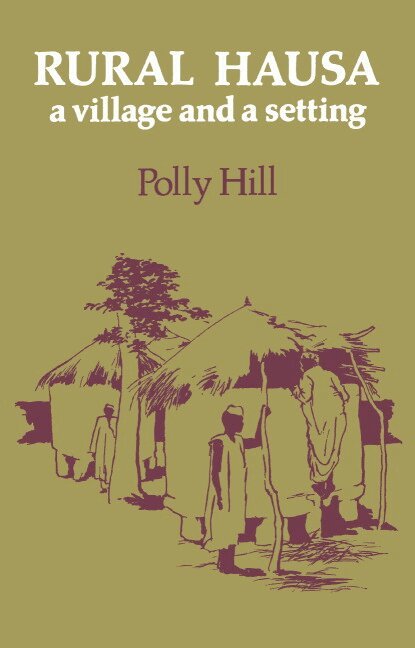
This book was originally published in 1972 and relates to the Hausa-speaking people of West Africa. At the time of publication there were perhaps as many as 15 million Hausa-speaking people in the area, most of whom lived in the countryside in northern Nigeria and the neighbouring Niger Republic. This book is at once an examination of the socio-economic life of a small Hausa village and a study of the way of life of the rural Hausa generally. The book as a whole provides a wide-ranging survey both of what was known and of what was, and in some cases still is, little understood. Very few books had been written on the rural Hausa, much of the literature consisting of scarce pamphlets and official reports; this book not only reports important research, but also surveys literature which was otherwise not generally available. The themes which emerge from this study are similar to many which Polly Hill has stressed elsewhere: people who do not fit into crude stereotypes and socio-economic life are always much more varied and sophisticated than superficial observers would suppose.
428 kr
Skickas inom 7-10 vardagar
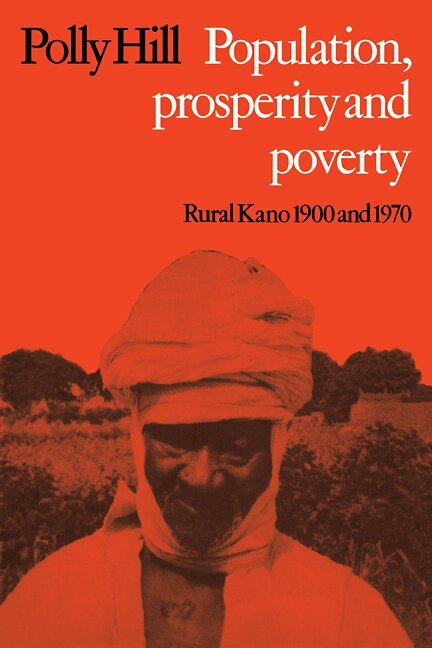
This book, which reports on fieldwork done in an exceedingly densely populated locality of rural Hausaland (Dorayi) in 1971-1972, is complete in itself. In it Dr Hill compares and contrasts Dorayi with the much less densely populated village of her previous study, with special reference to the consequences of high and persistent population density; she also attempts to interpret the present-day stability of this stagnating, impoverished, overcrowded community in terms of socio-economic conditions in rural Kano Emirate generally in very early colonial times, utilising archival as well as field material. Some of the consequences of persistent population pressure are most surprising (an example is the brake it puts on outward migration): they will be eagerly studied by demographers who commonly search in vain for relevant socio-economic studies, particularly any dealing with the plight of the most impoverished, who tend to get overlooked.
428 kr
Skickas inom 7-10 vardagar
Originally published in 1970, this is a collection of studies of indigenous economies in Ghana and Nigeria by an author with an unusual interdisciplinary approach. In the opening section it is contended that most economists interested in underdeveloped countries have neglected the detailed study of economic organization and mechanism in the field, especially in rural areas, and that, as a result, there has been little testing of many conventional implicit assumptions that happen to be invalid. The subsequent chapters of the book are both a vigorous corrective to socio-economic generalisations based on too little data and a demonstration of the possibilities of a research method that owes more to the example of social anthropologists than to that of economists. The sophistication of the picture of certain sectors of rural life that emerges from the whole book will surprise many readers.
507 kr
Skickas inom 7-10 vardagar
This book was originally published in 1972 and relates to the Hausa-speaking people of West Africa. At the time of publication there were perhaps as many as 15 million Hausa-speaking people in the area, most of whom lived in the countryside in northern Nigeria and the neighbouring Niger Republic. This book is at once an examination of the socio-economic life of a small Hausa village and a study of the way of life of the rural Hausa generally. The book as a whole provides a wide-ranging survey both of what was known and of what was, and in some cases still is, little understood. Very few books had been written on the rural Hausa, much of the literature consisting of scarce pamphlets and official reports; this book not only reports important research, but also surveys literature which was otherwise not generally available. The themes which emerge from this study are similar to many which Polly Hill has stressed elsewhere: people who do not fit into crude stereotypes and socio-economic life are always much more varied and sophisticated than superficial observers would suppose.
485 kr
Skickas inom 7-10 vardagar
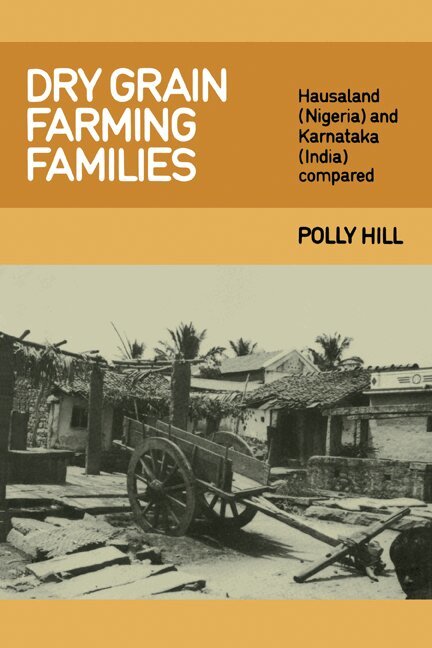
Anthropologists and economists have made persistent efforts to identify economic features of rural tropical economies in the simplest possible terms, in order to enhance their universality. This has resulted in the creation of doctrine on such matters as the causes of rural economic inequality and abysmal poverty. The doctrine is far too generalised to have any practical utility; it is ahistorical; and it usually involves the false belief that all cultivators in a community have similar economic responses. So firm is this orthodoxy that under-development studies have become deadlocked - to the point that our ignorance is constantly on the increase. The book represents a radical assault on prevailing orthodoxy, breaking the deadlock by insisting that we properly categorise the main types of agrarian system in the tropical world. Moreover, it practically demonstrates how to identify these important categories, and draw useful generalised conclusions about it, on the basis of detailed fieldwork in parts of northern Nigeria and south India.
466 kr
Skickas inom 7-10 vardagar
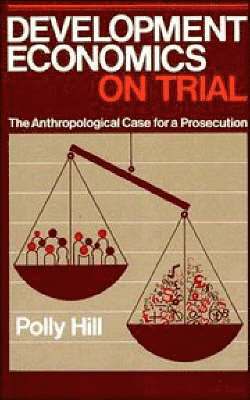
Polly Hill's provocative book examines the disastrous gulf that separates development economics from its sister discipline, economic anthropology. Working with material from the rural tropical world, much of it collected at first hand in West Africa and South India, Dr Hill demonstrates in the first, polemical part of her book, how unreliable and western-biased assumptions most development economists base their theoretical work. She shows in particular that misleading official statistics are handled uncritically, that the significance of innate rural inequality is consistently ignored and the revered concepts such as the 'population explosion' are in anthropological terms largely meaningless. The longer, second part of the book illustrates the enormous relevance and potential of economic anthropology for economists by looking in turn at the true complexity of farming households, labour and inheritance; at debt, social stratification and economic inequality, and at problems connected with the sale of land, the role of women and migration. Taken overall, Development Economics on Trial represents a powerful and urgent plea for co-operation.
339 kr
Skickas inom 10-15 vardagar
With a new introduction by Gareth AustinThis series of Classics in African Anthropology is primarily drawn from a distinct family of texts which dominated the academic analysis of society in mid-20th century Africa. The texts reproduced are significant yet often neglected, and have stood the test of time.Polly Hill's classic study was originally published in 1963. New edition published in association with the International African InstituteNorth America: Transaction Books; Germany: Lit Verlag.
79 kr
Skickas inom 7-10 vardagar
In this study, which is statistically based on the 1960 Ghana population census, author Polly Hill attempts to show that economically motivated migration takes a much greater variety of occupational forms than is conventionally supposed. Hill reports on the occupations, geographical distribution, and urbanization of Ghana’s migrant population, and supplies notes on 34 migratory ethic groups.
1 698 kr
Skickas inom 10-15 vardagar
Originally published in 1940, The Unemployment Services provides a thorough examination of the system of unemployment relief. The book looks at fundamental proposals for the extension of necessary provisions for improving the conditions of the unemployed, and their dependents. The book provides a detailed knowledge of regulations and scales, and uses an unorthodox dissection of the principles embodied in this code of laws, which plays so large a part in the lives of industrial workers and their dependents.
494 kr
Skickas inom 10-15 vardagar
Originally published in 1940, The Unemployment Services provides a thorough examination of the system of unemployment relief. The book looks at fundamental proposals for the extension of necessary provisions for improving the conditions of the unemployed, and their dependents. The book provides a detailed knowledge of regulations and scales, and uses an unorthodox dissection of the principles embodied in this code of laws, which plays so large a part in the lives of industrial workers and their dependents.