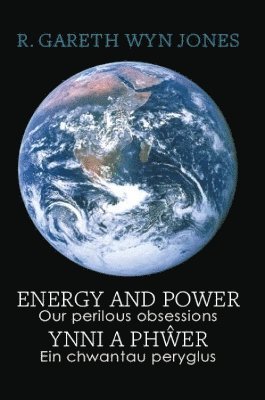
R. Gareth Wyn Jones – författare
230 kr
Skickas
252 kr
Läs direkt efter köp
Drawing on research and concepts from fields as varied as physics, biology, anthropology, behavioural psychology and economics, this volume proposes that two unifying threads can be identified running through the 4-billion-year history of life on this planet. The first is the exploitation of energy sources, coupled to an attendant capacity to do work and exert power, generating increasing material and social complexity; the second is a hierarchy of homeostatic regulatory mechanisms, which sequentially stabilise these evolving complexities and are essential to their sustainability and well-being. Six major step-changes in energy use are highlighted, from energising the first cell, out of equilibrium with its environment, to the latest, the industrial revolution fuelled by burning fossil hydrocarbons. Humans now face a seventh revolution, to energise society without these greenhouse gas emissions – however ill-adapted our historic (as hunter-gatherers-cookers) and recently constructed (as Homo economicus) homeostatic mechanisms are to this challenge.
''Given the huge inequalities in wealth and lifestyle, the energy and consequently CO2 footprints of the jet-setting elite from any country must be at least double, probably, treble, the mean, even the ‘rich’ countries. Energy use permeates all aspects of modern life. This is supplied largely by burning fossil fuels. Regrettably, it appears that the non-catastrophic-resolution of one of humanity’s gravest problems, global warming, is made more difficulty by nature of the homeostatic mechanisms that have historically modulated human behaviour.'' - Read more about this on page 14 https://www.booklaunch.london/issue-6
252 kr
Läs direkt efter köp
This book describes the long-term four billion-year context of anthropogenic climate change, and seeks to explain our inability to respond positively to its challenges. It argues that the availability of energy and the consequential capacity to do work and exert power has, over this time, defined the trajectory of life on planet Earth as well as many of its physiochemical characteristics. Six major historic energy revolutions are recognised – energising of the first living cell; harvesting the Sun’s energy; emergence of complex eukaryotic cells; hominid use of fire/cooking for brains not brawn; agriculture, more food and urban life; fossil fuel bonanza and the industrial revolution – and we are now in the midst of the seventh revolution, responding albeit reluctantly to anthropogenic global climate change.
''Given the huge inequalities in wealth and lifestyle, the energy and consequently CO2 footprints of the jet-setting elite from any country must be at least double, probably, treble, the mean, even the ‘rich’ countries. Energy use permeates all aspects of modern life. This is supplied largely by burning fossil fuels. Regrettably, it appears that the non-catastrophic-resolution of one of humanity’s gravest problems, global warming, is made more difficulty by nature of the homeostatic mechanisms that have historically modulated human behaviour.'' - Read more about this on page 14 https://www.booklaunch.london/issue-6
