R Grieve – författare
Visar alla böcker från författaren R Grieve. Handla med fri frakt och snabb leverans.
4 produkter
4 produkter
Häftad, Engelska, 2011
122 kr
Skickas inom 5-8 vardagar
E-bok
PDF, Engelska, 2014735 kr
Läs direkt efter köp
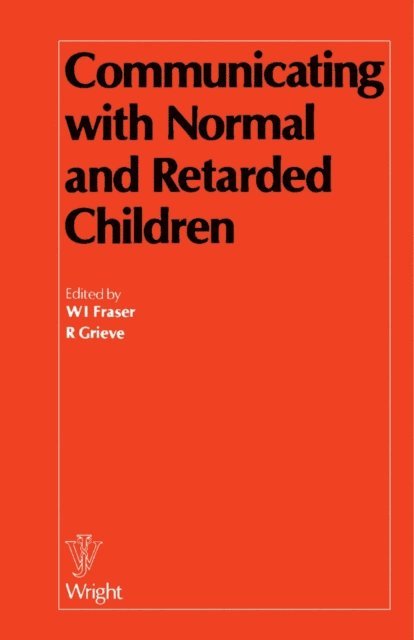
Communicating with Normal and Retarded Children explores the way in which normal children acquire language and the mistakes they make. It aims to trace the common growth between professions in understanding of normal language development and the retarded person''s language and to encourage research, particularly of an interdisciplinary kind. This book is organized into five main sections. The contributors provide different professional perspectives of how and why the mentally retarded get their communication wrong and what remedies can be applied. They also present their own research findings, often in little-explored areas or from a novel angle, and offer their opinion on the types and topics of research that should be carried out. This book will be of interest to academic and clinical psychologists, educators, linguists, advisors and tutors in nursing and social studies, child health doctors, psychiatrists, and a range of therapists.
E-bok
PDF, Engelska, 20131 672 kr
Läs direkt efter köp
In the past fi fteen years there has been a growi ng interest in the development of children''s awareness of language as an object in itself -- a phenomenon now generally referred to as metal inguistic awareness. Until the publication of an earlier volume in the Springer Series in Language and Communication, The Chitd''s Conoeption oi Language, edited by A. Sinclair, R. J. Jarvella, and W. J. M. Levelt, there had been no systematic treatment of metalinguistic awareness. The major goal of that volume was to map out the field of study by describing the phenomenon of interest and defining major theoretical issues. The aim of the present volume is to present an overview of metalinguistic awareness in children which reflects the current state of research and theory. The volume is divided into three major sections. The first considers various conceptual and methodological issues that have arisen from efforts to study metalinguistic awareness. It addresses such questions as what is metalinguistic awareness, when does it begin to emerge, and what tasks and procedures can be employed to assess its development in young children. The second sect ion cri ti ca 11y revi ews the research that has been conducted i nto the four general types of metalinguistic awareness -- phonologieal, word, syntactic, and pragmatic awareness. In the final section the development of metalinguistic awareness is examined in relation to general cognitive development, reading acquisition, bilingualism, and early childhood education.
Häftad, Engelska, 2011
1 307 kr
Skickas inom 10-15 vardagar
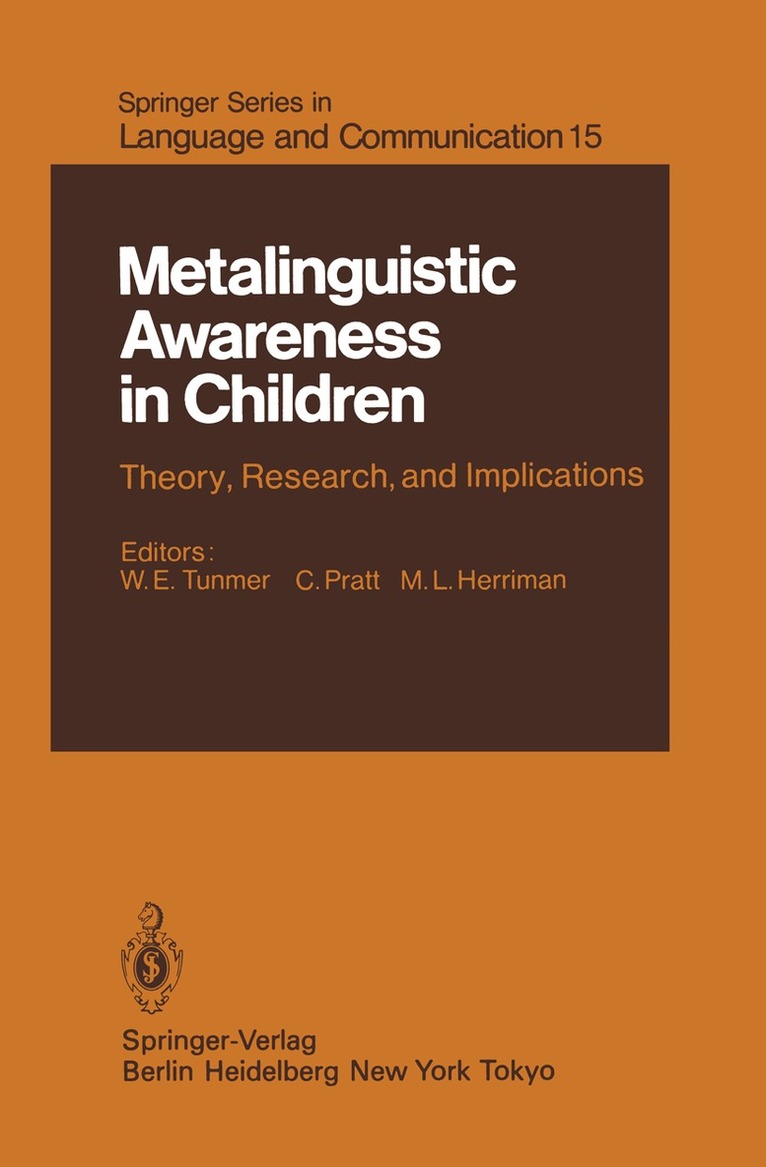
In the past fi fteen years there has been a growi ng interest in the development of children's awareness of language as an object in itself -- a phenomenon now generally referred to as metal inguistic awareness. Until the publication of an earlier volume in the Springer Series in Language and Communication, The Chitd's Conoeption oi Language, edited by A. Sinclair, R. J. Jarvella, and W. J. M. Levelt, there had been no systematic treatment of metalinguistic awareness. The major goal of that volume was to map out the field of study by describing the phenomenon of interest and defining major theoretical issues. The aim of the present volume is to present an overview of metalinguistic awareness in children which reflects the current state of research and theory. The volume is divided into three major sections. The first considers various conceptual and methodological issues that have arisen from efforts to study metalinguistic awareness. It addresses such questions as what is metalinguistic awareness, when does it begin to emerge, and what tasks and procedures can be employed to assess its development in young children. The second sect ion cri ti ca 11y revi ews the research that has been conducted i nto the four general types of metalinguistic awareness -- phonologieal, word, syntactic, and pragmatic awareness. In the final section the development of metalinguistic awareness is examined in relation to general cognitive development, reading acquisition, bilingualism, and early childhood education.