R. Harré – författare
Visar alla böcker från författaren R. Harré. Handla med fri frakt och snabb leverans.
3 produkter
3 produkter
Del 13 - Language and Communication Library
Linguistics and Philosophy
The Controversial Interface
Inbunden, Engelska, 1993
1 036 kr
Kommande
As hopes that generative linguistics might solve philosophical problems about the mind give way to disillusionment, old problems concerning the relationship between linguistics and philosophy survive unresolved. This collection surveys the historical engagement between the two, and opens up avenues for further reflection. In Part 1 two contrasting views are presented of the interface nowadays called 'philosophy of linguistics'. Part 2 gives a detailed historical survey of the engagement of analytic philosophy with linguistic problems during the present century, and sees the imposition by philosophers of an 'exploratory' model of thinking as a major challenge to the discipline of linguistics. Part 3 poses the problem of whether linguistics is dedicated to describing independently existing linguistic structures or to imposing its own structures on linguistic phenomena. In Part 4 Harris points out some similarities in the way an eminent linguist and an eminent philosopher invoke the analogy between languages and games; while Taylor analyses the rationale of our metalinguistic claims and their relationship to linguistic theorizing. Providing a wide range of views and ideas this book will be of interest to all those interested and involved in the interface of philosophy and linguistics.
E-bok
PDF, Engelska, 2014802 kr
Läs direkt efter köp
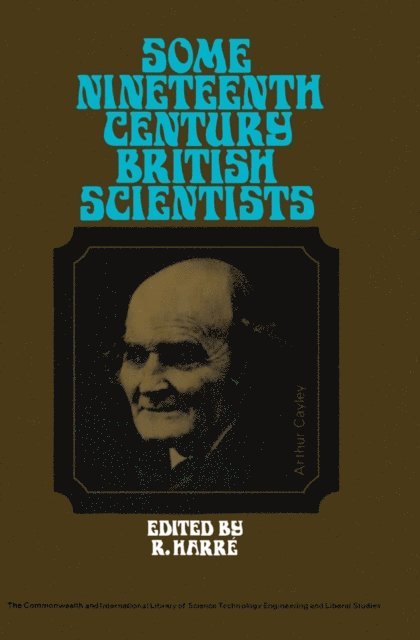
Some Nineteenth Century British Scientists presents the biographies of eight British scientists who represent the state of science in the second half of the Victorian era: Charles Wyville Thomson, James Murray, Arthur Cayley, Francis Galton, William Thomson, Lord Kelvin, Norman Lockyer, Sidney Gilchrist Thomas, and William Ramsay. This book is comprised of seven chapters and begins by focusing on the contributions and achievements of Charles Wyville Thomson in the fields of natural history, marine biology, and deep-sea exploration, especially his expedition aboard H.M.S. Challenger, and of James Murray in oceanography. Subsequent chapters discuss the works of Arthur Cayley (mathematics), Francis Galton (exploration, anthropology, and eugenics), and William Thomson, Lord Kelvin (mathematical physics). The achievements of Norman Lockyer (astrophysics), Sidney Gilchrist Thomas (inventor of the Thomas-Gilchrist process for eliminating phosphorus in the Bessemer converter), and William Ramsay (chemistry) are also considered. This monograph will be a useful resource for students and scientists alike.
E-bok
PDF, Engelska, 20171 362 kr
Läs direkt efter köp
As hopes that generative linguistics might solve philosophical problems about the mind give way to disillusionment, old problems concerning the relationship between linguistics and philosophy survive unresolved. This collection surveys the historical engagement between the two, and opens up avenues for further reflection. In Part 1 two contrasting views are presented of the interface nowadays called ''philosophy of linguistics''. Part 2 gives a detailed historical survey of the engagement of analytic philosophy with linguistic problems during the present century, and sees the imposition by philosophers of an ''exploratory'' model of thinking as a major challenge to the discipline of linguistics. Part 3 poses the problem of whether linguistics is dedicated to describing independently existing linguistic structures or to imposing its own structures on linguistic phenomena. In Part 4 Harris points out some similarities in the way an eminent linguist and an eminent philosopher invoke the analogy between languages and games; while Taylor analyses the rationale of our metalinguistic claims and their relationship to linguistic theorizing. Providing a wide range of views and ideas this book will be of interest to all those interested and involved in the interface of philosophy and linguistics.