RAdiger Schmitt-Beck – författare
Visar alla böcker från författaren RAdiger Schmitt-Beck. Handla med fri frakt och snabb leverans.
5 produkter
5 produkter
E-bok
PDF, Engelska, 20141 271 kr
Läs direkt efter köp
Voters on the Move or on the Run? addresses electoral change, the reasons, and the consequences. By investigating heterogeneity of voting, and complexity of voting and its context the volume shows that increasing heterogeneity is not arbitrary and unstructured. Heterogeneity of voting rather is a way of voters dealing with the increasing complexity of the context of elections - diversified social structures, increasing differentiation of political supply,increasing complexity of the information environment. By analysing the conditions of heterogeneity and showing that the calculus of voting becomes more and more conditional in terms of what voters regard as relevant criteria for vote choice, the book demonstrates that the new feature of electoral behaviour isstructured heterogeneity. The dimensions of differentiation of the electorate are cognitive capacity and the structure of individual information acquisition systems. The book demonstrates that voters are on the move looking for appropriate answers to new complexities rather than on the run. The book uses data predominantly from the German Longitudinal Election Study (GLES), and also comparative data from the Comparative Study of Electoral Systems (CSES). Cross-sectional analysis is complementedby long- and short-term dynamic analyses with panel data, and comparative analyses.
E-bok
PDF, Engelska, 20171 099 kr
Läs direkt efter köp
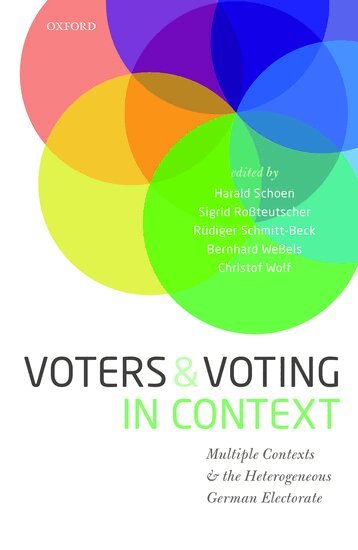
Voters and Voting in Context investigates the role of context in affecting political opinion formation and voting behaviour. Building on a model of contextual effects on individual-level voter behaviour, the chapters of this volume explore contextual effects in Germany in the early twenty-first century.The volume draws upon manifold combinations of individual and contextual information gathered in the German Longitudinal Election Study (GLES) framework and employ advanced methods. In substantive terms, it investigates the impact of campaign communication on political learning, effects of media coverage on the perceived importance of political problems, and the role of electoral competition on candidate strategies and perceptions. It also examines the role of social and economic contexts aswell as parties'' policy stances in affecting electoral turnout. The volume explores the impact of social cues on candidate voting, effects of electoral arenas on vote functions, the role of media coverage on ideological voting, and effects of campaign communication on the timing of electoraldecision-making.Voters and Voting in Context demonstrates the key role of the processes of communication and politicization in bringing about contextual effects. Context thus plays a nuanced role in voting behaviour. The contingency of contextual effects suggests that they will become an important topic in research on political behaviour and democratic politics.
E-bok
Engelska, 20171 099 kr
Läs direkt efter köp
Voters and Voting in Context investigates the role of context in affecting political opinion formation and voting behaviour. Building on a model of contextual effects on individual-level voter behaviour, the chapters of this volume explore contextual effects in Germany in the early twenty-first century.The volume draws upon manifold combinations of individual and contextual information gathered in the German Longitudinal Election Study (GLES) framework and employ advanced methods. In substantive terms, it investigates the impact of campaign communication on political learning, effects of media coverage on the perceived importance of political problems, and the role of electoral competition on candidate strategies and perceptions. It also examines the role of social and economic contexts aswell as parties'' policy stances in affecting electoral turnout. The volume explores the impact of social cues on candidate voting, effects of electoral arenas on vote functions, the role of media coverage on ideological voting, and effects of campaign communication on the timing of electoraldecision-making.Voters and Voting in Context demonstrates the key role of the processes of communication and politicization in bringing about contextual effects. Context thus plays a nuanced role in voting behaviour. The contingency of contextual effects suggests that they will become an important topic in research on political behaviour and democratic politics.
Inbunden, Engelska, 2017
1 443 kr
Skickas inom 7-10 vardagar
Voters and Voting in Context investigates the role of context in affecting political opinion formation and voting behaviour. Building on a model of contextual effects on individual-level voter behaviour, the chapters of this volume explore contextual effects in Germany in the early twenty-first century. The volume draws upon manifold combinations of individual and contextual information gathered in the German Longitudinal Election Study (GLES) framework and employ advanced methods. In substantive terms, it investigates the impact of campaign communication on political learning, effects of media coverage on the perceived importance of political problems, and the role of electoral competition on candidate strategies and perceptions. It also examines the role of social and economic contexts as well as parties' policy stances in affecting electoral turnout. The volume explores the impact of social cues on candidate voting, effects of electoral arenas on vote functions, the role of media coverage on ideological voting, and effects of campaign communication on the timing of electoral decision-making.Voters and Voting in Context demonstrates the key role of the processes of communication and politicization in bringing about contextual effects. Context thus plays a nuanced role in voting behaviour. The contingency of contextual effects suggests that they will become an important topic in research on political behaviour and democratic politics.
Inbunden, Engelska, 2022
1 710 kr
Skickas inom 7-10 vardagar
This is an open access title available under the terms of a CC BY-NC-ND 4.0 International licence. It is free to read at Oxford Scholarship Online and offered as a free PDF download from OUP and selected open access locations.Over the past half century, the behavior of German voters has changed profoundly - at first rather gradually, but during the last decade at accelerated speed. Electoral decision-making has become much more volatile, rendering election outcomes less predictable. Party system fragmentation intensified sharply. The success of the AfD put an end to Germany's exceptionality as one of the few European countries without a strong right-wing populist party. Utilizing a wide range of data compiled by the German Longitudinal Election Study, the book examines changing voters' behavior in the context of changing parties, campaigns, and media during the period of its hitherto most dramatically increased fluidity at the 2009, 2013, and 2017 federal elections. Guided by the notions of realignment and dealignment the study addresses three questions: How did the turbulences that increasingly characterize German electoral politics come about? How did they in turn condition voters' decision-making? How were voters' attitudes and choices affected by situational factors that pertained to the specifics of particular elections? The Changing German Voter demonstrates how traditional cleavages lost their grip on voters and a new socio-cultural line of conflict became the dominant axis of party competition. A series of major crises, but also programmatic shifts of the established parties promoted this development. It led to a segmentation of the party system that pits the right-wing populist AfD against the traditional parties. The book also demonstrates the relevance of coalition preferences, candidate images as well as media and campaign effects for voters' attitudes, beliefs, and preferences.