Rahul Banerjee - Böcker
Visar alla böcker från författaren Rahul Banerjee. Handla med fri frakt och snabb leverans.
5 produkter
5 produkter
1 213 kr
Kommande
617 kr
Skickas inom 10-15 vardagar
India has a rich tradition of meditative practices designed to study the phenomenon of consciousness. From the distant past to the present, India has evolved a unique psychological culture with grand unifying themes and universal modes of meditative practice. This book provides a detailed analysis of classical and modern Indian views on consciousness along with their related meditative methods. It offers a critical analysis of three distinct trends of Indian thought, viz., a dualistic mode of understanding and realizing consciousness in Hindu Sāṃkhya, an interactive mode in early Buddhist abhidhamma, and the evolutionary transformational mode in the teachings of the twentieth-century sage Sri Aurobindo. This book explores the unifying features in Indian first person practices with regard to consciousness and the importance of these applied psychological practices and their associated understanding of our conscious inner lives. The most striking feature of the work is that side by side theoretical exposition of consciousness, it includes a number of worksheets which explain how to use meditation to achieve relaxation as well as cognitive ‘maps’ of the different levels of conscious states and instruction and how one can traverse from one state to another. The final chapter explores Sri Aurobindo who introduced new and decisive Indian spiritual thought and practice to India in the form of Integral Yoga. This innovative book will be of interest to scholars studying Indian philosophy, Indian religion and the emerging field of contemplation studies.
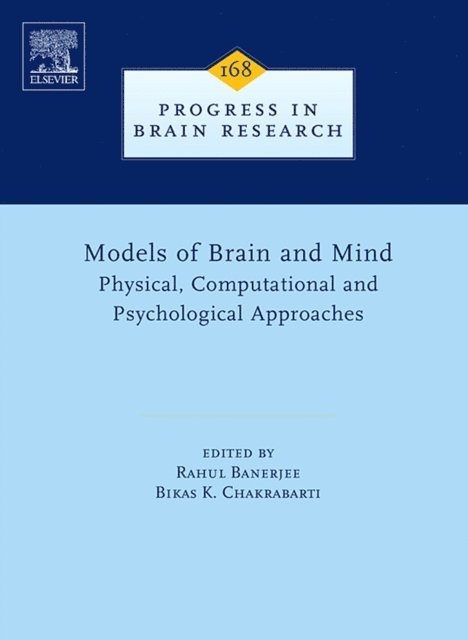
Del 168 - Progress in Brain Research
Models of Brain and Mind
Physical, Computational and Psychological Approaches
Inbunden, Engelska, 2008
3 198 kr
Skickas inom 7-10 vardagar
The phenomenon of consciousness has always been a central question for philosophers and scientists. Emerging in the past decade are new approaches to the understanding of consciousness in a scientific light. This book presents a series of essays by leading thinkers giving an account of the current ideas prevalent in the scientific study of consciousness. The value of the book lies in the discussion of this interesting though complex subject from different points of view ranging from physics and computer science to the cognitive sciences. Reviews of controversial ideas related to the philosophy of mind from western and eastern sources including classical Indian first person methodologies provide a breadth of coverage that has seldom been attempted in a book before. Additionally, chapters relating to the new approaches in computational modeling of higher order cognitive function and consciousness are included. The book is of great value for established as well as young researchers from a wide cross-section of interdisciplinary scientific backgrounds, aiming to pursue research in this field, as well as an informed public. Presents the latest developments in the scientific study of consciousness Critically reviews different theoretical and philosophical explanations related to the subject An important book for both students and researchers in designing research projects on consciousness
2 098 kr
Skickas inom 10-15 vardagar
India has a rich tradition of meditative practices designed to study the phenomenon of consciousness. From the distant past to the present, India has evolved a unique psychological culture with grand unifying themes and universal modes of meditative practice. This book provides a detailed analysis of classical and modern Indian views on consciousness along with their related meditative methods. It offers a critical analysis of three distinct trends of Indian thought, viz., a dualistic mode of understanding and realizing consciousness in Hindu Sāṃkhya, an interactive mode in early Buddhist abhidhamma, and the evolutionary transformational mode in the teachings of the twentieth-century sage Sri Aurobindo. This book explores the unifying features in Indian first person practices with regard to consciousness and the importance of these applied psychological practices and their associated understanding of our conscious inner lives. The most striking feature of the work is that side by side theoretical exposition of consciousness, it includes a number of worksheets which explain how to use meditation to achieve relaxation as well as cognitive ‘maps’ of the different levels of conscious states and instruction and how one can traverse from one state to another. The final chapter explores Sri Aurobindo who introduced new and decisive Indian spiritual thought and practice to India in the form of Integral Yoga. This innovative book will be of interest to scholars studying Indian philosophy, Indian religion and the emerging field of contemplation studies.
3 099 kr
Skickas inom 5-8 vardagar
Supramolecular materials have a great number of applications due to the reversibility of their non-covalent molecular interactions, such as reversible hydrogen bonding, host–guest interactions and electrostatic interactions. This book provides a comprehensive source of information on the structure and function of organic and metal–organic supramolecular materials.The chapters of this book provide an overview of supramolecular material assembly at various scales, including the formation of 2D polymers and molecular cages. The role of intermolecular interactions in solid and solution state self-assembly is discussed, as is the role of mechanochemistry on molecular and supramolecular architectures. Finally, novel applications of these materials in molecular recognition, catalysis, light harvesting and environmental remediation are covered.Functional Supramolecular Materials will be of interest to graduate students and researchers in academia and industry in the fields of supramolecular chemistry and functional materials science.