Raimund L. Feldmann – författare
Visar alla böcker från författaren Raimund L. Feldmann. Handla med fri frakt och snabb leverans.
2 produkter
2 produkter
Häftad, Engelska, 2001
561 kr
Skickas inom 10-15 vardagar
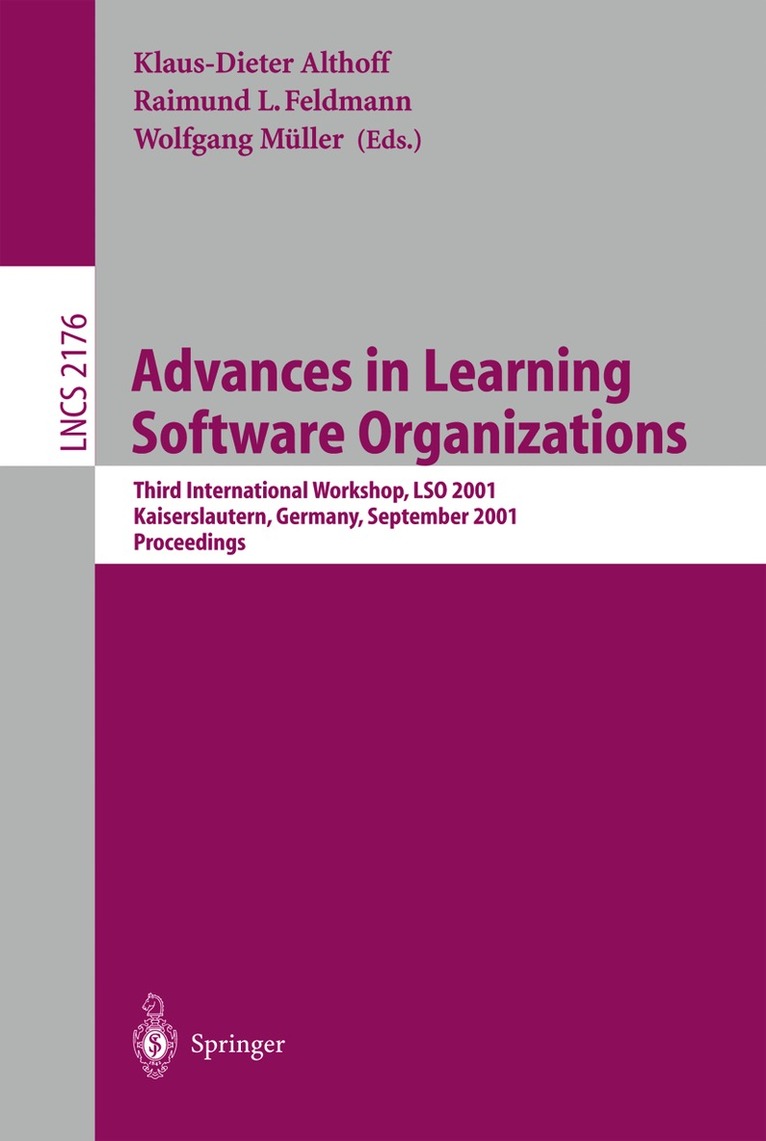
This book constitutes the refereed proceedings of the Third International Workshop on Learning Software Organizations, LSO 2001, held in Kaiserslautern, Germany, in September 2001. The twelve revised full papers presented together with an introductory overview, keynote and panel summaries, and three posters were carefully reviewed and selected for inclusion in the book. Among the topics addressed are organizational learning in dynamic domains, knowledge management in software development, Web-based collaborative learning, knowledge management support, software process improvement, Web-based data mining, process-integrated learning, process-centered software engineering education, etc.
E-bok
PDF, Engelska, 2003668 kr
Läs direkt efter köp
The importance of production and use of high quality software is still growing, as more and more businesses depend on information technology. Well educated, highly skilled, and experienced employees characterize the situation in most companies in the developed countries. Increasingly they work together in temporary networks with geographically distributed offices. Using and developing their knowledge is a key issue in gaining competitive advantages. We have learned during recent years that the exchange and development of knowledge (which we call learning) demands a great deal of human interaction. However, it is widely recognized that information systems will, in many cases, enable the sharing of experience across distributed organizations and act as a knowledge repository. A Learning Software Organization (LSO) will turn Intellectual Capital into market shares and profit, as it establishes the means to manage its knowledge. The LSO workshop series was created in 1999 to provide a communication forum that addresses the questions of organizational learning from a software point of view and builds upon existing work on Knowledge Management and Organizational Learning. It aims at bringing together practitioners and researchers for an open exchange of experience with successes and failures in organizational learning. Right from the beginning, fostering interdisciplinary approaches and providing an opportunity to learn about new ideas has been a central issue of the workshop series. The feedback that we have obtained in recent years has encouraged us to continue our work for a better understanding of the setup and running of Learning Software Organizations.