Rainald Löhner - Böcker
Visar alla böcker från författaren Rainald Löhner. Handla med fri frakt och snabb leverans.
3 produkter
3 produkter
Applied Computational Fluid Dynamics Techniques
An Introduction Based on Finite Element Methods
Inbunden, Engelska, 2008
1 491 kr
Skickas inom 7-10 vardagar
Computational fluid dynamics (CFD) is concerned with the efficient numerical solution of the partial differential equations that describe fluid dynamics. CFD techniques are commonly used in the many areas of engineering where fluid behavior is an important factor. Traditional fields of application include aerospace and automotive design, and more recently, bioengineering and consumer and medical electronics. With Applied Computational Fluid Dynamics Techniques, 2nd edition, Rainald Löhner introduces the reader to the techniques required to achieve efficient CFD solvers, forming a bridge between basic theoretical and algorithmic aspects of the finite element method and its use in an industrial context where methods have to be both as simple but also as robust as possible.This heavily revised second edition takes a practice-oriented approach with a strong emphasis on efficiency, and offers important new and updated material on; Overlapping and embedded grid methodsTreatment of free surfacesGrid generationOptimal use of supercomputing hardwareOptimal shape and process designApplied Computational Fluid Dynamics Techniques, 2nd edition is a vital resource for engineers, researchers and designers working on CFD, aero and hydrodynamics simulations and bioengineering. Its unique practical approach will also appeal to graduate students of fluid mechanics and aero and hydrodynamics as well as biofluidics.
536 kr
Skickas inom 10-15 vardagar
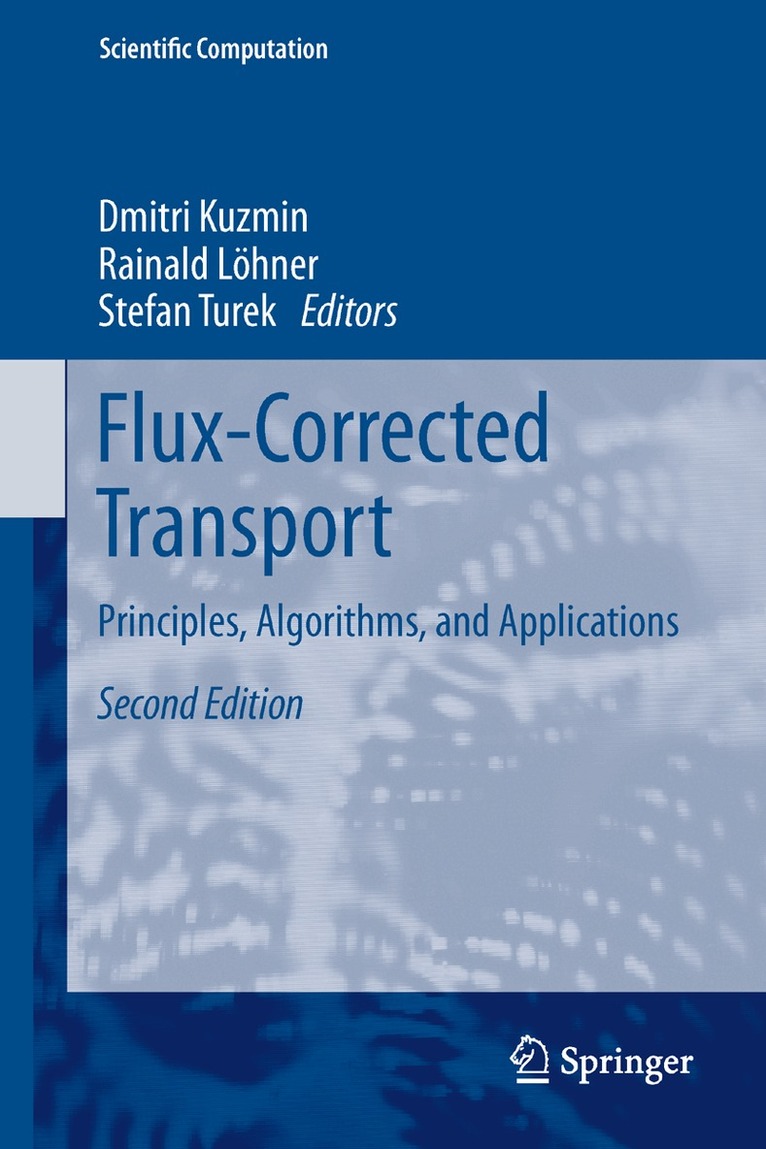
Addressing students and researchers as well as Computational Fluid Dynamics practitioners, this book is the most comprehensive review of high-resolution schemes based on the principle of Flux-Corrected Transport (FCT). The foreword by J.P. Boris and historical note by D.L. Book describe the development of the classical FCT methodology for convection-dominated transport problems, while the design philosophy behind modern FCT schemes is explained by S.T. Zalesak. The subsequent chapters present various improvements and generalizations proposed over the past three decades. In this new edition, recent results are integrated into existing chapters in order to describe significant advances since the publication of the first edition. Also, 3 new chapters were added in order to cover the following topics: algebraic flux correction for finite elements, iterative and linearized FCT schemes, TVD-like flux limiters, acceleration of explicit and implicit solvers, mesh adaptation, failsafe limiting for systems of conservation laws, flux-corrected interpolation (remapping), positivity preservation in RANS turbulence models, and the use of FCT as an implicit subgrid scale model for large eddy simulations.
536 kr
Skickas inom 10-15 vardagar
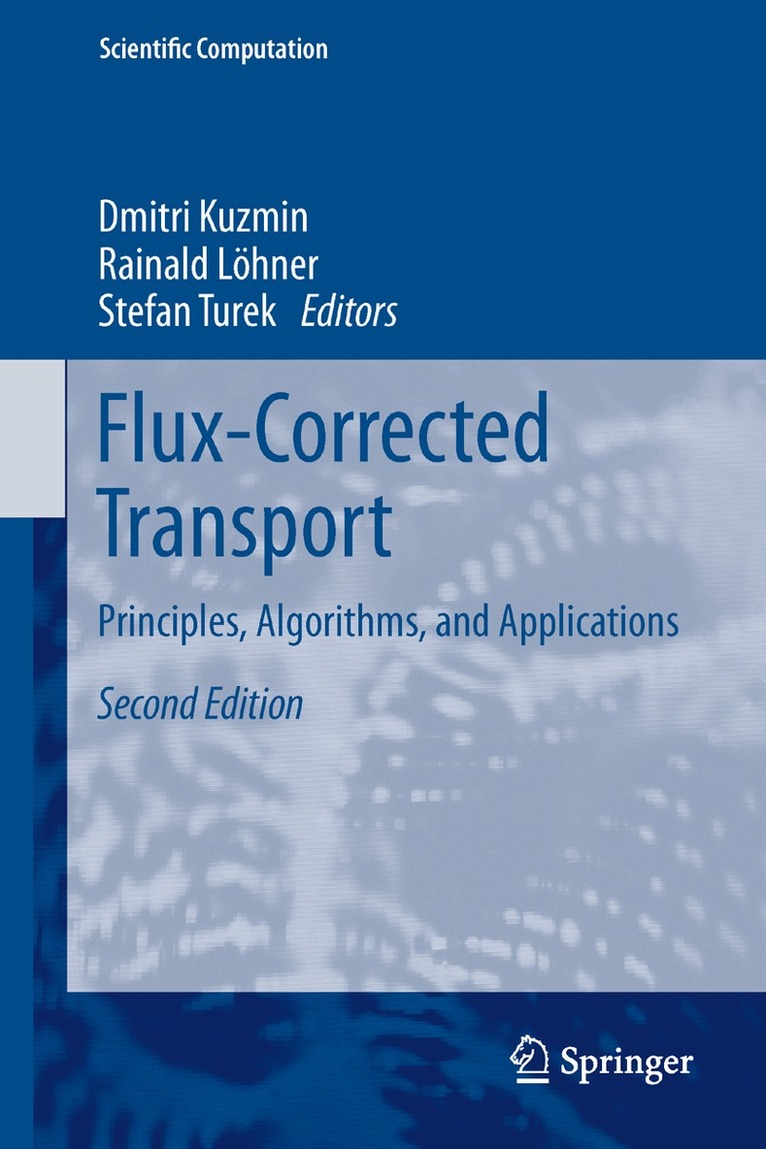
Addressing students and researchers as well as Computational Fluid Dynamics practitioners, this book is the most comprehensive review of high-resolution schemes based on the principle of Flux-Corrected Transport (FCT). The foreword by J.P. Boris and historical note by D.L. Book describe the development of the classical FCT methodology for convection-dominated transport problems, while the design philosophy behind modern FCT schemes is explained by S.T. Zalesak. The subsequent chapters present various improvements and generalizations proposed over the past three decades. In this new edition, recent results are integrated into existing chapters in order to describe significant advances since the publication of the first edition. Also, 3 new chapters were added in order to cover the following topics: algebraic flux correction for finite elements, iterative and linearized FCT schemes, TVD-like flux limiters, acceleration of explicit and implicit solvers, mesh adaptation, failsafe limiting for systems of conservation laws, flux-corrected interpolation (remapping), positivity preservation in RANS turbulence models, and the use of FCT as an implicit subgrid scale model for large eddy simulations.