E-bok
Engelska, 20101 283 kr
Läs direkt efter köp
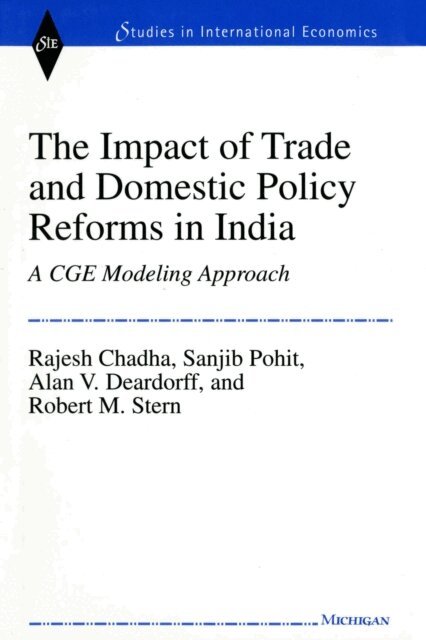
Major economic reforms undertaken since 1991 have brought the Indian economy into a new phase of development directed toward becoming globally competitive through the opening of trade, foreign investment, and technology inflows. The private sector is expected to play a lead role, with a corresponding reduction in the role played by the public sector. This book is aimed at analyzing the comparative static effects of selected post-1991 trade and domestic policy reforms on trade, factor prices, economic welfare, and the intersectoral allocation of resources. The study relies on a computable general equilibrium (CGE) model that has been specially designed to analyze the potential economic effects of India''s policy reforms. The model was developed in a collaborative effort involving the National Council of Applied Economic Research in New Delhi and the University of Michigan. Patterned after the Michigan CGE Model of World Production and Trade that has been in use for more than two decades, the India CGE model features closer attention to special characteristics of India''s economic structure, including more agricultural sector detail, allowance for state ownership, and administered pricing. The conclusions of the study suggest that the policy reforms will yield increased real returns to land, labor, and capital, and shift the terms of trade in favor of Indian agriculture. Lastly, not only are there efficiency-enhancing intersectoral shifts in resource allocation but there are notable increases in scale economies across the Indian manufacturing sectors. Rajesh Chadha and Sanjib Pohit are Economists at the National Council of Applied Economic Research in New Delhi. Alan V. Deardorff and Robert M. Stern are Professors of Economics and Public Policy, University of Michigan.