Ralf Brand - Böcker
Visar alla böcker från författaren Ralf Brand. Handla med fri frakt och snabb leverans.
5 produkter
5 produkter
771 kr
Skickas inom 10-15 vardagar
Bringing together comparative case studies from Belfast, Beirut, Amsterdam and Berlin, this book examines the role of the urban environment in social polarisation processes. In doing so, it provides a timely and refreshingly innovative voice in the confusing babble on (counter-)terrorism, urban conflict and community cohesion. Despite their socio-political differences, these cities are telling cases of how the location and shape of very mundane objects such as rubbish bins, bridges, clothes’ stores, shopping malls and cafés - in addition to the obvious fences, walls and barbed wire - are often subject to heated controversies and influence the way urban conflict is 'lived' and practised. Within a Science and Technology Studies (STS) theoretical framework, the authors provide a systematic analysis of these four cities and provide many concrete and richly illustrated examples of ’material agency’ without losing sight of their specific historical, political, geographical and social conditions. The STS angle permits some surprising, yet extremely convincing, conclusions which are of use not only for a range of practitioners but also to scholars interested in the social shaping processes and the consequences of urban artefacts. The authors argue that, although architecture and urban design is clearly not the sole cause of conflict and polarisation, neither is it completely innocent. Conversely, it cannot be the silver bullet to solve related problems and to create community cohesion. However, the materiality of our cities must not be ignored; in fact, it can and should be ’enrolled’ in our efforts. The book contains detailed descriptions of such positive cases as inspiration for practitioners as diverse as policy makers, architects, urban designers, planners, community workers, consultants or police officers.
2 164 kr
Skickas inom 10-15 vardagar
Bringing together comparative case studies from Belfast, Beirut, Amsterdam and Berlin, this book examines the role of the urban environment in social polarisation processes. In doing so, it provides a timely and refreshingly innovative voice in the confusing babble on (counter-)terrorism, urban conflict and community cohesion. Despite their socio-political differences, these cities are telling cases of how the location and shape of very mundane objects such as rubbish bins, bridges, clothes’ stores, shopping malls and cafés - in addition to the obvious fences, walls and barbed wire - are often subject to heated controversies and influence the way urban conflict is 'lived' and practised. Within a Science and Technology Studies (STS) theoretical framework, the authors provide a systematic analysis of these four cities and provide many concrete and richly illustrated examples of ’material agency’ without losing sight of their specific historical, political, geographical and social conditions. The STS angle permits some surprising, yet extremely convincing, conclusions which are of use not only for a range of practitioners but also to scholars interested in the social shaping processes and the consequences of urban artefacts. The authors argue that, although architecture and urban design is clearly not the sole cause of conflict and polarisation, neither is it completely innocent. Conversely, it cannot be the silver bullet to solve related problems and to create community cohesion. However, the materiality of our cities must not be ignored; in fact, it can and should be ’enrolled’ in our efforts. The book contains detailed descriptions of such positive cases as inspiration for practitioners as diverse as policy makers, architects, urban designers, planners, community workers, consultants or police officers.
816 kr
Skickas inom 10-15 vardagar
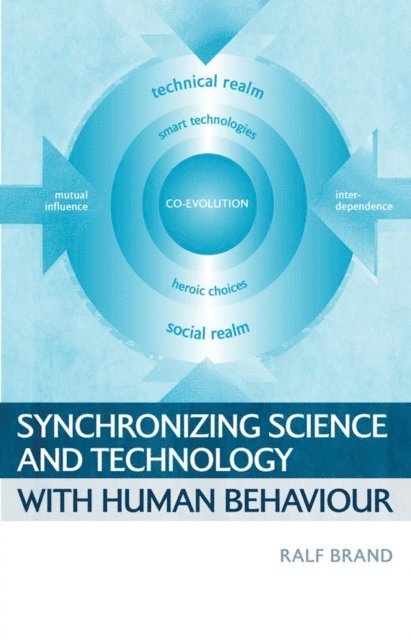
�A rare achievement, one of the first books to link technological and behavioural change to the sustainability agenda� Charles Landry, author of The Creative City�Any course interested in sustainable development in practice would benefit from the case studies here� Dr Adrian Smith, SPRU Science and Technology Policy Research Unit, University of Sussex, UKTwo disjointed voices can be identified in the prevailing sustainability discourse: one technology-focused, the other favouring behavioural solutions. This new, practical text bridges the gap in a 'co-evolutionary' framework, enabling more sustainable policies and projects to be developed.Arguing that technical and social realms are much more connected than most people concerned with sustainability tend to admit, the author has developed an innovative and integrated strategy that encourages planners, architects and politicians to work with end-users in 'co-designing' technologies and infrastructures that make socially desired behaviours more attractive. Having explained the nature of the problem, the author outlines key concepts and shared characteristics of co-evolutionary projects and anticipates possible criticisms. Through detailed analysis and diverse case studies, the reader is presented with a clear picture of a more holistic approach to planning sustainable cities and regions, which will be invaluable for students and professionals alike.This will be an invaluable textbook and planning tool suitable for students of science and technology studies (STS), regional policy and planning, and practitioners including city and regional planners, policy makers and consultants.
246 kr
Skickas inom 10-15 vardagar
Dieses Lehrbuch der Sportpsychologie ist anders als andere: Es liefert einen einführenden Fachüberblick, will aber vor allem Verständnisgrundlagen aufbauen. Vermittelt wird, was das thematisch sehr breitgefasste Fach Sportpsychologie im Innersten zusammenhält. Studierende in sportwissenschaftlichen Studiengängen werden mit grundlegenden Konzepten von Psychologie vertraut gemacht und lernen, sportpsychologische Studienergebnisse einzuordnen. Studierende der Psychologie lernen sportpsychologische Herangehensweisen kennen, die über allgemein psychologische Grundlagenkenntnisse hinausreichen. – Mit zusätzlichen Lern- und Lehrmaterialien im Internet.
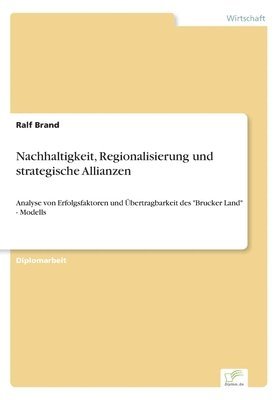
Nachhaltigkeit, Regionalisierung und strategische Allianzen
Analyse von Erfolgsfaktoren und Übertragbarkeit des "Brucker Land" - Modells
Häftad, Tyska, 1999
623 kr
Skickas inom 5-8 vardagar