Ram Ramesh – författare
Visar alla böcker från författaren Ram Ramesh. Handla med fri frakt och snabb leverans.
4 produkter
4 produkter
E-bok
Engelska, 2000196 kr
Läs direkt efter köp
Financial Analyst’s Indispensable Pocketguide is the first reference to give the more than 20,000 candidates who take AIMR-administered CFA exams annually—and the 60,000-plus CFAs and finance professionals who currently practice investment management—a single broad-based resource for specific terminology and information. Much more than just a dictionary, this dynamic book explains and expands upon the fundamental concepts that comprise a financial analyst’s lexicon.Within each section, Ramesh arranges fundamental terms alphabetically, then provides CFA-related tips and profiles of industry leaders. Key topics include:*Timeless tips for CFA candidates and practitioners*Graphics and mnemonics to help with important concepts*Derivatives, equity valuation, and portfolio management
Inbunden, Engelska, 2006
3 330 kr
Skickas inom 10-15 vardagar
Ontology, or the nature of being, has been a focal area of study in the philosophical disciplines for a long time. Interpreted simply, the term ontology refers to the question “what kinds of things exist?” to a philosopher, while a computer scientist grapples with the question “what kinds of things should we capture and represent?” Together, research on the two questions yield a broad framework for the analysis of a discourse universe, its representation in some abstract form and the development of organizations and systems within the universe. The philosophical perspective on ontology provides a description of the essential properties and relations of all beings in the universe, while this notion has been expanded as well as specialized in the fields of computer science and artificial intelligence. The AI/CS communities now use this notion to refer to not one but multiple ontologies. In the AI/CS perspective, an ontology refers to the specification of knowledge about entities, and their relationships and interactions in a bounded universe of discourse only. As a result, a number of bounded-universe ontologies have been created over the last decade. These include the Chemicals ontology in the chemistry area, the TOVE and Enterprise ontologies for enterprise modeling, the REA ontology in the accounting area, organizational knowledge ontology in the knowledge management area, an ontology of air campaign planning in the defense area, and the GALEN ontology in the medical informatics area.
E-bok
PDF, Engelska, 20073 137 kr
Läs direkt efter köp
Ontology, or the nature of being, has been a focal area of study in the philosophical disciplines for a long time. Interpreted simply, the term ontology refers to the question “what kinds of things exist?” to a philosopher, while a computer scientist grapples with the question “what kinds of things should we capture and represent?” Together, research on the two questions yield a broad framework for the analysis of a discourse universe, its representation in some abstract form and the development of organizations and systems within the universe. The philosophical perspective on ontology provides a description of the essential properties and relations of all beings in the universe, while this notion has been expanded as well as specialized in the fields of computer science and artificial intelligence. The AI/CS communities now use this notion to refer to not one but multiple ontologies. In the AI/CS perspective, an ontology refers to the specification of knowledge about entities, and their relationships and interactions in a bounded universe of discourse only. As a result, a number of bounded-universe ontologies have been created over the last decade. These include the Chemicals ontology in the chemistry area, the TOVE and Enterprise ontologies for enterprise modeling, the REA ontology in the accounting area, organizational knowledge ontology in the knowledge management area, an ontology of air campaign planning in the defense area, and the GALEN ontology in the medical informatics area.
Del 14 - Integrated Series in Information Systems
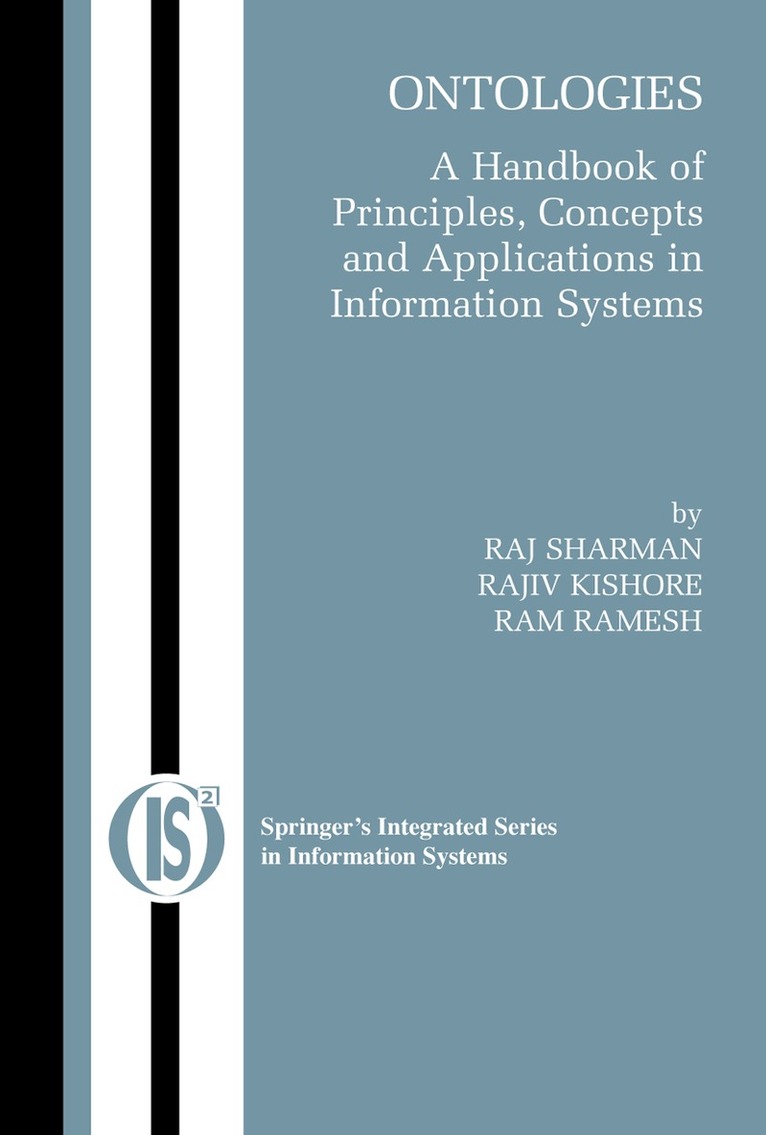
Ontologies
A Handbook of Principles, Concepts and Applications in Information Systems
Häftad, Engelska, 2016
2 433 kr
Skickas inom 10-15 vardagar
Ontology, or the nature of being, has been a focal area of study in the philosophical disciplines for a long time. Interpreted simply, the term ontology refers to the question “what kinds of things exist?” to a philosopher, while a computer scientist grapples with the question “what kinds of things should we capture and represent?” Together, research on the two questions yield a broad framework for the analysis of a discourse universe, its representation in some abstract form and the development of organizations and systems within the universe. The philosophical perspective on ontology provides a description of the essential properties and relations of all beings in the universe, while this notion has been expanded as well as specialized in the fields of computer science and artificial intelligence. The AI/CS communities now use this notion to refer to not one but multiple ontologies. In the AI/CS perspective, an ontology refers to the specification of knowledge about entities, and their relationships and interactions in a bounded universe of discourse only. As a result, a number of bounded-universe ontologies have been created over the last decade. These include the Chemicals ontology in the chemistry area, the TOVE and Enterprise ontologies for enterprise modeling, the REA ontology in the accounting area, organizational knowledge ontology in the knowledge management area, an ontology of air campaign planning in the defense area, and the GALEN ontology in the medical informatics area.