Rathinam Raja – författare
1 667 kr
Skickas inom 10-15 vardagar
1 679 kr
Skickas inom 10-15 vardagar
2 388 kr
Läs direkt efter köp
909 kr
Läs direkt efter köp
Algae for Food: Cultivation, Processing and Nutritional Benefits
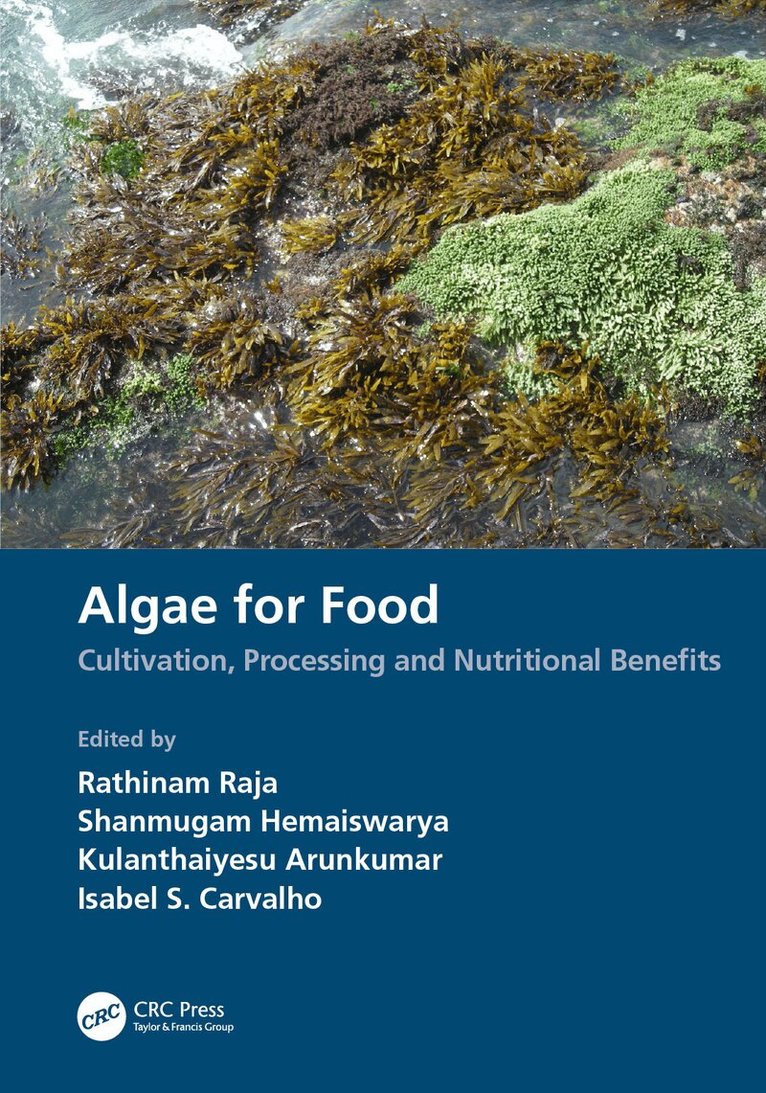
Algae are a primitive, living photosynthetic form and they are the oldest living organism. In the marine ecosystem, algae are the primary producers that supply energy required to a diverse marine organism and especially seaweed provides a habitat for invertebrates and fishes. There have been significant advances in many areas of phycology. This book describes the advances related to food and nutrition of algae achieved during the last decades, it also identifies gaps in the present knowledge and needs for the future. The 17 chapters, grouped into 6 parts, are written by phycologists. More insight on industrial exploitation of algae and their products is supported by current studies and will help academia. The first part explains new technologies to improve the microalgal biomass, strain improvement and different methods of seaweed cultivation. In the second part, food and nutraceutical applications of algae, food safety aspects, green nanotechnology and formulation methods for the extraction and isolation of algal functional foods are described. The third part deals with pigments and carotenoids while the fourth part exploits the isolation and application of hydrocolloids, nutritional implications of algal polysaccharides and the characterization and bioactivity of fucoidans. In the fifth part, the biomedical potential of seaweed followed by agricultural applications of algae are well described. The book is an important resource for scholars that provides knowledge on wide range of topics.
Key Features
Covers important fields of algae from biomass production to genetic engineering aspects of algae Useful in the field of algal biotechnology, aquaculture, marine micro and macrobiology, microbial biotechnology and bioprocess technology
Focuses on the therapeutic and nutritional areas of algae
917 kr
Läs direkt efter köp
Algae for Food: Cultivation, Processing and Nutritional Benefits
Algae are a primitive, living photosynthetic form and they are the oldest living organism. In the marine ecosystem, algae are the primary producers that supply energy required to a diverse marine organism and especially seaweed provides a habitat for invertebrates and fishes. There have been significant advances in many areas of phycology. This book describes the advances related to food and nutrition of algae achieved during the last decades, it also identifies gaps in the present knowledge and needs for the future. The 17 chapters, grouped into 6 parts, are written by phycologists. More insight on industrial exploitation of algae and their products is supported by current studies and will help academia. The first part explains new technologies to improve the microalgal biomass, strain improvement and different methods of seaweed cultivation. In the second part, food and nutraceutical applications of algae, food safety aspects, green nanotechnology and formulation methods for the extraction and isolation of algal functional foods are described. The third part deals with pigments and carotenoids while the fourth part exploits the isolation and application of hydrocolloids, nutritional implications of algal polysaccharides and the characterization and bioactivity of fucoidans. In the fifth part, the biomedical potential of seaweed followed by agricultural applications of algae are well described. The book is an important resource for scholars that provides knowledge on wide range of topics.
Key Features
Covers important fields of algae from biomass production to genetic engineering aspects of algae Useful in the field of algal biotechnology, aquaculture, marine micro and macrobiology, microbial biotechnology and bioprocess technology
Focuses on the therapeutic and nutritional areas of algae
2 358 kr
Skickas inom 10-15 vardagar
848 kr
Skickas inom 10-15 vardagar
886 kr
Läs direkt efter köp
Biobased biodegradable polymers are emerging as an alternative to fossil fuel-based plastics. Biodegradable Polymers, Blends and Biocomposites: Trends and Applications discusses trends in the development of microbial/other renewable source-based bioplastic products, their blends and biocomposites applications in various industrial fields. It covers biodegradable polymeric materials preparation, extraction, formulation, modification of properties, product development and applications and end-of-life options. Furthermore, the book discusses topics like bioplastic resources, isolation procedures, utilization at commercial level and markets and economy.
Features:
Explains emerging application possibilities of biobased biodegradable polymers. Provides detailed application notes on agricultural waste-based bioplastics. Covers microbial and agro-based biocomposites and their applications. Summarizes bioplastic degradation and blending research. Discusses application possibilities of biobased biodegradable polymers.The book is aimed at researchers and graduate students in polymers and composites.
Chapters 5, 6 and 11 of this book are freely available as a downloadable Open Access PDF at http://www.taylorfrancis.com under a Creative Commons [Attribution-Non Commercial-No Derivatives (CC-BY-NC-ND)] 4.0 license.
886 kr
Läs direkt efter köp
Biobased biodegradable polymers are emerging as an alternative to fossil fuel-based plastics. Biodegradable Polymers, Blends and Biocomposites: Trends and Applications discusses trends in the development of microbial/other renewable source-based bioplastic products, their blends and biocomposites applications in various industrial fields. It covers biodegradable polymeric materials preparation, extraction, formulation, modification of properties, product development and applications and end-of-life options. Furthermore, the book discusses topics like bioplastic resources, isolation procedures, utilization at commercial level and markets and economy.
Features:
Explains emerging application possibilities of biobased biodegradable polymers. Provides detailed application notes on agricultural waste-based bioplastics. Covers microbial and agro-based biocomposites and their applications. Summarizes bioplastic degradation and blending research. Discusses application possibilities of biobased biodegradable polymers.The book is aimed at researchers and graduate students in polymers and composites.
Chapters 5, 6 and 11 of this book are freely available as a downloadable Open Access PDF at http://www.taylorfrancis.com under a Creative Commons [Attribution-Non Commercial-No Derivatives (CC-BY-NC-ND)] 4.0 license.
2 202 kr
Skickas inom 10-15 vardagar
2 822 kr
Läs direkt efter köp
1 983 kr
Skickas inom 10-15 vardagar
2 465 kr
Läs direkt efter köp
This book offers a comprehensive analysis of microalgal cultivation methods and optimization of astaxanthin production for various applications, including clinical uses, algae polymers, proteins and pigments, food applications and packaging, algae forming, cosmetics, and more.
Microalgae are unicellular living forms and are the primary producers that play a major role in the ecosystem. Commercially, while many documents are available, some recent fields are yet to be explored. The book comprises 19 chapters contributed by experts and reviews the recent developments in the cultivation, harvest, and genetic engineering of H. pluvialis-derived astaxanthin. It also discusses their bottlenecks and challenges in commercial-scale production, as well as current and prospective global market. Current research supports the exploration of new topics and practical applications of microalgae and their products, which will also benefit academia.
The book will be an importantresource for researchers and industry, providing comprehensive knowledge on broad topics. Flow charts, updated methods, and colour images are included to help the readers'' understanding.
625 kr
Skickas inom 5-8 vardagar
1 925 kr
Skickas inom 10-15 vardagar