Raymond J. Seeger – författare
Visar alla böcker från författaren Raymond J. Seeger. Handla med fri frakt och snabb leverans.
8 produkter
8 produkter
E-bok
PDF, Engelska, 2013783 kr
Läs direkt efter köp
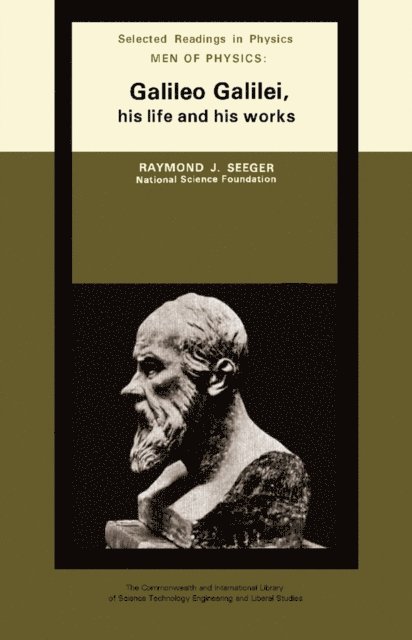
Men of Physics: Galileo Galilei, His Life and His Works deals with Galileo Galilei''s radical discoveries and trail during the Inquisition. The book describes the life of Galileo and his many interests in art and music, in addition to science. Galileo is born in Pisa in 1564, and at age 25, he is appointed to the Chair of Mathematics at the University of Pisa. He writes several papers, for example, mathematical continuum as contrasted with physical atomism, and investigates the behavior of magnetic poles. He believes in William Gilbert''s experiment that the earth itself is a large magnet. He conducts experiments on oscillations — using a simple pendulum to investigate complex phenomena. He defines uniform motion, with respect to time intervals, whether these are great or small. He suggests a method to measure the speed of light, believing that light has a definite speed. He contributes to knowledge on sunspots, constructs his own telescopes, and is considered by some as the inventor of the telescope. He publishes ""The Two Chief World Systems,"" comparing the Ptolemaic and Copernican theories of the solar system and claiming that the earth moves and the sun stands still. For this, the Inquisition orders him to stand trial. He confesses, abjures, and lives under house arrest. In 1639, he refuses an offer of freedom by the Pope. Galileo dies in 1642. He is known as the founder of modern physics. Students of history and most readers with general interest will find this book entertaining and informative.
E-bok
PDF, Engelska, 2016832 kr
Läs direkt efter köp
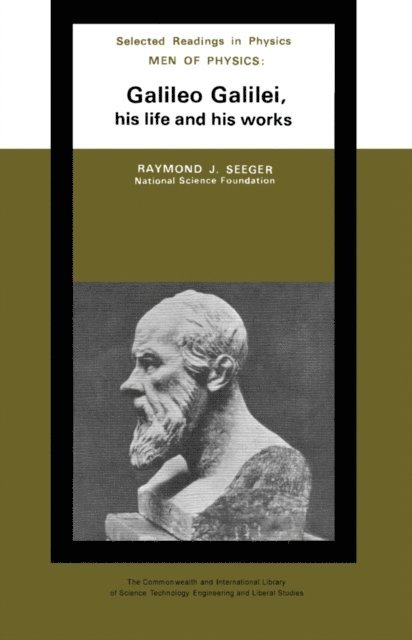
Galileo Galilei, His Life and His Works is a biographic of Galileo Galilei. The text accounts some of the most important moments of Galileo''s life, along with his contribution in physics. The first part of the text covers the major aspects of Galileo''s. Part I details Galileo''s life as a student, professor, courtier, and author. Part II covers the major works of Galileo, such as magnetism, weight of air, alloy analysis, materials strength, falling bodies, and natural oscillations. The book will be of great interest to readers who have a keen interest in the history of physics.
Del 6 - Boston Studies in the Philosophy and History of Science
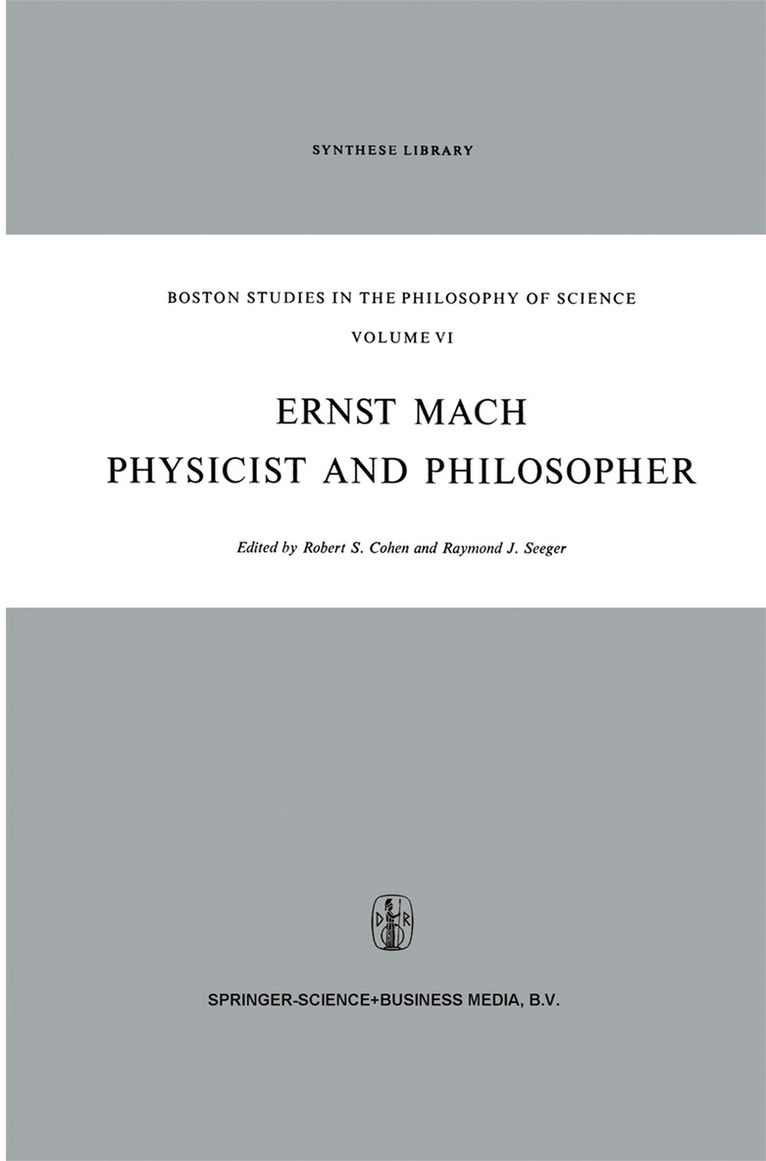
Ernst Mach: Physicist and Philosopher
Inbunden, Engelska, 1975
1 849 kr
Skickas inom 10-15 vardagar
At the annual meeting of the American Association for the Advancement of Science in Washington, D.C., 27 December 1966, a symposium was held to commemorate the 50th anniversary of the death of Ernst Mach, the physicist who was vitally concerned about philosophical foundations. It was arranged by Section B on Physics, and co-sponsored by Section L on the History and Philosophy of Science, as well as by the History of Science Society. Dr. Allen W. Astin, Vice-President of the Association and Director of the National Bureau of Standards, presided. Representing the Austrian ambassador, Dr. Ernst Lemberger, a few opening remarks on his behalf were made by Dr. Walter Hietsch. Also present was Dr. Ernest A. Lederer, a grandson of Ernst Mach. The contributors, to the symposium, mostly physicists, represented different backgrounds and differing points of view; they presented their review of Mach's work primarily in the light of subsequent developments. They all, however, share a common interest in the life and works of Ernst Mach. Two of them, Otto BlUh and Peter G. Bergmann, received their doctoral degrees in theoretical physics from the University of Prague. Karl Menger received his doctoral degree in mathematics from the University of Vienna (he is responsible for the latest edition [1960] of Mach's celebrated The Science of Mechanics: A Critical and Historical Account of its Development, for which he prepared a new Introduction).
Del 11 - Boston Studies in the Philosophy and History of Science
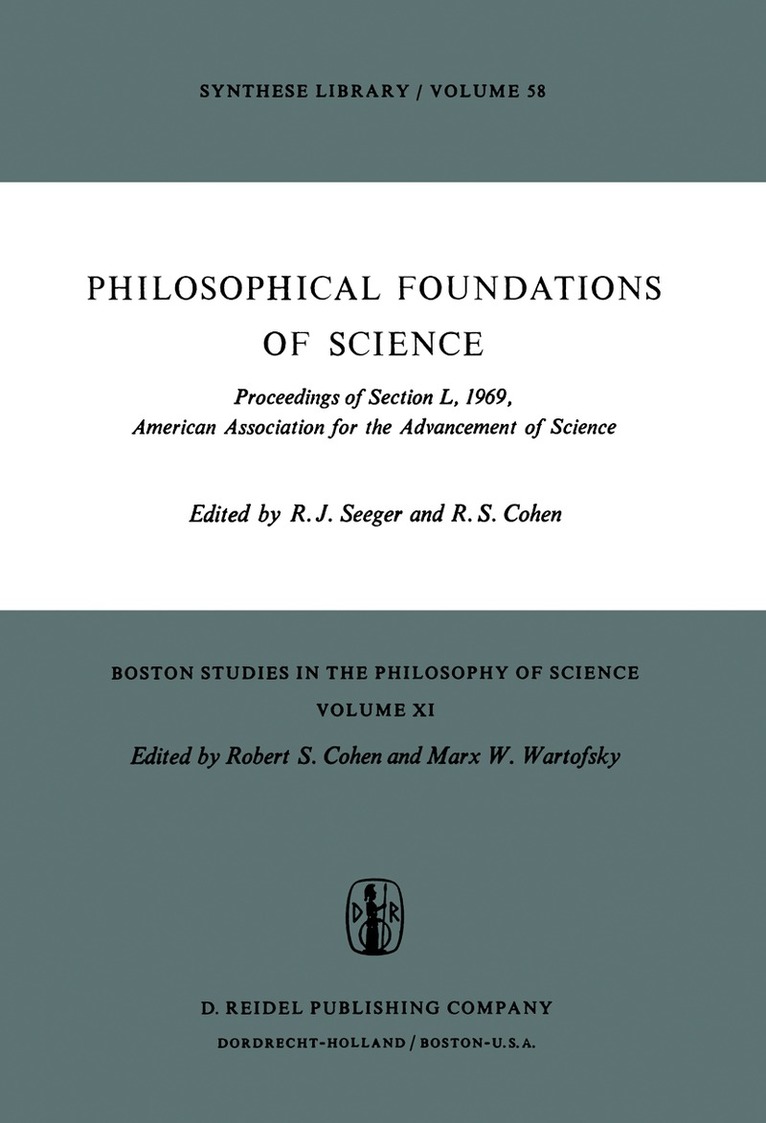
Philosophical Foundations of Science
Proceedings of Section L, 1969, American Association for the Advancement of Science
Häftad, Engelska, 1974
2 174 kr
Skickas inom 10-15 vardagar
At the 1969 annual meeting of the American Association for the Ad vancement ofScience, held in Boston on December 27-29, a sequence of symposia on the philosophical foundations of science was organized jointly by Section L of the Association and the Boston Colloquium for the Philosophy of Science. Section L is devoted to the history, philos ophy, logic and sociology of science, with broad connotations extended both to 'science' and to 'philosophy'. With collaboration generously extended by other and more specialized Sections of the AAAS, the Section L program took an unusually rich range of topics, and indeed the audiences were large, and the discussions lively. This book, regrettably delayed in publication, contains the major papers from those symposia of 1969. In addition, it contains the distin guished George Sarton Memorial Lecture of that meeting, 'Boltzmann, Monocycles and Mechanical Explanation' by Martin J. Klein. Some additions and omissions should be noted: In Part 1, dedicated to the 450th anniversary of the birth of Leonardo da Vinci, we have been una bie to include a contrihution by Elmer Belt who was prevented by storms from participating. In Part II, on physics and the explanation of life, we were unable to persuade Isaac Asimov to overcome his modesty about the historical remarks he made under the title 'Arrhenius Revisited'.
Inbunden, Engelska, 1974
2 174 kr
Skickas inom 10-15 vardagar
At the 1969 annual meeting of the American Association for the Ad vancement ofScience, held in Boston on December 27-29, a sequence of symposia on the philosophical foundations of science was organized jointly by Section L of the Association and the Boston Colloquium for the Philosophy of Science. Section L is devoted to the history, philos ophy, logic and sociology of science, with broad connotations extended both to 'science' and to 'philosophy'. With collaboration generously extended by other and more specialized Sections of the AAAS, the Section L program took an unusually rich range of topics, and indeed the audiences were large, and the discussions lively. This book, regrettably delayed in publication, contains the major papers from those symposia of 1969. In addition, it contains the distin guished George Sarton Memorial Lecture of that meeting, 'Boltzmann, Monocycles and Mechanical Explanation' by Martin J. Klein. Some additions and omissions should be noted: In Part 1, dedicated to the 450th anniversary of the birth of Leonardo da Vinci, we have been una bie to include a contrihution by Elmer Belt who was prevented by storms from participating. In Part II, on physics and the explanation of life, we were unable to persuade Isaac Asimov to overcome his modesty about the historical remarks he made under the title 'Arrhenius Revisited'.
Del 6 - Boston Studies in the Philosophy and History of Science
Ernst Mach: Physicist and Philosopher
Häftad, Engelska, 2010
1 849 kr
Skickas inom 10-15 vardagar
At the annual meeting of the American Association for the Advancement of Science in Washington, D.C., 27 December 1966, a symposium was held to commemorate the 50th anniversary of the death of Ernst Mach, the physicist who was vitally concerned about philosophical foundations. It was arranged by Section B on Physics, and co-sponsored by Section L on the History and Philosophy of Science, as well as by the History of Science Society. Dr. Allen W. Astin, Vice-President of the Association and Director of the National Bureau of Standards, presided. Representing the Austrian ambassador, Dr. Ernst Lemberger, a few opening remarks on his behalf were made by Dr. Walter Hietsch. Also present was Dr. Ernest A. Lederer, a grandson of Ernst Mach. The contributors, to the symposium, mostly physicists, represented different backgrounds and differing points of view; they presented their review of Mach's work primarily in the light of subsequent developments. They all, however, share a common interest in the life and works of Ernst Mach. Two of them, Otto BlUh and Peter G. Bergmann, received their doctoral degrees in theoretical physics from the University of Prague. Karl Menger received his doctoral degree in mathematics from the University of Vienna (he is responsible for the latest edition [1960] of Mach's celebrated The Science of Mechanics: A Critical and Historical Account of its Development, for which he prepared a new Introduction).
E-bok
PDF, Engelska, 20122 840 kr
Läs direkt efter köp
At the 1969 annual meeting of the American Association for the Ad vancement ofScience, held in Boston on December 27-29, a sequence of symposia on the philosophical foundations of science was organized jointly by Section L of the Association and the Boston Colloquium for the Philosophy of Science. Section L is devoted to the history, philos ophy, logic and sociology of science, with broad connotations extended both to ''science'' and to ''philosophy''. With collaboration generously extended by other and more specialized Sections of the AAAS, the Section L program took an unusually rich range of topics, and indeed the audiences were large, and the discussions lively. This book, regrettably delayed in publication, contains the major papers from those symposia of 1969. In addition, it contains the distin guished George Sarton Memorial Lecture of that meeting, ''Boltzmann, Monocycles and Mechanical Explanation'' by Martin J. Klein. Some additions and omissions should be noted: In Part 1, dedicated to the 450th anniversary of the birth of Leonardo da Vinci, we have been una bie to include a contrihution by Elmer Belt who was prevented by storms from participating. In Part II, on physics and the explanation of life, we were unable to persuade Isaac Asimov to overcome his modesty about the historical remarks he made under the title ''Arrhenius Revisited''.
E-bok
PDF, Engelska, 20132 283 kr
Läs direkt efter köp
At the annual meeting of the American Association for the Advancement of Science in Washington, D.C., 27 December 1966, a symposium was held to commemorate the 50th anniversary of the death of Ernst Mach, the physicist who was vitally concerned about philosophical foundations. It was arranged by Section B on Physics, and co-sponsored by Section L on the History and Philosophy of Science, as well as by the History of Science Society. Dr. Allen W. Astin, Vice-President of the Association and Director of the National Bureau of Standards, presided. Representing the Austrian ambassador, Dr. Ernst Lemberger, a few opening remarks on his behalf were made by Dr. Walter Hietsch. Also present was Dr. Ernest A. Lederer, a grandson of Ernst Mach. The contributors, to the symposium, mostly physicists, represented different backgrounds and differing points of view; they presented their review of Mach''s work primarily in the light of subsequent developments. They all, however, share a common interest in the life and works of Ernst Mach. Two of them, Otto BlUh and Peter G. Bergmann, received their doctoral degrees in theoretical physics from the University of Prague. Karl Menger received his doctoral degree in mathematics from the University of Vienna (he is responsible for the latest edition [1960] of Mach''s celebrated The Science of Mechanics: A Critical and Historical Account of its Development, for which he prepared a new Introduction).