Rebecca Bednarek – författare
Visar alla böcker från författaren Rebecca Bednarek. Handla med fri frakt och snabb leverans.
12 produkter
12 produkter
E-bok
PDF, Engelska, 2015253 kr
Läs direkt efter köp
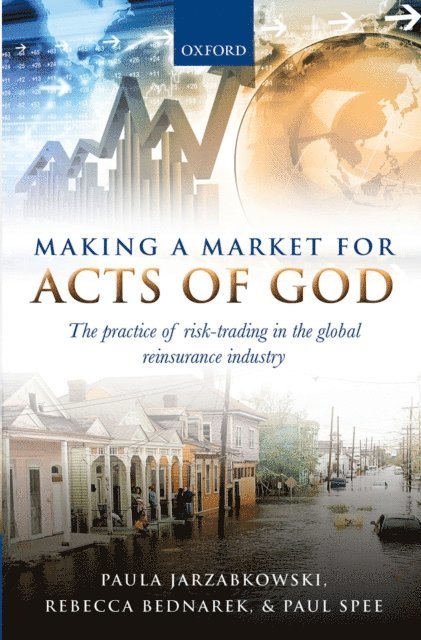
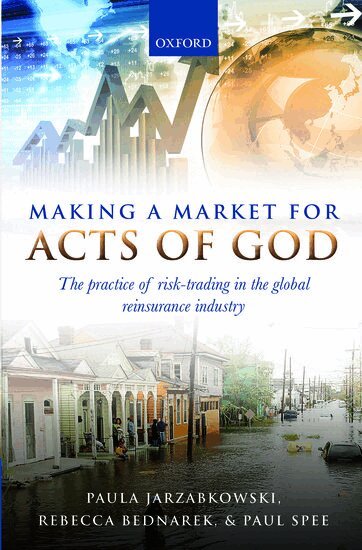
Reinsurance is a financial market that trades in the risk of unpredictable and devastating disasters - such as Hurricane Katrina, the Tohoku earthquake and tsunami, and the terrorist attacks on the World Trade Centre. Such disasters are increasing in both frequency and severity, with the cost of their losses mounting rapidly. Reinsurance insures insurance companies, enabling them to pay claims arising from these losses. It is thus a market mechanism that is acritical part of the social and economic safety net, helping to pick up the pieces after disasters. Yet, how is the risk of such disasters calculated and traded in a global market?This book brings to life the reinsurance market through vivid real-life tales that draw from an ethnographic, "fly-on-the-wall" study of the global reinsurance industry over three annual cycles. The authors shadowed underwriters around the world as they traded risks through multiple disasters. For instance, this book takes readers into the desperate hours of pricing Japanese risks during March 2011, while the devastating aftermath of the Tohoku earthquake is unfolding. To show how the marketworks, the book offers authentic tales gathered from observations of reinsurers in Bermuda, Lloyd''s of London, Continental Europe and SE Asia as they evaluate, price and compete for different risks as part of their everyday practice.Understanding how this market for disasters works has never been more critical given the impact of climate change and increased global connectivity, where a flood in one country can trigger losses to supply chains around the world. The authors develop a novel concept of how global markets work, which advances scholarship and challenges current thinking about how financial markets trade in intangible assets such as risk.This book will be useful to readers interested in markets for disasters, insurance, reinsurance and financial markets, and academics interested in the practice of financial markets specifically or the practice of strategy and organizations generally.
E-bok
PDF, Engelska, 2023416 kr
Läs direkt efter köp
This is an open access title available under the terms of a CC BY-NC-ND 4.0 International licence. It is free to read at Oxford Academic and offered as a free PDF download from OUP and selected open access locations.This book examines the growing role and importance of ''Protection Gap Entities'' (PGEs), not-for-profit entities providing insurance protection that would otherwise be unavailable within a purely private sector context. Around the world, PGEs and the insurance instruments they use are becoming increasingly crucial in making sure that funds are available to rebuild after disasters. These PGEs, typically developed as collaborations between governments and the insurance industry, enable insurance to continue at a time when climate change, urbanization, global interdependence, and geo-political instability are making disaster insurance increasingly expensive or unavailable. Given their growing importance, understanding the role of PGEs in both insurance protection and their potential to create a more resilient society is critical. Disaster Insurance Reimagined uses practical examples from different countries to explain how PGEs step in to maintain disaster insurance and how their work can, but does not always, improve financial and physical resilience to disaster. Drawing on 5 years of research into 17 entities that provide insurance cover in 49 countries, the authors examine the strengths, limitations, and evolution of PGEs in providing disaster protection in the face of a growing insurance crisis. They provide an accessible discussion of disaster insurance, its complexities, and the transformation it needs to undergo in order to remain relevant and to contribute to meaningful disaster protection. PGEs and their work offer a path to re-imagining disaster insurance as a key tool in an ecosystem that has societal protection from disaster at its heart.
E-bok
Engelska, 2023367 kr
Läs direkt efter köp
This is an open access title available under the terms of a CC BY-NC-ND 4.0 International licence. It is free to read at Oxford Academic and offered as a free PDF download from OUP and selected open access locations.This book examines the growing role and importance of ''Protection Gap Entities'' (PGEs), not-for-profit entities providing insurance protection that would otherwise be unavailable within a purely private sector context. Around the world, PGEs and the insurance instruments they use are becoming increasingly crucial in making sure that funds are available to rebuild after disasters. These PGEs, typically developed as collaborations between governments and the insurance industry, enable insurance to continue at a time when climate change, urbanization, global interdependence, and geo-political instability are making disaster insurance increasingly expensive or unavailable. Given their growing importance, understanding the role of PGEs in both insurance protection and their potential to create a more resilient society is critical. Disaster Insurance Reimagined uses practical examples from different countries to explain how PGEs step in to maintain disaster insurance and how their work can, but does not always, improve financial and physical resilience to disaster. Drawing on 5 years of research into 17 entities that provide insurance cover in 49 countries, the authors examine the strengths, limitations, and evolution of PGEs in providing disaster protection in the face of a growing insurance crisis. They provide an accessible discussion of disaster insurance, its complexities, and the transformation it needs to undergo in order to remain relevant and to contribute to meaningful disaster protection. PGEs and their work offer a path to re-imagining disaster insurance as a key tool in an ecosystem that has societal protection from disaster at its heart.
Inbunden, Engelska, 2023
497 kr
Skickas inom 5-8 vardagar
This is an open access title available under the terms of a CC BY-NC-ND 4.0 International licence. It is free to read at Oxford Academic and offered as a free PDF download from OUP and selected open access locations.This book examines the growing role and importance of 'Protection Gap Entities' (PGEs), not-for-profit entities providing insurance protection that would otherwise be unavailable within a purely private sector context. Around the world, PGEs and the insurance instruments they use are becoming increasingly crucial in making sure that funds are available to rebuild after disasters. These PGEs, typically developed as collaborations between governments and the insurance industry, enable insurance to continue at a time when climate change, urbanization, global interdependence, and geo-political instability are making disaster insurance increasingly expensive or unavailable. Given their growing importance, understanding the role of PGEs in both insurance protection and their potential to create a more resilient society is critical. Disaster Insurance Reimagined uses practical examples from different countries to explain how PGEs step in to maintain disaster insurance and how their work can, but does not always, improve financial and physical resilience to disaster. Drawing on 5 years of research into 17 entities that provide insurance cover in 49 countries, the authors examine the strengths, limitations, and evolution of PGEs in providing disaster protection in the face of a growing insurance crisis. They provide an accessible discussion of disaster insurance, its complexities, and the transformation it needs to undergo in order to remain relevant and to contribute to meaningful disaster protection. PGEs and their work offer a path to re-imagining disaster insurance as a key tool in an ecosystem that has societal protection from disaster at its heart.
Häftad, Engelska, 2017
361 kr
Skickas inom 5-8 vardagar
Reinsurance is a financial market that trades in the risk of unpredictable and devastating disasters - such as Hurricane Katrina, the Tohoku earthquake and tsunami, and the terrorist attacks on the World Trade Centre. Such disasters are increasing in both frequency and severity, with the cost of their losses mounting rapidly. Reinsurance insures insurance companies, enabling them to pay claims arising from these losses. It is thus a market mechanism that is a critical part of the social and economic safety net, helping to pick up the pieces after disasters. Yet, how is the risk of such disasters calculated and traded in a global market? This book brings to life the reinsurance market through vivid real-life tales that draw from an ethnographic, "fly-on-the-wall" study of the global reinsurance industry over three annual cycles. The authors shadowed underwriters around the world as they traded risks through multiple disasters. For instance, this book takes readers into the desperate hours of pricing Japanese risks during March 2011, while the devastating aftermath of the Tohoku earthquake is unfolding. To show how the market works, the book offers authentic tales gathered from observations of reinsurers in Bermuda, Lloyd's of London, Continental Europe and SE Asia as they evaluate, price and compete for different risks as part of their everyday practice. Understanding how this market for disasters works has never been more critical given the impact of climate change and increased global connectivity, where a flood in one country can trigger losses to supply chains around the world. The authors develop a novel concept of how global markets work, which advances scholarship and challenges current thinking about how financial markets trade in intangible assets such as risk. This book will be useful to readers interested in markets for disasters, insurance, reinsurance and financial markets, and academics interested in the practice of financial markets specifically or the practice of strategy and organizations generally.
Inbunden, Engelska, 2015
1 043 kr
Skickas inom 3-6 vardagar
Reinsurance is a financial market that trades in the risk of unpredictable and devastating disasters - such as Hurricane Katrina, the Tohoku earthquake and tsunami, and the terrorist attacks on the World Trade Centre. Such disasters are increasing in both frequency and severity, with the cost of their losses mounting rapidly. Reinsurance insures insurance companies, enabling them to pay claims arising from these losses. It is thus a market mechanism that is a critical part of the social and economic safety net, helping to pick up the pieces after disasters. Yet, how is the risk of such disasters calculated and traded in a global market? This book brings to life the reinsurance market through vivid real-life tales that draw from an ethnographic, "fly-on-the-wall" study of the global reinsurance industry over three annual cycles. The authors shadowed underwriters around the world as they traded risks through multiple disasters. For instance, this book takes readers into the desperate hours of pricing Japanese risks during March 2011, while the devastating aftermath of the Tohoku earthquake is unfolding. To show how the market works, the book offers authentic tales gathered from observations of reinsurers in Bermuda, Lloyd's of London, Continental Europe and SE Asia as they evaluate, price and compete for different risks as part of their everyday practice. Understanding how this market for disasters works has never been more critical given the impact of climate change and increased global connectivity, where a flood in one country can trigger losses to supply chains around the world. The authors develop a novel concept of how global markets work, which advances scholarship and challenges current thinking about how financial markets trade in intangible assets such as risk. This book will be useful to readers interested in markets for disasters, insurance, reinsurance and financial markets, and academics interested in the practice of financial markets specifically or the practice of strategy and organizations generally.
E-bok
Engelska, 20211 131 kr
Läs direkt efter köp
Interdisciplinary Dialogues on Organizational Paradox is an innovative two-part volume that enriches our understanding about paradox; both deepening the theory and offering greater insight to address the grand challenges we face in the world today. Authors demonstrate how paradox theory benefits from interdisciplinary theorizing by reaching out to disciplines beyond organizational theory and exploring best practice in undertaking such research.The 13 chapters in this double volume draw from four disciplinary realms: beliefs, physicality, expression, and social structure. Unique commentaries from thought leaders expand and assess the focal pieces of each volume.Part A: Learning from Belief and Science, explores the realms of beliefs - from Ubuntu, Ying-Yang, Christian and Islamic philosophies - and physicality - from quantum mechanics, technology, to ecology - with reflective commentaries from Jean M. Bartunek and Mary Frohlich, and Andrew Van de Ven.
E-bok
PDF, Engelska, 20211 141 kr
Läs direkt efter köp
Interdisciplinary Dialogues on Organizational Paradox is an innovative two-part volume that enriches our understanding about paradox; both deepening the theory and offering greater insight to address the grand challenges we face in the world today. Authors demonstrate how paradox theory benefits from interdisciplinary theorizing by reaching out to disciplines beyond organizational theory and exploring best practice in undertaking such research.The 13 chapters in this double volume draw from four disciplinary realms: beliefs, physicality, expression, and social structure. Unique commentaries from thought leaders expand and assess the focal pieces of each volume.Part A: Learning from Belief and Science, explores the realms of beliefs - from Ubuntu, Ying-Yang, Christian and Islamic philosophies - and physicality - from quantum mechanics, technology, to ecology - with reflective commentaries from Jean M. Bartunek and Mary Frohlich, and Andrew Van de Ven.
Inbunden, Engelska, 2021
1 082 kr
Skickas inom 5-8 vardagar
Interdisciplinary Dialogues on Organizational Paradox is an innovative two-part volume that enriches our understanding about paradox; both deepening the theory and offering greater insight to address the grand challenges we face in the world today. Authors demonstrate how paradox theory benefits from interdisciplinary theorizing by reaching out to disciplines beyond organizational theory and exploring best practice in undertaking such research.The 13 chapters in this double volume draw from four disciplinary realms: beliefs, physicality, expression, and social structure. Unique commentaries from thought leaders expand and assess the focal pieces of each volume.Part A: Learning from Belief and Science, explores the realms of beliefs - from Ubuntu, Ying-Yang, Christian and Islamic philosophies - and physicality - from quantum mechanics, technology, to ecology - with reflective commentaries from Jean M. Bartunek and Mary Frohlich, and Andrew Van de Ven.
E-bok
PDF, Engelska, 20211 131 kr
Läs direkt efter köp
Interdisciplinary Dialogues on Organizational Paradox is a two-part volume exploring how paradox theory benefits from interdisciplinary theorizing and how we might go about undertaking such research.The chapters draw from four disciplinary realms: beliefs, physicality, expression, and social structure. Unique commentaries from thought leaders expand and assess the focal pieces of each volume.Part B: Investigating Social Structures and Human Expression continues the exploration of the why, how and where of interdisciplinary research within paradox theory by looking specifically at the realms of social structure - from logic and Luhmann, to historical analysis - and expression - from linguistics, to the maths and poetry of Spencer-Brown, to jazz. The chapters are complemented with reflective commentaries from Charles Hampden-Turner and Ann Langley. The collection ends with an examination of where the interdisciplinary foundations for organizational paradox theory arose via conversations with seminal paradox scholars.
Inbunden, Engelska, 2021
1 082 kr
Skickas inom 5-8 vardagar
Interdisciplinary Dialogues on Organizational Paradox is a two-part volume exploring how paradox theory benefits from interdisciplinary theorizing and how we might go about undertaking such research.The chapters draw from four disciplinary realms: beliefs, physicality, expression, and social structure. Unique commentaries from thought leaders expand and assess the focal pieces of each volume.Part B: Investigating Social Structures and Human Expression continues the exploration of the why, how and where of interdisciplinary research within paradox theory by looking specifically at the realms of social structure - from logic and Luhmann, to historical analysis - and expression - from linguistics, to the maths and poetry of Spencer-Brown, to jazz. The chapters are complemented with reflective commentaries from Charles Hampden-Turner and Ann Langley. The collection ends with an examination of where the interdisciplinary foundations for organizational paradox theory arose via conversations with seminal paradox scholars.
E-bok
Engelska, 20211 131 kr
Läs direkt efter köp
Interdisciplinary Dialogues on Organizational Paradox is a two-part volume exploring how paradox theory benefits from interdisciplinary theorizing and how we might go about undertaking such research.The chapters draw from four disciplinary realms: beliefs, physicality, expression, and social structure. Unique commentaries from thought leaders expand and assess the focal pieces of each volume.Part B: Investigating Social Structures and Human Expression continues the exploration of the why, how and where of interdisciplinary research within paradox theory by looking specifically at the realms of social structure - from logic and Luhmann, to historical analysis - and expression - from linguistics, to the maths and poetry of Spencer-Brown, to jazz. The chapters are complemented with reflective commentaries from Charles Hampden-Turner and Ann Langley. The collection ends with an examination of where the interdisciplinary foundations for organizational paradox theory arose via conversations with seminal paradox scholars.