
Rebecca Hasselbach - Böcker
Visar alla böcker från författaren Rebecca Hasselbach. Handla med fri frakt och snabb leverans.
2 produkter
2 produkter
Del 3 - Oxford Studies in Diachronic and Historical Linguistics
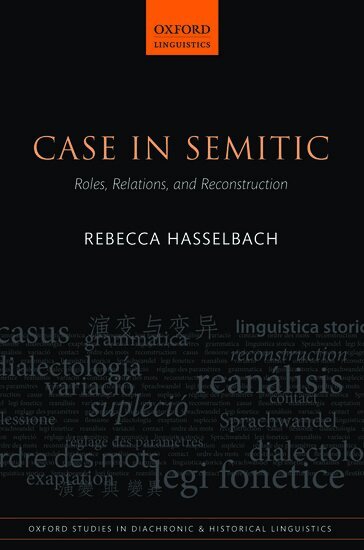
Case in Semitic
Roles, Relations, and Reconstruction
Inbunden, Engelska, 2013
1 576 kr
Skickas inom 5-8 vardagar
This book sets out a new reconstruction for the Semitic case system. It is based on a detailed analysis of the expression of grammatical roles and relations in the attested Semitic languages and, for the first time, brings typological methods to bear in the study of these features in Semitic languages and their reconstruction for proto-Semitic. Professor Hasselbach supports her argument with detailed analyses of a wide range of data and presents it in a way that will be accessible to both Semitists and typologists. The volume is divided into seven chapters: the first discusses basic methodologies used in Semitic linguistics and the limitations thereof. The second presents the evidence for morphological case-marking in the individual Semitic languages, the conventional reconstruction of Proto-Semitic, and the evidence which conflicts with it. The third introduces typological concepts and methods and their deployment in Semitic. Chapter 4 considers the case alignment of early Semitic. Chapter 5 presents a detailed study of marking structures and patterns and considers what these reveal about the nature of the original case system. Chapter 6 looks at the functions of case markers, considers the light they cast on the nominal system, and shows that the reconstruction of early Semitic as ergative is implausible. In the final chapter the author argues that early Semitic had a different nominal system from that of the later Semitic languages. She shows that the course of its development has parallels in other Afroasiatic languages, including Berber and Cushitic. Her book sheds important new light on the history of the Semitic languages and on the early development of the Afro-Asiatic language family as a whole.
Del 67 - Studies in Ancient Oriental Civilization
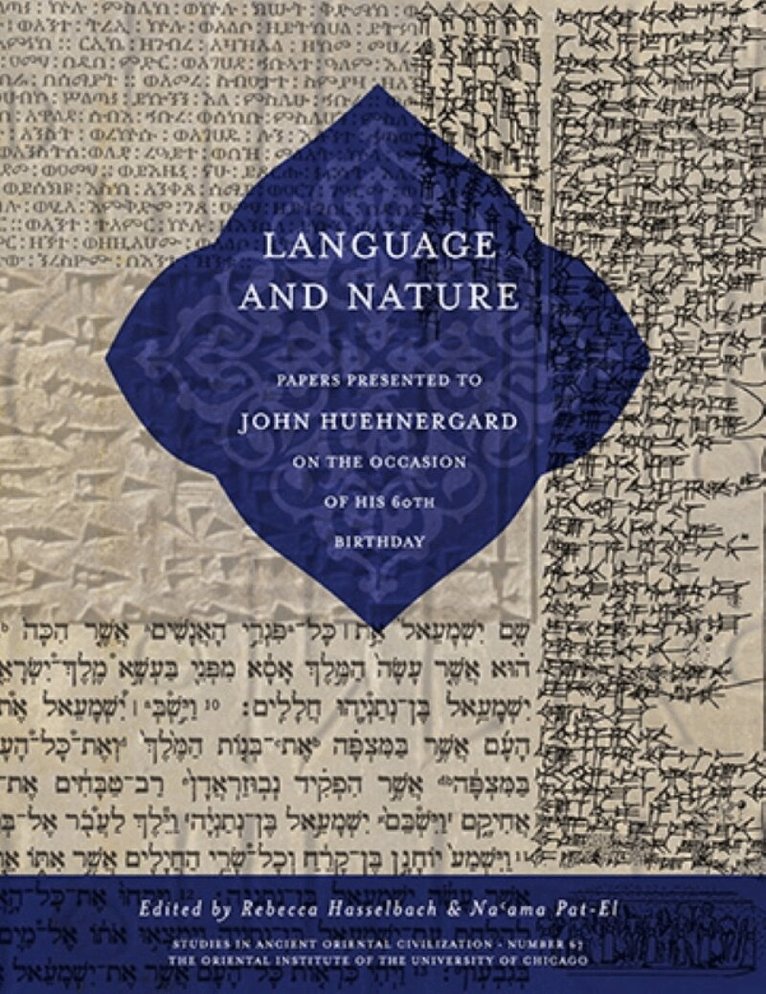
Language and Nature
Papers Presented to John Huehnergard on the Occasion of His 60th Birthday
Häftad, Engelska, 2012
406 kr
Skickas inom 5-8 vardagar
This book includes thirty contributions - twenty-nine papers and one artistic contribution - by John's colleagues, former students, and friends, on a variety of topics that represent John's versatility and many interests, including philology, history, natural history, and art. Many of the papers concentrate on the Akkadian speaking world, reflecting one of the major languages John Huehnergard has worked on throughout the years. Eran Cohen reviews and discusses the functional value of Akkadian iprus in conditional clauses in epistolary and legal texts. Lutz Edzard discusses the Akkadian injunctive umma, used in oath formulae. Daniel Fleming asks who were the 'Apiru people mentioned in Egyptian texts in the Late Bronze Age and what was their social standing as is reflected in the Amarna letters. Shlomo Izre'el offers a revised and improved version of his important study of the language of the Amarna letters. Leonid Kogan offers a comparative etymological study of botanical terminology in Akkadian, while Josef Tropper argues that Akkadian poetry, as well as Northwest Semitic poetry, are based on certain metric principles. Wilfred von Soldt lists and discusses personal names ending in -ayu from Amarna. A number of papers deal with Arabic grammarians and their concepts of language. Gideon Goldenberg discusses the concept of vocalic length in Arabic grammatical tradition and in the medieval Hebrew tradition that was its product. Wolfhart Heinrichs's contribution shows that Ibn Khaldun held innovative views of language and its evolution. Several other papers deal with Hebrew and the Hebrew Bible. Steven Fassberg deals with verbal t-forms that do not exhibit the expected metathesis in Hebrew and Aramaic of the Dead Sea Scrolls. Randall Garr studies one class of denominal hiphil verbs and asks why these verbs are assigned to the causative stem despite their non-causative semantic content. Ed Greenstein suggests that the roots of biblical wisdom can be located in second-millennium Canaanite literature by identifying wisdom sayings and themes in the Ugaritic corpus. Jeremy Hutton sheds more light on tG forms in Biblical Hebrew. Paul Korchin explains occurrences of the cohortative in Biblical Hebrew that do not conform to the normative volitive function. Dennis Pardee provides a detailed study of the Hebrew verbal system as primarily expressing aspect, not tense. Gary A. Rendsburg argues in favor of Late Biblical Hebrew features in the book of Haggai. Four papers deal with linguistic aspects of non-Classical Semitic languages. Charles Häberl looks into predicates of verbless sentences in Semitic and particularly in Neo-Mandaic. Geoffrey Khan discusses the functional differences between the preterite and the perfect in NENA. Aaron D. Rubin provides Semitic etymologies of two Modern South Arabian words. Ofra Tirosh-Becker discusses the language of the Judeo-Arabic translation of the books of Prophets. Papers on comparative Semitics are likewise numerous. Jo Ann Hackett takes another look at Ugaritic yaqtul and argues for the existence of a preterite yaqtul on comparative grounds, among others. Rebecca Hasselbach tackles the evasive origin of the Semitic verbal endings -u and -a. Na'ama Pat-El continues the discussion of the origin of the Hebrew relative particle seC- from a syntactic and comparative perspective. Richard C. Steiner proposes a new vowel syncope rule for Proto Semitic. David Testen argues for a different reconstruction of the Semitic case system. Tamar Zewi shows that prepositional phrases can function as subjects in a variety of Semitic languages. Andrzej Zaborski suggests that Berber and Cushitic preserve archaic features that have been lost for the most part in the Semitic languages. There is one paper on an Indo-European language with important ties to Semitic languages in P. Oktor Skjaervo discussion of the Pahlavi verb *awas 'to dry.' Finally, Richard Walton contributes a paper about the jumping spiders of Concord, Massachusetts, a project he labored on with John Huehnergard. The book is beautifully decorated by the drawings of the artist X Bonnie Woods, who prepared special illustration for this volume, based on cuneiform.