Reiko Mazuka - Böcker
Visar alla böcker från författaren Reiko Mazuka. Handla med fri frakt och snabb leverans.
6 produkter
6 produkter
1 933 kr
Skickas inom 7-10 vardagar
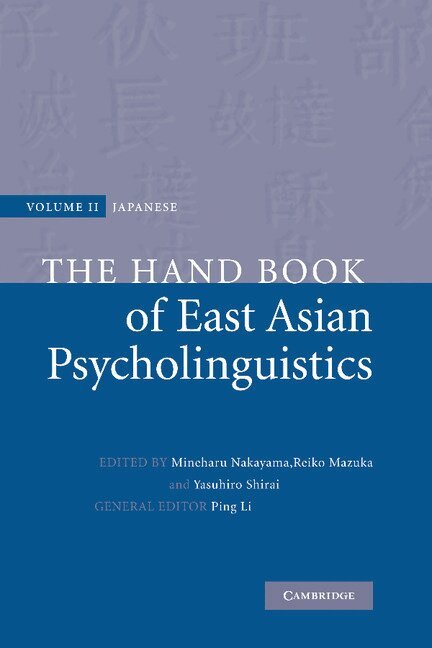
A large body of knowledge has accumulated in recent years on the cognitive processes and brain mechanisms underlying language. Much of this knowledge has come from studies of Indo-European languages, in particular English. Japanese, a language of growing interest to linguists, differs significantly from most Indo-European languages in its grammar, its lexicon, and its written and spoken forms - features which have profound implications for the learning, representation and processing of language. This handbook, the second in a three-volume series on East Asian psycholinguistics, presents a state-of-the-art discussion of the psycholinguistic study of Japanese. With contributions by over fifty leading scholars, it covers topics in first and second language acquisition, language processing and reading, language disorders in children and adults, and the relationships between language, brain, culture, and cognition. It will be invaluable to all scholars and students interested in the Japanese language, as well as cognitive psychologists, linguists, and neuroscientists.
2 150 kr
Skickas inom 10-15 vardagar
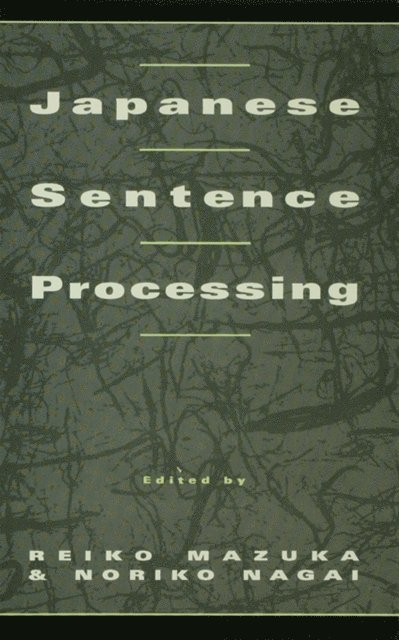
This volume is a direct result of the International Symposium on Japanese Sentence Processing held at Duke University. The symposium provided the first opportunity for researchers in three disciplinary areas from both Japan and the United States to participate in a conference where they could discuss issues concerning Japanese syntactic processing. The goals of the symposium were three-fold:* to illuminate the mechanisms of Japanese sentence processing from the viewpoints of linguistics, psycholinguistics and computer science;* to synthesize findings about the mechanisms of Japanese sentence processing by researchers in these three fields in Japan and the United States;* to lay foundations for future interdisciplinary research in Japanese sentence processing, as well as international collaborations between researchers in Japan and the United States.The chapters in this volume have been written from the points of view of three different disciplines, with various immediate objectives -- from building usable speech understanding systems to investigating the nature of competence grammars for natural languages. All of the papers share the long term goal of understanding the nature of human language processing mechanisms. The book is concerned with two central issues -- the universality of language processing mechanisms, and the nature of the relation between the components of linguistic knowledge and language processing. This volume demonstrates that interdisciplinary research can be fruitful, and provides groundwork for further research in Japanese sentence processing.
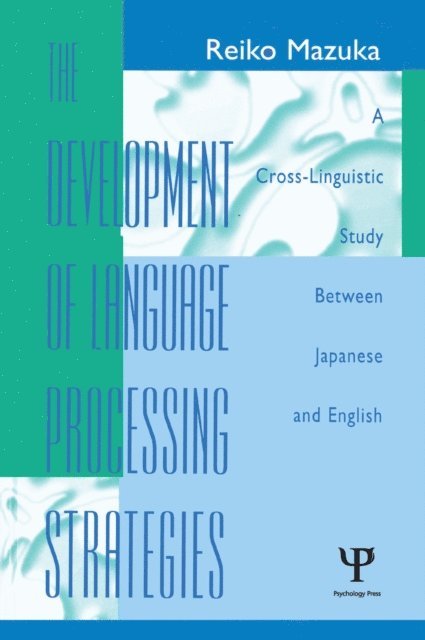
Development of Language Processing Strategies
A Cross-linguistic Study Between Japanese and English
Inbunden, Engelska, 1998
2 029 kr
Skickas inom 10-15 vardagar
Ever since the notion of explanatory adequacy was promoted by Chomsky in his 1965 Aspects, linguists and psycholinguists have been in pursuit of a psychologically valid theory of grammar. To be explanatorily adequate, a theory of grammar can not only describe the general characteristics of a language but can also account for the underlying psychological processes of acquiring and processing that language. To be considered psychologically valid, a grammar must be learnable by ordinary children (the problem of acquisition) and must generate sentences that are parsable by ordinary people (the problem of processing). Ultimately, the fields of language acquisition and processing are concerned with the same goal: to build a theory that accounts for grammar as it is acquired by children; accessed in comprehension and production of speech; and represented within the human mind. Unfortunately, these two fields developed independently and have rarely been well-informed about each other's concerns. Both have experienced past difficulties as a result.Recently, new models have been developed with full consideration to cross-linguistic diversity. Gone are many of the basic assumptions of conventional models, and in their place a variety of innovative and more flexible assumptions have emerged. However, in their attempt to address cross-linguistic issues, these processing models have yet to fully address the developmental challenge: How can a child without a stable grammar process language and still manage to acquire new grammar?This book attempts to develop a model of language processing that addresses both cross-linguistic and developmental challenges. It proposes to link the setting of a basic configurational parameter during language acquisition to the different organization of processing strategies in left- and right-branching languages. Based primarily on Mazuka's doctoral dissertation, this volume incorporates various responses to the original proposal as well as the author's responses to the comments.
510 kr
Skickas inom 7-10 vardagar
A large body of knowledge has accumulated in recent years on the cognitive processes and brain mechanisms underlying language. Much of this knowledge has come from studies of Indo-European languages, in particular English. Japanese, a language of growing interest to linguists, differs significantly from most Indo-European languages in its grammar, its lexicon, and its written and spoken forms - features which have profound implications for the learning, representation and processing of language. This handbook, the second in a three-volume series on East Asian psycholinguistics, presents a state-of-the-art discussion of the psycholinguistic study of Japanese. With contributions by over fifty leading scholars, it covers topics in first and second language acquisition, language processing and reading, language disorders in children and adults, and the relationships between language, brain, culture, and cognition. It will be invaluable to all scholars and students interested in the Japanese language, as well as cognitive psychologists, linguists, and neuroscientists.
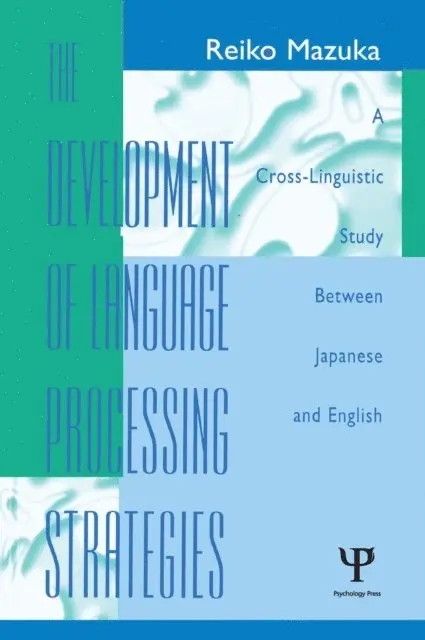
Development of Language Processing Strategies
A Cross-linguistic Study Between Japanese and English
Häftad, Engelska, 2014
784 kr
Skickas inom 10-15 vardagar
Ever since the notion of explanatory adequacy was promoted by Chomsky in his 1965 Aspects, linguists and psycholinguists have been in pursuit of a psychologically valid theory of grammar. To be explanatorily adequate, a theory of grammar can not only describe the general characteristics of a language but can also account for the underlying psychological processes of acquiring and processing that language. To be considered psychologically valid, a grammar must be learnable by ordinary children (the problem of acquisition) and must generate sentences that are parsable by ordinary people (the problem of processing). Ultimately, the fields of language acquisition and processing are concerned with the same goal: to build a theory that accounts for grammar as it is acquired by children; accessed in comprehension and production of speech; and represented within the human mind. Unfortunately, these two fields developed independently and have rarely been well-informed about each other's concerns. Both have experienced past difficulties as a result.Recently, new models have been developed with full consideration to cross-linguistic diversity. Gone are many of the basic assumptions of conventional models, and in their place a variety of innovative and more flexible assumptions have emerged. However, in their attempt to address cross-linguistic issues, these processing models have yet to fully address the developmental challenge: How can a child without a stable grammar process language and still manage to acquire new grammar?This book attempts to develop a model of language processing that addresses both cross-linguistic and developmental challenges. It proposes to link the setting of a basic configurational parameter during language acquisition to the different organization of processing strategies in left- and right-branching languages. Based primarily on Mazuka's doctoral dissertation, this volume incorporates various responses to the original proposal as well as the author's responses to the comments.
705 kr
Skickas inom 10-15 vardagar
This volume is a direct result of the International Symposium on Japanese Sentence Processing held at Duke University. The symposium provided the first opportunity for researchers in three disciplinary areas from both Japan and the United States to participate in a conference where they could discuss issues concerning Japanese syntactic processing. The goals of the symposium were three-fold:* to illuminate the mechanisms of Japanese sentence processing from the viewpoints of linguistics, psycholinguistics and computer science;* to synthesize findings about the mechanisms of Japanese sentence processing by researchers in these three fields in Japan and the United States;* to lay foundations for future interdisciplinary research in Japanese sentence processing, as well as international collaborations between researchers in Japan and the United States.The chapters in this volume have been written from the points of view of three different disciplines, with various immediate objectives -- from building usable speech understanding systems to investigating the nature of competence grammars for natural languages. All of the papers share the long term goal of understanding the nature of human language processing mechanisms. The book is concerned with two central issues -- the universality of language processing mechanisms, and the nature of the relation between the components of linguistic knowledge and language processing. This volume demonstrates that interdisciplinary research can be fruitful, and provides groundwork for further research in Japanese sentence processing.