Reinhard Schweitzer-Stenner - Böcker
Visar alla böcker från författaren Reinhard Schweitzer-Stenner. Handla med fri frakt och snabb leverans.
2 produkter
2 produkter
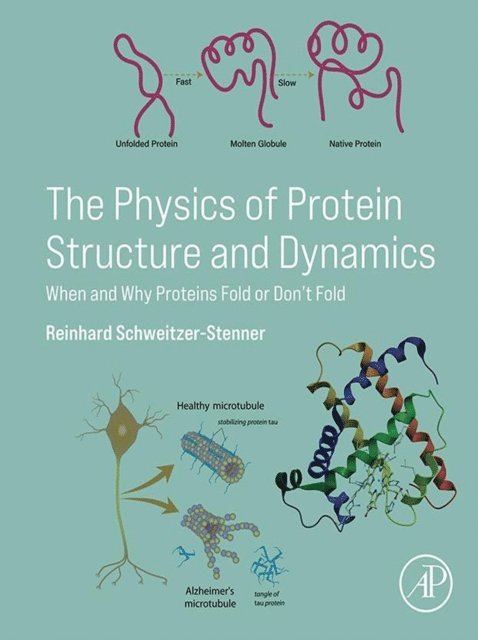
The Physics of Protein Structure and Dynamics
When and Why Proteins Fold or Don't Fold
Häftad, Engelska, 2024
1 593 kr
Skickas inom 7-10 vardagar
The Physics of Protein Structure and Dynamics looks at various aspects of protein structure and dynamics from a physico-chemical point of view. It goes into some depth regarding the description of non-covalent forces that determine the relative stability of folded and unfolded proteins. Anharmonic protein dynamics involving motions between different minima of a rugged Gibbs energy landscape is described in great detail. The book combines various aspects of the protein folding/unfolding processes with an overview of intrinsically disordered proteins, which have attracted considerable interest of the protein community over the last 25 years but are thus far underrepresented in classroom-oriented textbooks. The book looks at protein folding and intrinsically disordered proteins as heavily interrelated topics that need to be viewed together. Furthermore, it presents some basic physico-chemical aspects of protein/peptide self-assembly into nanoscale fibrils. Intrinsically disordered peptides and proteins play a major role particularly in aggregation and self-assembly processes that lead to various diseases (Alzheimer, Parkinson, Huntington, Mad-Cow). Therefore, the relevance of protein disorder for protein self-assembly deserves a closer look. Protein self-assembly cannot be separated from protein folding since it is frequently the product of misfolding. With regard to modern theories, the folding processes are linked to insights on protein dynamics and the discovered relationship between proteins and spin glasses.The readers will benefit from being provided with an in-depth overview of the physical concepts that govern different aspects of protein folding, disorder and self-assembly. By emphasizing the relationship between these issues, the approach adds a holistic character to the bookThe book is to a major extent mathematically based. Mathematics is part of the language of physicists and physical chemists which cannot be properly substituted by wordsFor instructors, the book will offer a unique source for her/his teaching of current protein physics issuesThe way how the book will be constructed (multiple references to primary literature with DOI links, literature-based problem sets and topics for discussion) will facilitate a learning process suitable for research-oriented studentsProblem solving frequently requires the writing of short computer programs, something that is underemphasized in chemistry and biochemistry education (with the exception of computationally trained students, of course)
Del 13 - Wiley Series in Protein and Peptide Science
Protein and Peptide Folding, Misfolding, and Non-Folding
Inbunden, Engelska, 2012
1 952 kr
Skickas inom 5-8 vardagar
Sheds new light on intrinsically disordered proteins and peptides, including their role in neurodegenerative diseasesWith the discovery of intrinsically disordered proteins and peptides (IDPs), researchers realized that proteins do not necessarily adopt a well defined secondary and tertiary structure in order to perform biological functions. In fact, IDPs play biologically relevant roles, acting as inhibitors, scavengers, and even facilitating DNA/RNA-protein interactions. Due to their propensity for self-aggregation and fibril formation, some IDPs are involved in neurodegenerative diseases such as Parkinson's and Alzheimer's.With contributions from leading researchers, this text reviews the most recent studies, encapsulating our understanding of IDPs. The authors explain how the growing body of IDP research is building our knowledge of the folding process, the binding of ligands to receptor molecules, and peptide self-aggregation. Readers will discover a variety of experimental, theoretical, and computational approaches used to better understand the properties and function of IDPs. Moreover, they'll discover the role of IDPs in human disease and as drug targets.Protein and Peptide Folding, Misfolding, and Non-Folding begins with an introduction that explains why research on IDPs has significantly expanded in the past few years. Next, the book is divided into three sections: Conformational Analysis of Unfolded States Disordered Peptides and Molecular Recognition Aggregation of Disordered Peptides Throughout the book, detailed figures help readers understand the structure, properties, and function of IDPs. References at the end of each chapter serve as a gateway to the growing body of literature in the field.With the publication of Protein and Peptide Folding, Misfolding, and Non-Folding, researchers now have a single place to discover IDPs, their diverse biological functions, and the many disciplines that have contributed to our evolving understanding of them.