Renato De Mori - Böcker
Visar alla böcker från författaren Renato De Mori. Handla med fri frakt och snabb leverans.
3 produkter
3 produkter
1 703 kr
Skickas inom 7-10 vardagar
A comprehensive reference on the exciting growth area of spoken dialogs with computers, this text describes the components of a computer-based spoken dialog system, and will prove invaluable to researchers in industry and academia working on speech communication systems and for applications developers. This state-of-the-art book reviews the complete chain from microphone to speech synthesis. It provides methods, models, and algorithms for building a working system. Renato De Mori is coauthor of each chapter ensuring coherence and homogeneity throughout the text.Spoken Dialogs with Computers covers in detail: transducers and microphone arrays, speech analysis and transformation, acoustic modeling and model training, language modeling, and knowledge integration for automatic speech recognition (ASR). The book also presents generation of word hypotheses, speaker adaptation, robustness and telephone application, use of syntactic and semantic knowledge, speech interpretation and dialog strategies, speech generation, and software system architectures for practical implementation. All the necessary methods and models are provided for building a working systems and there is clear algorithmic presentation of the important components A section on automatic interpretation allows the building of a database query system in spoken language The book will be invaluable to researchers in industry and academia working on speech communication systems and for application developers in industry
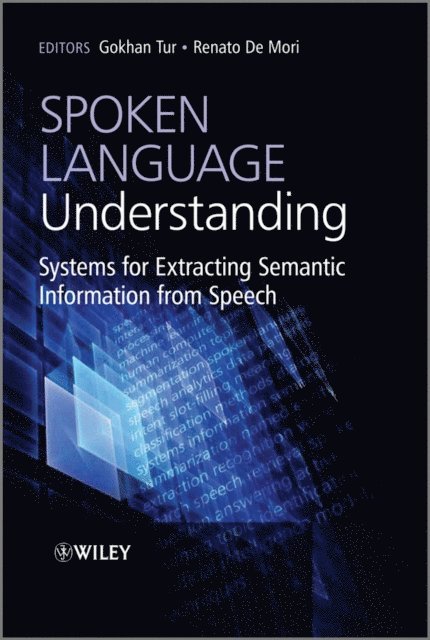
Spoken Language Understanding
Systems for Extracting Semantic Information from Speech
Inbunden, Engelska, 2011
1 491 kr
Skickas inom 7-10 vardagar
Spoken language understanding (SLU) is an emerging field in between speech and language processing, investigating human/ machine and human/ human communication by leveraging technologies from signal processing, pattern recognition, machine learning and artificial intelligence. SLU systems are designed to extract the meaning from speech utterances and its applications are vast, from voice search in mobile devices to meeting summarization, attracting interest from both commercial and academic sectors. Both human/machine and human/human communications can benefit from the application of SLU, using differing tasks and approaches to better understand and utilize such communications. This book covers the state-of-the-art approaches for the most popular SLU tasks with chapters written by well-known researchers in the respective fields. Key features include: Presents a fully integrated view of the two distinct disciplines of speech processing and language processing for SLU tasks.Defines what is possible today for SLU as an enabling technology for enterprise (e.g., customer care centers or company meetings), and consumer (e.g., entertainment, mobile, car, robot, or smart environments) applications and outlines the key research areas.Provides a unique source of distilled information on methods for computer modeling of semantic information in human/machine and human/human conversations.This book can be successfully used for graduate courses in electronics engineering, computer science or computational linguistics. Moreover, technologists interested in processing spoken communications will find it a useful source of collated information of the topic drawn from the two distinct disciplines of speech processing and language processing under the new area of SLU.
536 kr
Skickas inom 10-15 vardagar
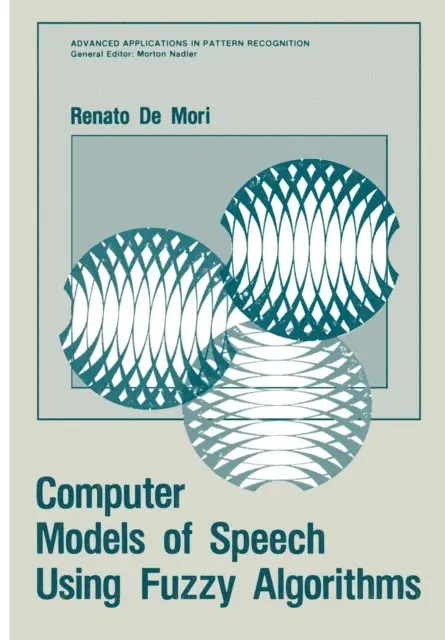
It is with great pleasure that I present this third volume of the series "Advanced Applications in Pattern Recognition." It represents the summary of many man- (and woman-) years of effort in the field of speech recognition by tne author's former team at the University of Turin. It combines the best results in fuzzy-set theory and artificial intelligence to point the way to definitive solutions to the speech-recognition problem. It is my hope that it will become a classic work in this field. I take this opportunity to extend my thanks and appreciation to Sy Marchand, Plenum's Senior Editor responsible for overseeing this series, and to Susan Lee and Jo Winton, who had the monumental task of preparing the camera-ready master sheets for publication. Morton Nadler General Editor vii PREFACE Si parva licet componere magnis Virgil, Georgics, 4,176 (37-30 B.C.) The work reported in this book results from years of research oriented toward the goal of making an experimental model capable of understanding spoken sentences of a natural language. This is, of course, a modest attempt compared to the complexity of the functions performed by the human brain. A method is introduced for conce1v1ng modules performing perceptual tasks and for combining them in a speech understanding system.