Rene Schott – författare
Visar alla böcker från författaren Rene Schott. Handla med fri frakt och snabb leverans.
13 produkter
13 produkter
1 158 kr
Skickas inom 5-8 vardagar
The aim of this book is to report on the progress realized in probability theory in the field of dynamic random walks and to present applications in computer science, mathematical physics and finance. Each chapter contains didactical material as well as more advanced technical sections. Few appendices will help refreshing memories (if necessary!).� New probabilistic model, new results in probability theory� Original applications in computer science� Applications in mathematical physics� Applications in finance
Algebraic Structures and Operator Calculus
Volume I: Representations and Probability Theory
Inbunden, Engelska, 1993
536 kr
Skickas inom 10-15 vardagar
This is the first of three volumes which present, in an original way, some of the most important tools of applied mathematics, in areas such as probability theory, operator calculus, representation theory, and special functions, used in solving problems in mathematics, physics and computer science. Volume 1 deals with probability theory in connection with group representation. Volume 2 will consider applications to computer science, and Volume 3 will deal largely with infinite-dimensional representations of Lie algebras and groups. This first volume - "Representations and Probability Theory" - presents an introduction to Lie algebras and Lie groups which emphasises the connections with probability theory and representation theory. The book contains an introduction and seven chapters which treat, respectively, noncommutative algebra, hypergeometric functions, probability and Fock spaces, moment systems, Bernoulli processes/systems, and matrix elements. Each chapter contains exercises which range in difficulty from easy to advanced. The text is written so as to be suitable for self-study for both beginning graduate students and researchers.For students, teachers and researchers with an interest in algebraic structures and operator calculus.
Algebraic Structures and Operator Calculus
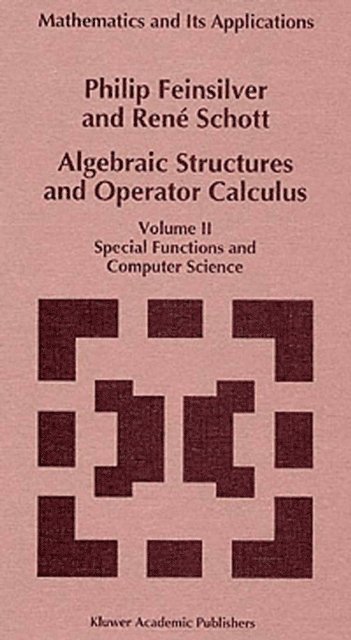
Volume II: Special Functions and Computer Science
Inbunden, Engelska, 1994
536 kr
Skickas inom 10-15 vardagar
This is the second of three volumes which present some important tools of applied mathematics, in areas such as probability theory, operator calculus, representation theory, and special functions, used in solving problems in mathematics, physics and computer science. This second volume - "Special Functions and Computer Science" - presents some applications of special functions in computer science. It largely consists of adaptations of articles that have appeared in the literature, but here they are presented in a format which aims to be accessible for the non-expert by providing some context. The material on group representation and young tableaux is introductory in nature. The text has an algebraic approach in Chapter 2. The solutions are tackled with the help of various analytical techniques, such as generating functions and probabilistic methods and insights appear regularly. This text is aimed at pure and applied mathematicians and theoretical computer scientists. It should be suitable for study by researchers, as well as being appropriate as a text for a course on the subject.
536 kr
Skickas inom 10-15 vardagar
Quantum groups have been investigated rather deeply in mathematical physics over the last decade. Among the most prominent contributions in this area let us mention the works of V.G. Drinfeld, S.L. Woronowicz, S. Majid. Prob ability the- ory on quantum groups has developed in several directions (see works of P. Biane, RL. Hudson and K.R Partasarathy, P.A. Meyer, M. Schurmann, D. Voiculescu). The aim of this book is to present several new aspects related to quantum groups: operator calculus, dual representations, stochastic processes and diffusions, Appell polynomials and systems in connection with evolution equations. Much of the ma- terial is scattered throughout available literature, however, we have nowhere found in accessible form all of this material collected. The presentation of representation theory in connection with Appell systems is original with the authors. Stochastic processes (example: Brownian motion, diffusion processes, Levy processes) are in- vestigated and several examples are presented. As a text the work is intended to be accessible to graduate students and researchers not specialised in quantum prob ability. We would like to acknowledge our colleagues P.Feinsilver, R Lenzceswki, D.
1 066 kr
Skickas inom 10-15 vardagar
Probabilistic and Statistical Methods in Computer Science presents a large variety of applications of probability theory and statistics in computer science and more precisely in algorithm analysis, speech recognition and robotics. It is written on a self-contained basis: all probabilistic and statistical tools needed are introduced on a comprehensible level. In addition all examples are worked out completely.Most of the material is scattered throughout available literature. However, this is the first volume that brings together all of this material in such an accessible format.Probabilistic and Statistical Methods in Computer Science is intended for students in computer science and applied mathematics, for engineers and for all researchers interested in applications of probability theory and statistics. It is suitable for self study as well as being appropriate for a course or seminar.
2 125 kr
Skickas inom 10-15 vardagar
This text is about a field on the crossroads between computer science, combinatorics and probability theory. Computer scientists need random generators for performance analysis, simulation, image synthesis, etc. The algorithms presented here are efficient and easy to code. Some aspects of Horton-Strahler numbers, programs written in C and pictures are presented in the appendices. The complexity analysis is done rigorously both in the worst and average cases. The book is intended for students in computer science and applied mathematics as well as researchers interested in random generation.
1 066 kr
Skickas inom 10-15 vardagar
Probabilistic and Statistical Methods in Computer Science presents a large variety of applications of probability theory and statistics in computer science and more precisely in algorithm analysis, speech recognition and robotics. It is written on a self-contained basis: all probabilistic and statistical tools needed are introduced on a comprehensible level. In addition all examples are worked out completely.Most of the material is scattered throughout available literature. However, this is the first volume that brings together all of this material in such an accessible format.Probabilistic and Statistical Methods in Computer Science is intended for students in computer science and applied mathematics, for engineers and for all researchers interested in applications of probability theory and statistics. It is suitable for self study as well as being appropriate for a course or seminar.
2 125 kr
Skickas inom 10-15 vardagar
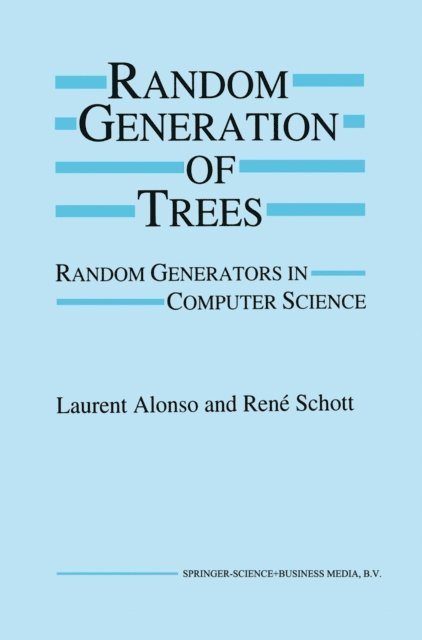
Random Generation of Trees is about a field on the crossroads between computer science, combinatorics and probability theory. Computer scientists need random generators for performance analysis, simulation, image synthesis, etc. In this context random generation of trees is of particular interest. The algorithms presented here are efficient and easy to code. Some aspects of Horton--Strahler numbers, programs written in C and pictures are presented in the appendices. The complexity analysis is done rigorously both in the worst and average cases. Random Generation of Trees is intended for students in computer science and applied mathematics as well as researchers interested in random generation.
2 056 kr
Skickas inom 3-6 vardagar
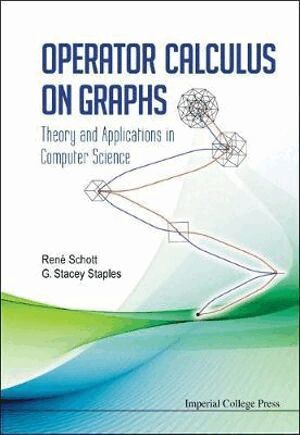
This pioneering book presents a study of the interrelationships among operator calculus, graph theory, and quantum probability in a unified manner, with significant emphasis on symbolic computations and an eye toward applications in computer science.Presented in this book are new methods, built on the algebraic framework of Clifford algebras, for tackling important real world problems related, but not limited to, wireless communications, neural networks, electrical circuits, transportation, and the world wide web. Examples are put forward in Mathematica throughout the book, together with packages for performing symbolic computations.
536 kr
Skickas inom 10-15 vardagar
Quantum groups have been investigated rather deeply in mathematical physics over the last decade. Among the most prominent contributions in this area let us mention the works of V.G. Drinfeld, S.L. Woronowicz, S. Majid. Prob ability the- ory on quantum groups has developed in several directions (see works of P. Biane, RL. Hudson and K.R Partasarathy, P.A. Meyer, M. Schurmann, D. Voiculescu). The aim of this book is to present several new aspects related to quantum groups: operator calculus, dual representations, stochastic processes and diffusions, Appell polynomials and systems in connection with evolution equations. Much of the ma- terial is scattered throughout available literature, however, we have nowhere found in accessible form all of this material collected. The presentation of representation theory in connection with Appell systems is original with the authors. Stochastic processes (example: Brownian motion, diffusion processes, Levy processes) are in- vestigated and several examples are presented. As a text the work is intended to be accessible to graduate students and researchers not specialised in quantum prob ability. We would like to acknowledge our colleagues P.Feinsilver, R Lenzceswki, D.
Algebraic Structures and Operator Calculus
Volume I: Representations and Probability Theory
Häftad, Engelska, 2012
536 kr
Skickas inom 10-15 vardagar
This series presents some tools of applied mathematics in the areas of proba bility theory, operator calculus, representation theory, and special functions used currently, and we expect more and more in the future, for solving problems in math ematics, physics, and, now, computer science. Much of the material is scattered throughout available literature, however, we have nowhere found in accessible form all of this material collected. The presentation of the material is original with the authors. The presentation of probability theory in connection with group represen tations is new, this appears in Volume I. Then the applications to computer science in Volume II are original as well. The approach found in Volume III, which deals in large part with infinite-dimensional representations of Lie algebras/Lie groups, is new as well, being inspired by the desire to find a recursive method for calcu lating group representations. One idea behind this is the possibility of symbolic computation of the matrix elements. In this volume, Representations and Probability Theory, we present an intro duction to Lie algebras and Lie groups emphasizing the connections with operator calculus, which we interpret through representations, principally, the action of the Lie algebras on spaces of polynomials. The main features are the connection with probability theory via moment systems and the connection with the classical ele mentary distributions via representation theory. The various systems of polynomi als that arise are one of the most interesting aspects of this study.
Algebraic Structures and Operators Calculus
Volume III: Representations of Lie Groups
Häftad, Engelska, 2011
536 kr
Skickas inom 10-15 vardagar
Introduction I. General remarks . . . . . . . . . . . . . . . . . . . . . . . . . . . . . . . . . . . . . . . . . . . . . . . . . . . . . . . . . . . . . . . . . . 1 II. Notations . . . . . . . . . . . . . . . . . . . . . . . . . . . . . . . . . . . . . . . . . . . . . . . . . . . . . . . . . . . . . . . . . . . . . . . . 5 III. Lie algebras: some basics . . . . . . . . . . . . . . . . . . . . . . . . . . . . . . . . . . . . . . . . . . . . . . . . . . . . . . . . . 8 Chapter 1 Operator calculus and Appell systems I. Boson calculus . . . . . . . . . . . . . . . . . . . . . . . . . . . . . . . . . . . . . . . . . . . . . . . . . . . . . . . . . . . . . . . . . . 17 II. Holomorphic canonical calculus . . . . . . . . . . . . . . . . . . . . . . . . . . . . . . . . . . . . . . . . . . . . . . . . . . 18 III. Canonical Appell systems . . . . . . . . . . . . . . . . . . . . . . . . . . . . . . . . . . . . . . . . . . . . . . . . . . . . . . . 23 Chapter 2 Representations of Lie groups I. Coordinates on Lie groups . . . . . . . . . . . . . . . . . . . . . . . . . . . . . . . . . . . . . . . . . . . . . . . . . . . . . . . 28 II. Dual representations . . . . . . . . . . . . . . . . . . . . . . . . . . . . . . . . . . . . . . . . . . . . . . . . . . . . . . . . . . . . . 29 III. Matrix elements . . . . . . . . . . . . . . . . . . . . . . . . . . . . . . . . . . . . . . . . . . . . . . . . . . . . . . . . . . . . . . . . . 37 IV. Induced representations and homogeneous spaces . . . . . . . . . . . . . . . . . . . . . . . . . . . . . . . . 40 General Appell systems Chapter 3 I. Convolution and stochastic processes . . . . . . . . . . . . . . . . . . . . . . . . . . . . . . . . . . . . . . . . . . . . 44 II. Stochastic processes on Lie groups . . . . . . . . . . . . . . . . . . . .. . . . . . . . . . . . . . . . . . . . . . . . . . . 46 III. Appell systems on Lie groups . . . . . . . . . . . . . . . . . . . . . . . . . . . . . . . . . . . . . . . . . . . . . . . . . . . . 49 Chapter 4 Canonical systems in several variables I. Homogeneous spaces and Cartan decompositions . . . . . . . . . . . . . . . . . . . . . . . . . . . . . . . . . 54 II. Induced representation and coherent states . . . . . . . . . . . . . . . . . . . . . . . . . . . . . . . . . . . . . . 62 III. Orthogonal polynomials in several variables . . . . . . . . . . . . . . . . . . . . . . . . . . . . . . . . . . . . . . 68 Chapter 5 Algebras with discrete spectrum I. Calculus on groups: review of the theory . . . . . . . . . . . . . . . . . . . . . . . . . . . . . . . . . . . . . . . . . 83 II. Finite-difference algebra . . . . . . . . . . . . . . . . . . . . . . . . . . . . . . . . . . . . . . . . . . . . . . . . . . . . . . . . . 85 III. q-HW algebra and basic hypergeometric functions . . . . . . . . . . . . . . . . . . . . . . . . . . . . . . . 89 IV. su2 and Krawtchouk polynomials . . . . . . . . . . . . . . . . . . . . . . . . . . . . . . . . . . . . . . . . . . . . . . . . 93 V. e2 and Lommel polynomials . . . . . . . . . . . . . . . . . . . . . . . . . . . . . . . . . . . . . . . . . . . . . . . . . . . . 101 Chapter 6 Nilpotent and solvable algebras I. Heisenberg algebras . . . . . . . . . . . . . . . . . . . . . . . . . . . . . . . . . . . . . . . . . . . . . . . . . . . . . . . . . . . . 113 II. Type-H Lie algebras . . . . . . . . . . . . . . . . . . . . . . . . . . . . . . . . . . . . . . . . . . . . . . . . . . . . . . . . . . . . 118 Vll III. Upper-triangular matrices . . . . . . . . . . . . . . . . . . . . . . . . . . . . . . . . . . . . . . . . . . . . . . . . . . .. . . 125 IV. Affine and Euclidean algebras . . . . . . . . . . . . . . . . . . . . . . . . . . . . . . . . . . . . . . . . . . . . . . . . . . 127 Chapter 7 Hermitian symmetric spaces I. Basic structures . . . . . . . . . . . . . . . . . . . . . . . . . . . . . . . . . . . . . . . . . . . . . . . . . . . . . . . . . . . . . . . . 131 II. Space of rectangular matrices . . . . . . . . . . . . . . . . . . . . . . . . . . . . . . . . . . . . . . . . . . . . . . . . . . . 133 III. Space of skew-symmetric matrices . . . . . . . . . . . . . . . . . . . . . . . . . . . . . . . . . . . . . . . . . . . . . . 136 IV. Space of symmetric matrices . . . . . . . . . . . . . . . . . . . . . . . . . . . . . . . . . . . . . . . . . . . . . . . . . . . . 143 Chapter 8 Properties of matrix elements I. Addition formulas . . . . . . . . . . . . . . . . . . . . . . . . . . . . . . . . . . . . . . . . . . . . . . . . . . . . . . . . . . . . . . 147 II. Recurrences . . . . . . . . . . . . . . . . . . . . . . . . . . . . . . . . . . . . . . . . . . . . . . . . . . . . . . . . . . . . . . . . . . . . 148 III. Quotient representations and summation formulas . . . . . . . . . . . . . . . . . . . . . . . . . . . . . . 149 Chapter 9 Symbolic computations I. Computing the pi-matrices . . . . . . . . . . . . . . . . . . . . . . . . . . . . . . . . . . . . . . . . . . . . . . . . . . . . . 153 II. Adjoint group . . . . . . . . . . . . . . . . . . . . . . . . . . . . . . . . . . . . . . . . . . . . . . . . . . . . . . . . . . . . . . . . . . 154 III. Recursive computation of matrix elements . . . . . . . . . . . . . . . . . . . . . . . . . . . . . . . . . . . . . .
Algebraic Structures and Operator Calculus
Volume II: Special Functions and Computer Science
Häftad, Engelska, 2013
536 kr
Skickas inom 10-15 vardagar
In this volume we will present some applications of special functions in computer science. This largely consists of adaptations of articles that have appeared in the literature . Here they are presented in a format made accessible for the non-expert by providing some context. The material on group representations and Young tableaux is introductory in nature. However, the algebraic approach of Chapter 2 is original to the authors and has not appeared previously . Similarly, the material and approach based on Appell states, so formulated, is presented here for the first time . As in all volumes of this series, this one is suitable for self-study by researchers . It is as well appropriate as a text for a course or advanced seminar . The solutions are tackled with the help of various analytical techniques, such as g- erating functions, and probabilistic methods/insights appear regularly . An interesting feature is that, as has been the case in classical applications to physics, special functions arise- here in complexity analysis. And, as in physics, their appearance indicates an underlying Lie structure. Our primary audience is applied mathematicians and theoretical computer scientists . We are quite sure that pure mathematicians will find this volume interesting and useful as well .