Renliang Xu - Böcker
Visar alla böcker från författaren Renliang Xu. Handla med fri frakt och snabb leverans.
3 produkter
3 produkter
Del 39 - Interface Science and Technology
Zeta Potential
Fundamentals, Methods, and Applications
Häftad, Engelska, 2025
2 325 kr
Skickas inom 7-10 vardagar
Zeta Potential: Fundamentals, Methods, and Applications provides an up-to-date exploration of the principles and practice of zeta potential measurements. Tailored for an interdisciplinary audience, the book is invaluable for researchers, engineers, and students in fields like materials science, chemistry, and nanotechnology. It delves into the role of zeta potential in complex heterogeneous liquids such as dispersions and emulsions, and its significance in biomedical and industrial applications. By offering comprehensive yet accessible coverage, this book aims to bridge the educational gap and enhance understanding of this essential electric double layer characteristic.In addition to covering fundamental principles, the book emphasizes modern measurement methods, including electrophoresis, electroacoustics, and streaming current. It highlights the switch towards using zeta potential in formulation and quality control, providing a thorough review of published research. This allows readers to find data relevant to their projects. The book is a crucial resource for those who wish to navigate the complexities of zeta potential applications, ensuring precise and reliable results in their work.Explains the fundamentals of the zeta potential concept and provides formulae based on well verified and widely accepted theoretical models for interfacial double layer and electrokinetic phenomenaIntroduces common technologies for characterizing zeta potential, including the most widely used contemporary measuring methods and interpretation procedures for converting raw measured data into zeta potentialProvides useful examples of applications for a wide variety of R&D and industrial fields
2 414 kr
Skickas inom 10-15 vardagar
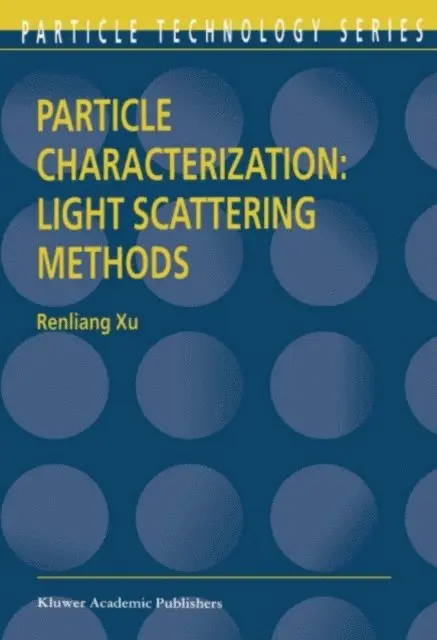
Particle characterization is an important component in product research and development, manufacture, and quality control of particulate materials and an important tool in the frontier of sciences, such as in biotechnology and nanotechnology. This text systematically describes one major branch of modern particle characterization technology - the light scattering methods. It takes the form of a monograph covering the principles, instrumentation, data interpretation, applications, and modern experimental development in laser diffraction, optical particle counting, photon correlation spectroscopy, and electrophoretic light scattering. In addition, a summary of all major particle sizing and other characterization methods, basic statistics and sample preparation techniques used in particle characterization, as well as almost 500 references are provided. The title should be useful for industrial users of light scattering techniques characterizing a variety of particulate systems and for undergraduate or graduate students who want to learn how to use light scattering to study particular materials, in chemical engineering, material sciences, physical chemistry and other related fields.
2 426 kr
Skickas inom 10-15 vardagar
Particle characterization is an important component in product research and development, manufacture, and quality control of particulate materials and an important tool in the frontier of sciences, such as in biotechnology and nanotechnology. This book systematically describes one major branch of modern particle characterization technology - the light scattering methods. This is the first monograph in particle science and technology covering the principles, instrumentation, data interpretation, applications, and latest experimental development in laser diffraction, optical particle counting, photon correlation spectroscopy, and electrophoretic light scattering. In addition, a summary of all major particle sizing and other characterization methods, basic statistics and sample preparation techniques used in particle characterization, as well as almost 500 latest references are provided. The book is a must for industrial users of light scattering techniques characterizing a variety of particulate systems and for undergraduate or graduate students who want to learn how to use light scattering to study particular materials, in chemical engineering, material sciences, physical chemistry and other related fields.