Resam Makvandi – författare
1 091 kr
Skickas inom 10-15 vardagar
1 108 kr
Läs direkt efter köp
874 kr
Skickas inom 10-15 vardagar
549 kr
Skickas inom 10-15 vardagar
712 kr
Läs direkt efter köp
The book also provides numerous examples, including some that can be solved using a graphical approach to help readers gain a better understanding of the computer implementation.
549 kr
Skickas inom 10-15 vardagar
1 741 kr
Skickas inom 10-15 vardagar
2 130 kr
Läs direkt efter köp
1 741 kr
Skickas inom 10-15 vardagar
665 kr
Skickas inom 10-15 vardagar
696 kr
Läs direkt efter köp
Diese Studienhilfe zu numerischen Optimierungsverfahren richtet sich an Studierende des Maschinenbaus im Grundstudium und im Hauptstudium. Optimierungsverfahren gewinnen zunehmend an Bedeutung für den Leichtbau, wo eine Gewichtsreduzierung z.B. im Automobilbau oder in der Luft- und Raumfahrtindustrie zu einem geringeren Kraftstoffverbrauch und einer entsprechenden Senkung der Betriebskosten sowie zu positiven Auswirkungen auf die Umwelt führen kann. Basierend auf dem freien Computeralgebrasystem Maxima stellen die Autoren Verfahren zur numerischen Lösung ingenieurmathematischer Probleme sowie Anwendungen aus traditionellen Lehrveranstaltungen zur Festigkeit von Werkstoffen vor. Die mechanischen Theorien konzentrieren sich auf die typischen eindimensionalen Strukturelemente, d.h. Federn, Stäbe und Euler-Bernoulli-Balken, um die Komplexität des numerischen Rahmens zu reduzieren und den resultierenden Entwurf auf eine geringe Anzahl von Variablen zu beschränken. Die Verwendung eines Computeralgebrasystems und der darin enthaltenen Funktionen, z. B. für Ableitungen oder Gleichungslösungen, ermöglicht eine stärkere Konzentration auf die Methodik der Optimierungsverfahren und nicht auf Standardverfahren.
Das Buch enthält auch zahlreiche Beispiele, darunter einige, die mit Hilfe eines grafischen Ansatzes gelöst werden können, um dem Leser ein besseres Verständnis der Computerimplementierung zu vermitteln.
1 849 kr
Skickas inom 10-15 vardagar
2 283 kr
Läs direkt efter köp
This book first provides a systematic and thorough introduction to the classical laminate theory for composite materials based on the theory for plane elasticity elements and classical (shear-rigid) plate elements. The focus is on unidirectional lamina which can be described based on orthotropic constitutive equations and their composition to layered laminates. In addition to the elastic behavior, failure is investigated based on the maximum stress, maximum strain, Tsai-Hill, and the Tsai-Wu criteria.
The solution of the fundamental equations of the classical laminate theory is connected with extensive matrix operations, and many problems require in addition iteration loops. Thus, a classical hand calculation of related problems is extremely time consuming. In order to facilitate the application of the classical laminate theory, we decided to provide a Python-based computational tool, the so-called Composite Laminate Analysis Tool (CLAT) to easily solve somestandard questions from the context of fiber-reinforced composites. The tool runs in any standard web browser and offers a user-friendly interface with many post-processing options. The functionality comprises stress and strain analysis of lamina and laminates, derivation of off-axis elastic properties of lamina, and the failure analysis based on different criteria.
648 kr
Skickas inom 5-8 vardagar
Numerical Approach to the Classical Laminate Theory of Composite Materials
The Composite Laminate Analysis Tool—CLAT v2.0
1 849 kr
Skickas inom 10-15 vardagar
Numerical Approach to the Simplified Laminate Theory of Composite Materials
The Composite Laminate Analysis Tool—CLAT 1D
1 416 kr
Skickas inom 10-15 vardagar
1 416 kr
Läs direkt efter köp
A typical approach to treat composite materials, which are composed of layered unidirectional lamina, is the so-called classical laminate theory (CLT). This theory is based on the theory for plane elasticity elements and classical (shear-rigid) plate elements under the assumption of orthotropic constitutive equations. The solution of the fundamental equations of the classical laminate theory is connected with extensive matrix operations and many problems require in addition iteration loops.
This two-dimensional approach and the underlying advanced continuum mechanical modeling might be very challenging for some students, particularly at universities of applied sciences. Thus, a reduced approach, the so-called simplified classical laminate theory (SCLT), has been recently proposed. The idea was to use solely isotropic one-dimensional elements, i.e., a superposition of bar and beam elements, to introduce the major calculation steps of the classical laminate theory. Understandingthis simplified theory is much easier and the final step it to highlight the differences when moving to the general two-dimensional case.
This monograph first provides a systematic and thorough introduction to the simplified laminate theory based on the theory for bars and classical beam plate elements. The focus is on stacking of isotropic layers to simplified laminates. In addition to the elastic behavior, failure is investigated based on the maximum stress, maximum strain, Tsai-Hill, and the Tsai-Wu criteria. We provide a Python-based computational tool, the so-called Composite Laminate Analysis Tool (CLAT 1D) to easily solve some standard questions from the context of fiber reinforced composites. The tool runs in any standard web browser and offers a user-friendly interface with many post-processing options. The functionality comprises stress and strain analysis of simplified lamina and laminates and the failure analysis based on different criteria.
Numerical Approach to the Simplified Laminate Theory of Composite Materials
The Composite Laminate Analysis Tool—CLAT 1D
1 091 kr
Skickas inom 10-15 vardagar
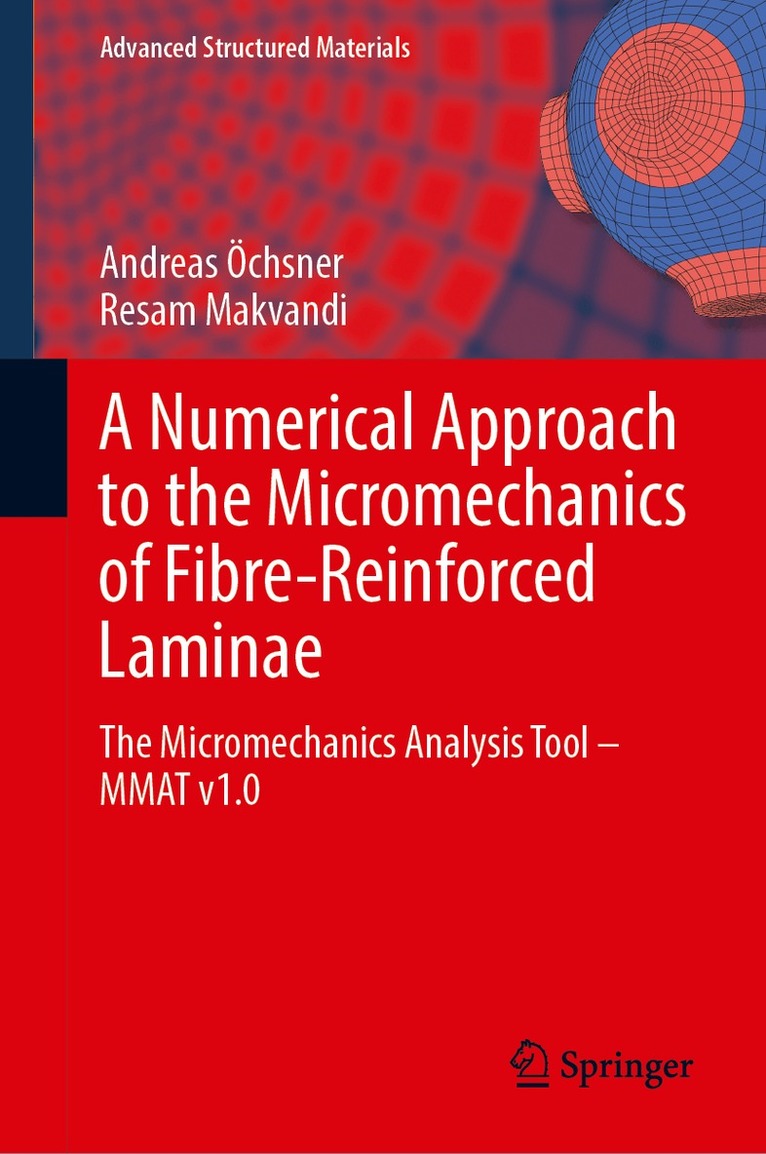
Numerical Approach to the Micromechanics of Fibre-Reinforced Laminae
The Micromechanics Analysis Tool—MMAT v1.0
1 741 kr
Skickas inom 10-15 vardagar
2 130 kr
Läs direkt efter köp
This book treats the micromechanics of laminae, i.e., the prediction of the macroscopic mechanical lamina properties based on the mechanical properties of the constituents, i.e., fibers and matrix. The focus is on unidirectional lamina which can be described based on orthotropic constitutive equations. In detail, predictions for the modulus of elasticity in and transverse to the fiber direction, the major Poisson’s ratio, as wells as the in-plane shear modulus are provided. The mechanics of materials approach, the elasticity solutions with contiguity after Tsai, and the Halpin-Tsai relationships, are presented in detail.
Composite materials, especially fiber-reinforced composites, are gaining increasing importance since they can overcome the limits of many structures based on classical engineering materials. Particularly the combination of a matrix with fibers provides far better properties than the single constituents alone. A typical basic layer, the so-called lamina, can be composed of unidirectional fibers which are embedded in a matrix. In a second step, layers of laminae may be stacked under different fiber angles to a so-called laminate, which reveals—depending on the stacking sequence—different types of anisotropy/isotropy.
A Python-based computational tool is provided, the so-called Micromechanics Analysis Tool (MMAT v1.0) to easily predict the elastic properties. The tool runs in any standard web browser and offers a user-friendly interface with many graphical representations of the elastic properties as a function of the fiber volume fraction.
717 kr
Kommande
1 001 kr
Kommande
549 kr
Skickas inom 10-15 vardagar
693 kr
Läs direkt efter köp
This book is intended as an essential study aid for the finite element method. Based on the free computer algebra system Maxima, the authors offer routines for symbolically or numerically solving problems in the context of plane truss and frame structures, allowing readers to check classical ‘hand calculations’ on the one hand and to understand the computer implementation of the method on the other. The mechanical theories focus on the classical one-dimensional structural elements, i.e. bars, Euler–Bernoulli and Timoshenko beams, and their combination to generalized beam elements. Focusing on one-dimensional elements reduces the complexity of the mathematical framework, and the resulting matrix equations can be displayed with all components and not merely in the form of a symbolic representation. In addition, the use of a computer algebra system and the incorporated functions, e.g. for equation solving, allows readers to focus more on the methodology of the finite element method andnot on standard procedures.