R.F. Whitcomb – författare
Visar alla böcker från författaren R.F. Whitcomb. Handla med fri frakt och snabb leverans.
2 produkter
2 produkter
E-bok
PDF, Engelska, 2012696 kr
Läs direkt efter köp
The Mycoplasmas, Volume III: Plant and Insect Mycoplasmas is a volume of a comprehensive three-volume series encompassing various facets of mycoplasmology. It attempts not only to present an extensive and critical review of the rapidly expanding field of plant and insect mycoplasmas, but also to integrate these important subdisciplines into the total field of mycoplasmology. This volume, in particular, shows relevant information on a group of helical mycoplasmas(spiroplasmas), stressing their part in plant and insect diseases. It discusses the tick-borne spiroplasmas and their possible role in vertebrate disease. Other suspected mycoplasmal plant diseases, vector transmission of mycoplasmas and spiroplasmas, and the chemotherapy of mycoplasmal plant diseases are also described. This book will serve as a standard reference work for mycoplasmologists, as well as for other interested microbiologists, cellular and molecular biologists, membrane biochemists, clinicians, veterinarians, plant pathologists, and entomologists.
Del 41 - Ecological Studies
Forest Island Dynamics in Man-Dominated Landscapes
Häftad, Engelska, 1981
1 091 kr
Skickas inom 10-15 vardagar
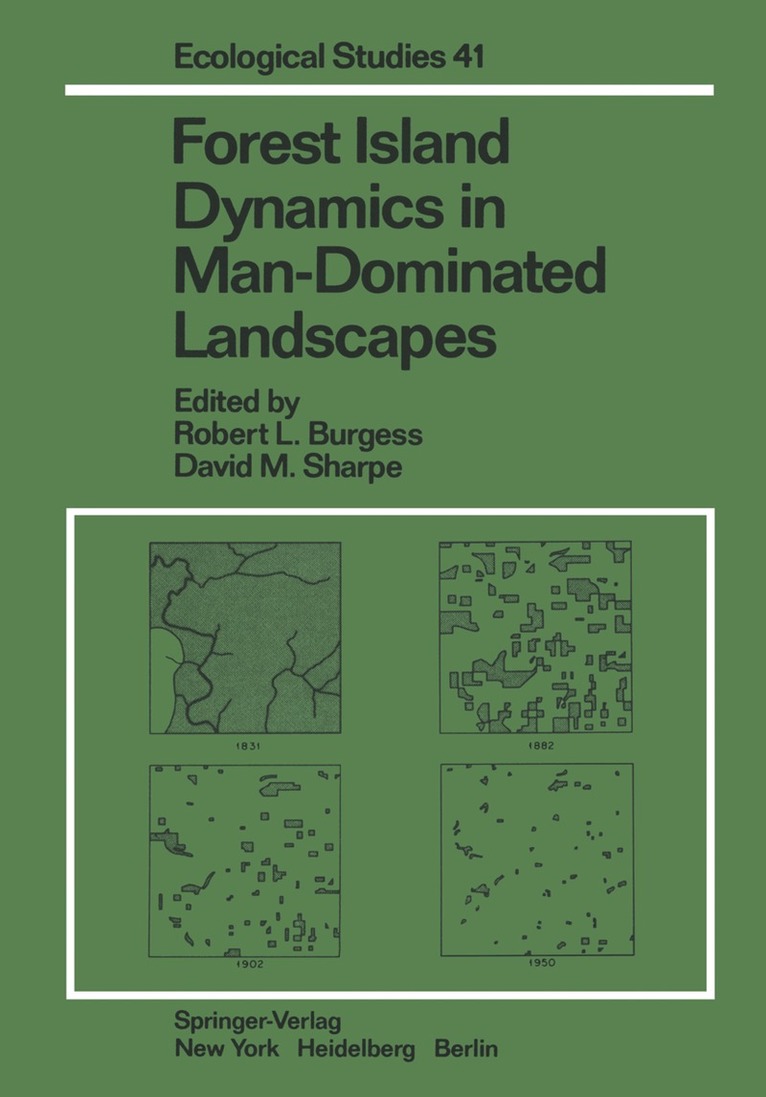
by the authors. This beach-head is only one of several which have recently been made in landscape ecology, striving to invade and occupy a fairly new territory on the map of science. This volume's editors and collaborators made another landing in analysis of space-time patterns of forest islands. Their contribution to the First International Conference on Landscape Ecology (3) and some related analyses (4, 5, 6, 7, 8) expressed the amount of area of a given landscape type as a function of rates of income minus rates of loss in simulation models for land use and cover change. Such models of landscape change as a Markov process complement others of ecological succession for replacement of one species by another (9, 10, 11, 12), and for competition in the growth and survival of individuals while competing for limited resources on a plot "island" in a "sea" of mixed landscape terrain (9, 13). Further analysis of the meaning of terrain and the geologic and soil boundary conditions which constrain ecosystem equations is provided by George Bowen's recent thesis (14) analyzing forest island pattern in Ohio. Percent cover of forest and a density parameter (number of islands per unit area) or else a dissection index for the glaciated and (rougher) unglaciated terrain embodied much of the pattern information that was expressed more abstractly in a factor analysis.