Riad I. Hammoud – författare
Visar alla böcker från författaren Riad I. Hammoud. Handla med fri frakt och snabb leverans.
8 produkter
8 produkter
Häftad, Engelska, 2014
1 119 kr
Skickas inom 10-15 vardagar
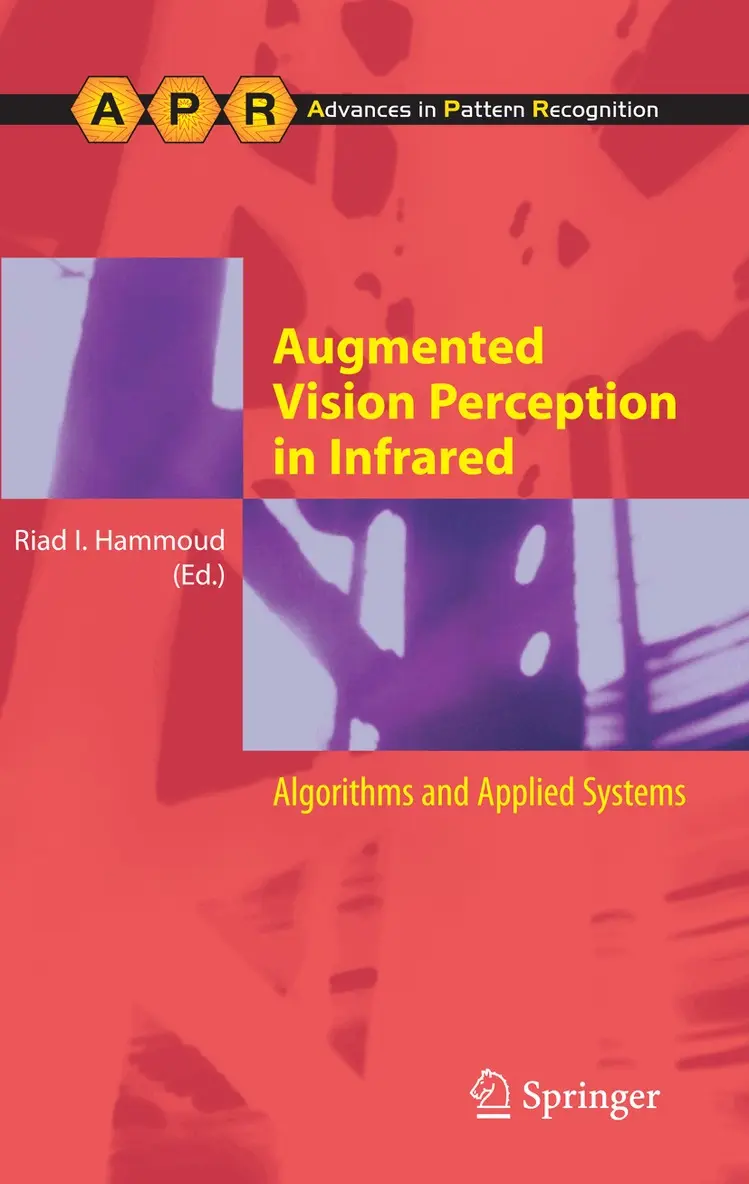
Throughout much of machine vision’s early years the infrared imagery has suffered from return on investment despite its advantages over visual counterparts. Recently, the ?scal momentum has switched in favor of both manufacturers and practitioners of infrared technology as a result of today’s rising security and safety challenges and advances in thermographic sensors and their continuous drop in costs. This yielded a great impetus in achieving ever better performance in remote surveillance, object recognition, guidance, noncontact medical measurements, and more. The purpose of this book is to draw attention to recent successful efforts made on merging computer vision applications (nonmilitary only) and nonvisual imagery, as well as to ?ll in the need in the literature for an up-to-date convenient reference on machine vision and infrared technologies. Augmented Perception in Infrared provides a comprehensive review of recent deployment of infrared sensors in modern applications of computer vision, along with in-depth description of the world’s best machine vision algorithms and intel- gent analytics. Its topics encompass many disciplines of machine vision, including remote sensing, automatic target detection and recognition, background modeling and image segmentation, object tracking, face and facial expression recognition, - variant shape characterization, disparate sensors fusion, noncontact physiological measurements, night vision, and target classi?cation. Its application scope includes homeland security, public transportation, surveillance, medical, and military. Mo- over, this book emphasizes the merging of the aforementioned machine perception applications and nonvisual imaging in intensi?ed, near infrared, thermal infrared, laser, polarimetric, and hyperspectral bands.
Inbunden, Engelska, 2009
1 091 kr
Skickas inom 10-15 vardagar
Throughout much of machine vision’s early years the infrared imagery has suffered from return on investment despite its advantages over visual counterparts. Recently, the ?scal momentum has switched in favor of both manufacturers and practitioners of infrared technology as a result of today’s rising security and safety challenges and advances in thermographic sensors and their continuous drop in costs. This yielded a great impetus in achieving ever better performance in remote surveillance, object recognition, guidance, noncontact medical measurements, and more. The purpose of this book is to draw attention to recent successful efforts made on merging computer vision applications (nonmilitary only) and nonvisual imagery, as well as to ?ll in the need in the literature for an up-to-date convenient reference on machine vision and infrared technologies. Augmented Perception in Infrared provides a comprehensive review of recent deployment of infrared sensors in modern applications of computer vision, along with in-depth description of the world’s best machine vision algorithms and intel- gent analytics. Its topics encompass many disciplines of machine vision, including remote sensing, automatic target detection and recognition, background modeling and image segmentation, object tracking, face and facial expression recognition, - variant shape characterization, disparate sensors fusion, noncontact physiological measurements, night vision, and target classi?cation. Its application scope includes homeland security, public transportation, surveillance, medical, and military. Mo- over, this book emphasizes the merging of the aforementioned machine perception applications and nonvisual imaging in intensi?ed, near infrared, thermal infrared, laser, polarimetric, and hyperspectral bands.
E-bok
PDF, Engelska, 20091 459 kr
Läs direkt efter köp
Throughout much of machine vision’s early years the infrared imagery has suffered from return on investment despite its advantages over visual counterparts. Recently, the ?scal momentum has switched in favor of both manufacturers and practitioners of infrared technology as a result of today’s rising security and safety challenges and advances in thermographic sensors and their continuous drop in costs. This yielded a great impetus in achieving ever better performance in remote surveillance, object recognition, guidance, noncontact medical measurements, and more. The purpose of this book is to draw attention to recent successful efforts made on merging computer vision applications (nonmilitary only) and nonvisual imagery, as well as to ?ll in the need in the literature for an up-to-date convenient reference on machine vision and infrared technologies. Augmented Perception in Infrared provides a comprehensive review of recent deployment of infrared sensors in modern applications of computer vision, along with in-depth description of the world’s best machine vision algorithms and intel- gent analytics. Its topics encompass many disciplines of machine vision, including remote sensing, automatic target detection and recognition, background modeling and image segmentation, object tracking, face and facial expression recognition, - variant shape characterization, disparate sensors fusion, noncontact physiological measurements, night vision, and target classi?cation. Its application scope includes homeland security, public transportation, surveillance, medical, and military. Mo- over, this book emphasizes the merging of the aforementioned machine perception applications and nonvisual imaging in intensi?ed, near infrared, thermal infrared, laser, polarimetric, and hyperspectral bands.
Häftad, Engelska, 2021
621 kr
Skickas inom 10-15 vardagar
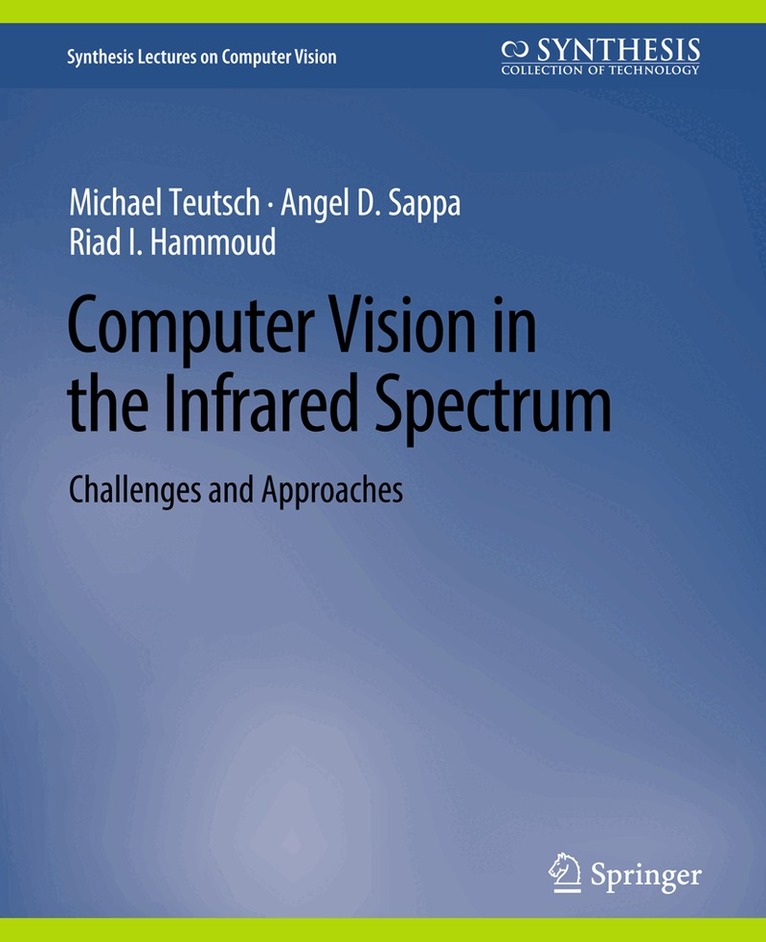
Human visual perception is limited to the visual-optical spectrum. Machine vision is not. Cameras sensitive to the different infrared spectra can enhance the abilities of autonomous systems and visually perceive the environment in a holistic way. Relevant scene content can be made visible especially in situations, where sensors of other modalities face issues like a visual-optical camera that needs a source of illumination. As a consequence, not only human mistakes can be avoided by increasing the level of automation, but also machine-induced errors can be reduced that, for example, could make a self-driving car crash into a pedestrian under difficult illumination conditions. Furthermore, multi-spectral sensor systems with infrared imagery as one modality are a rich source of information and can provably increase the robustness of many autonomous systems. Applications that can benefit from utilizing infrared imagery range from robotics to automotive and from biometrics to surveillance.In this book, we provide a brief yet concise introduction to the current state-of-the-art of computer vision and machine learning in the infrared spectrum. Based on various popular computer vision tasks such as image enhancement, object detection, or object tracking, we first motivate each task starting from established literature in the visual-optical spectrum. Then, we discuss the differences between processing images and videos in the visual-optical spectrum and the various infrared spectra. An overview of the current literature is provided together with an outlook for each task. Furthermore, available and annotated public datasets and common evaluation methods and metrics are presented. In a separate chapter, popular applications that can greatly benefit from the use of infrared imagery as a data source are presented and discussed. Among them are automatic target recognition, video surveillance, or biometrics including face recognition. Finally, we conclude with recommendations for well-fitting sensor setups and data processing algorithms for certain computer vision tasks. We address this book to prospective researchers and engineers new to the field but also to anyone who wants to get introduced to the challenges and the approaches of computer vision using infrared images or videos. Readers will be able to start their work directly after reading the book supported by a highly comprehensive backlog of recent and relevant literature as well as related infrared datasets including existing evaluation frameworks. Together with consistently decreasing costs for infrared cameras, new fields of application appear and make computer vision in the infrared spectrum a great opportunity to face nowadays scientific and engineering challenges.
E-bok
PDF, Engelska, 2022815 kr
Läs direkt efter köp
Human visual perception is limited to the visual-optical spectrum. Machine vision is not. Cameras sensitive to the different infrared spectra can enhance the abilities of autonomous systems and visually perceive the environment in a holistic way. Relevant scene content can be made visible especially in situations, where sensors of other modalities face issues like a visual-optical camera that needs a source of illumination. As a consequence, not only human mistakes can be avoided by increasing the level of automation, but also machine-induced errors can be reduced that, for example, could make a self-driving car crash into a pedestrian under difficult illumination conditions. Furthermore, multi-spectral sensor systems with infrared imagery as one modality are a rich source of information and can provably increase the robustness of many autonomous systems. Applications that can benefit from utilizing infrared imagery range from robotics to automotive and from biometrics to surveillance.In this book, we provide a brief yet concise introduction to the current state-of-the-art of computer vision and machine learning in the infrared spectrum. Based on various popular computer vision tasks such as image enhancement, object detection, or object tracking, we first motivate each task starting from established literature in the visual-optical spectrum. Then, we discuss the differences between processing images and videos in the visual-optical spectrum and the various infrared spectra. An overview of the current literature is provided together with an outlook for each task. Furthermore, available and annotated public datasets and common evaluation methods and metrics are presented. In a separate chapter, popular applications that can greatly benefit from the use of infrared imagery as a data source are presented and discussed. Among them are automatic target recognition, video surveillance, or biometrics including face recognition. Finally, we conclude with recommendations for well-fitting sensor setups and data processing algorithms for certain computer vision tasks. We address this book to prospective researchers and engineers new to the field but also to anyone who wants to get introduced to the challenges and the approaches of computer vision using infrared images or videos. Readers will be able to start their work directly after reading the book supported by a highly comprehensive backlog of recent and relevant literature as well as related infrared datasets including existing evaluation frameworks. Together with consistently decreasing costs for infrared cameras, new fields of application appear and make computer vision in the infrared spectrum a great opportunity to face nowadays scientific and engineering challenges.
Inbunden, Engelska, 2008
1 633 kr
Skickas inom 10-15 vardagar
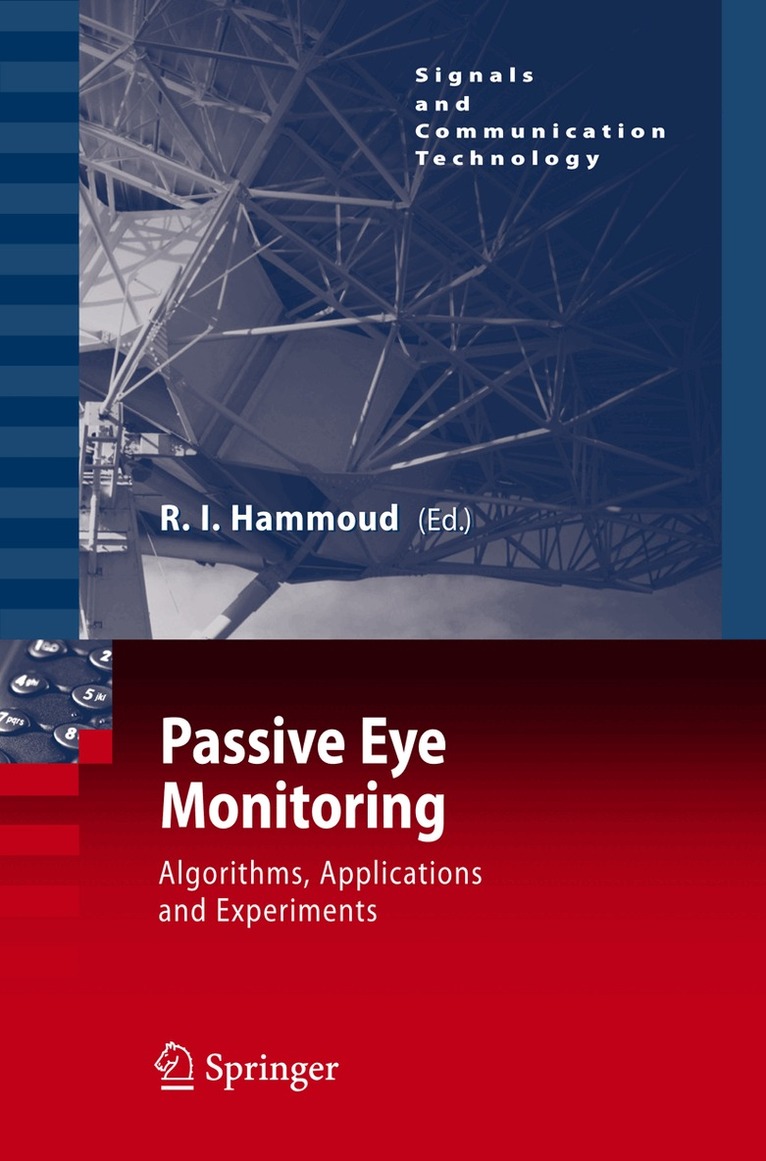
The advent of digital technology and image processing in the 1970s has marked a new era of human machine interaction. Since then there has been a rapid development in the eye monitoring ?eld – a sub-area of intelligent human computer interaction – that brought up e?cient ways for computers to support and assist humans while engaging in non-trivial tasks. The p- pose of this book is to provide a comprehensive in-depth coverage of both theory and practice of Passive Eye Monitoring. Passive Eye Monitoring is the science of teaching computers to autom- ically determine, in digital video streams, the spatial location, pupil’s act- ity, 3D gaze direction, movements and closure state of an individual’s eye, in real-time. It gained a lot of attention as opposed to invasive eye monitoring techniques like Electro Oculography and Magnetic Search Coil. Thetheory and practice of passive eye monitoring have now reached a level of maturity where good results can be achieved for applications – in automotive, mi- tary, medicine, information security and retrieval, typing and reading, online search, marketing, augmented and virtual reality, and video games – that were certainly non realistic a few decades ago. For instance, this technology has the potential to allow a disabled person to compose electronic messages, browseand navigatethroughwebpages,interactwith consumer – electronics devices, and while steering an operating machine, this technology monitors his/her fatigue and distraction state and issues appropriate vigilance wa- ings.
E-bok
PDF, Engelska, 20081 977 kr
Läs direkt efter köp
The advent of digital technology and image processing in the 1970s has marked a new era of human machine interaction. Since then there has been a rapid development in the eye monitoring ?eld – a sub-area of intelligent human computer interaction – that brought up e?cient ways for computers to support and assist humans while engaging in non-trivial tasks. The p- pose of this book is to provide a comprehensive in-depth coverage of both theory and practice of Passive Eye Monitoring. Passive Eye Monitoring is the science of teaching computers to autom- ically determine, in digital video streams, the spatial location, pupil’s act- ity, 3D gaze direction, movements and closure state of an individual’s eye, in real-time. It gained a lot of attention as opposed to invasive eye monitoring techniques like Electro Oculography and Magnetic Search Coil. Thetheory and practice of passive eye monitoring have now reached a level of maturity where good results can be achieved for applications – in automotive, mi- tary, medicine, information security and retrieval, typing and reading, online search, marketing, augmented and virtual reality, and video games – that were certainly non realistic a few decades ago. For instance, this technology has the potential to allow a disabled person to compose electronic messages, browseand navigatethroughwebpages,interactwith consumer – electronics devices, and while steering an operating machine, this technology monitors his/her fatigue and distraction state and issues appropriate vigilance wa- ings.
Häftad, Engelska, 2015
1 635 kr
Skickas inom 10-15 vardagar
The advent of digital technology and image processing in the 1970s has marked a new era of human machine interaction. Since then there has been a rapid development in the eye monitoring ?eld – a sub-area of intelligent human computer interaction – that brought up e?cient ways for computers to support and assist humans while engaging in non-trivial tasks. The p- pose of this book is to provide a comprehensive in-depth coverage of both theory and practice of Passive Eye Monitoring. Passive Eye Monitoring is the science of teaching computers to autom- ically determine, in digital video streams, the spatial location, pupil’s act- ity, 3D gaze direction, movements and closure state of an individual’s eye, in real-time. It gained a lot of attention as opposed to invasive eye monitoring techniques like Electro Oculography and Magnetic Search Coil. Thetheory and practice of passive eye monitoring have now reached a level of maturity where good results can be achieved for applications – in automotive, mi- tary, medicine, information security and retrieval, typing and reading, online search, marketing, augmented and virtual reality, and video games – that were certainly non realistic a few decades ago. For instance, this technology has the potential to allow a disabled person to compose electronic messages, browseand navigatethroughwebpages,interactwith consumer – electronics devices, and while steering an operating machine, this technology monitors his/her fatigue and distraction state and issues appropriate vigilance wa- ings.