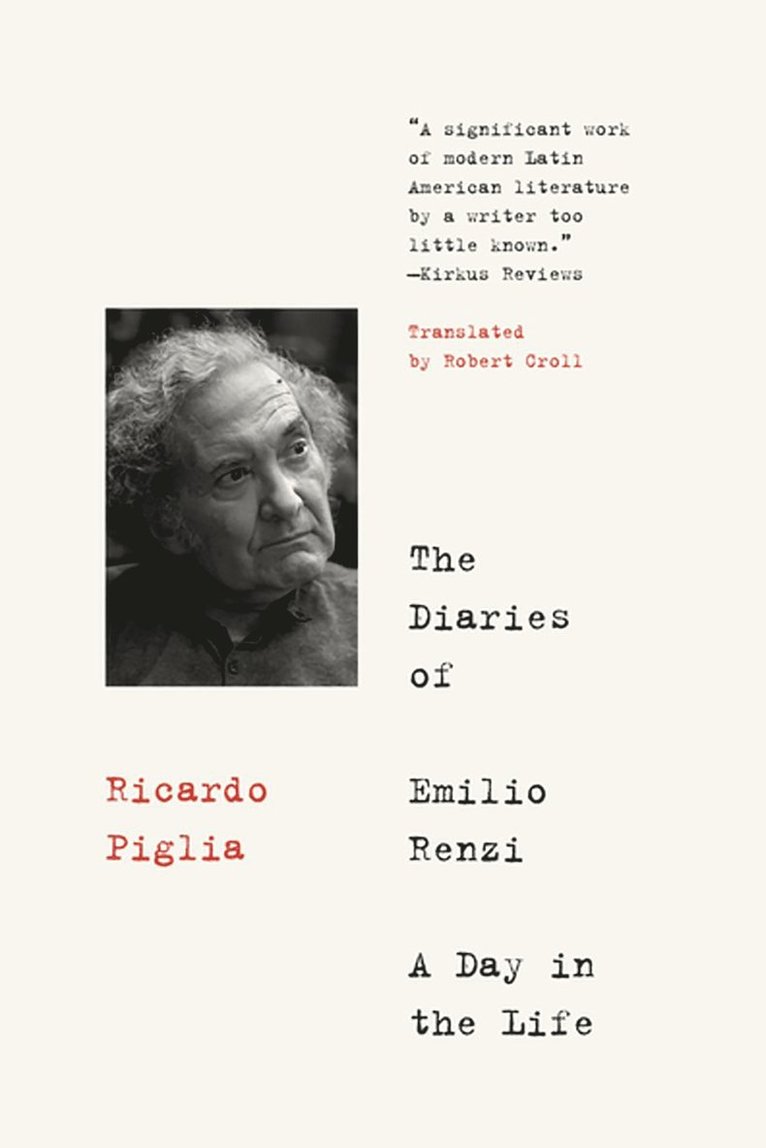
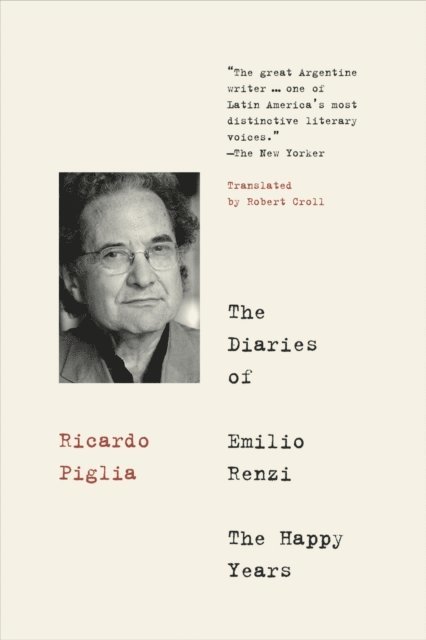
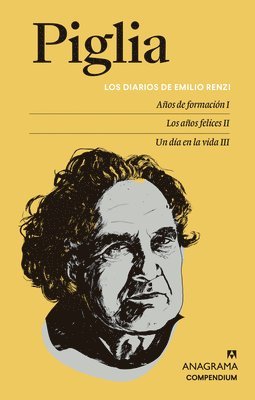
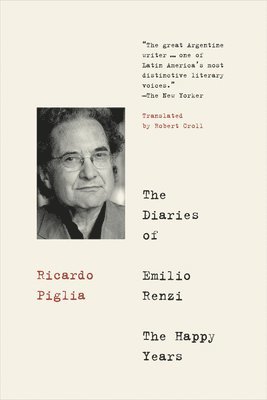
Sixty years in the making and the capstone of a monumental literary career, The Diaries of Emilio Renzi: A Day in the Life is the final volume of the autobiographical trilogy from the author who is considered Borges’ heir and the vanguard of the Post-Boom generation of Latin American literature.
How could we define a perfect day? Maybe it would be better to say: how could I narrate a perfect day?
Is that why I write a diary? To capture—or reread—one of those days of unexpected happiness?
The final installment of Ricardo Piglia’s lifelong compilation of journals completes the seemingly impossible project of documenting the entire life of a writer. A Day in the Life picks up the thread of Piglia’s life in the 1980s until his death from ALS in 2017. Emilio Renzi, Piglia’s literary alter ego, navigates the tumultuous ups and downs of a post-Peronist Argentina filled with political unrest, economic instability, and a burgeoning literary scene ready to make its mark on the rest of the world and escape the shadows of legendary authors Jorge Luis Borges and Roberto Arlt.
Renzi’s peripatetic, drinking, philandering ways don’t abate as he grows older, and we’re exposed to the intrinsic insecurities that continually plague him even as fate tips in his favor and he goes on to win international literary prizes and becomes professor emeritus of Princeton University. His literary success is marred only by the disappointments and tragedies of his personal life as he deals with the death of friends and family, failed relationships, and the constant pecuniary struggles of a writer trying to live solely on his ability to produce art. The final sections of this ambitious project intimately trace the deterioration of Piglia’s body after his diagnosis: My right hand is heavy and uncooperative but I can still write. When I can no longer. . . . The crowning achievement of a prolific, internationally acclaimed author, this third volume cements Ricardo Piglia’s position as one of the most influential Latin American authors of the last century.
Praise for The Diaries of Emilio Renzi: A Day in the Life
“[A] posthumous autobiographical masterpiece. . . . [P]rofoundly moving. A meditation on both the accumulation and ephemerality of time, Piglia’s final work is a brilliant addition to world literature.”—Publishers Weekly, Starred Review
“Filled with literary aperçus and fragments of history: an elegant, affecting close to a masterwork.”—Kirkus Reviews, Starred Review
“Much of the fascinating material is to be found in his brief appreciations and observations, such as notes on authors and his reading, but the life-story—of someone who has dedicated himself entirely to literature—also comes across, and it is thoroughly engaging, over all three volumes of this larger work…. A fine conclusion to this diary-trilogy, and a fascinating companion piece to this author and his work.”—M. A. Orthofer, The Complete Review
Praise for The Diaries of Emilio Renzi
“Splendidly crafted and interspliced with essays and stories, this beguiling work is to a diary as Piglia is to ‘Emilio Renzi’: a lifelong alter ego, a highly self-conscious shadow volume that brings to bear all of Piglia’s prowess as it illuminates his process of critical reading and the inevitable tensions between art and life. Amid meeting redheads at bars, he dissects styles and structures with a surgeon’s precision, turning his gaze on a range of writers, from Plato to Dashiell Hammett, returning time and again to Pavese, Faulkner, Dostoyevsky, Arlt and Borges. Chock-full of lists of books and films he consumed in those voracious early years of call girls, carbon paper, amphetamines and Heidegger, this is an embarrassment of riches — by turns an inspiring master class in narrative analysis, an accounting of the pesos left in his pockets and a novel of Piglia’s grandfather (named Emilio, natch) with his archive of World War I materials pilfered from Italian corpses. . . . No previous familiarity with Piglia’s work is needed to appreciate these bibliophilic diaries, adroitly repurposed through a dexterous game of representation and masks that speaks volumes of the role of the artist in society, the artist in his time, the artist in his tradition.”—Mara Faye Lethem, The New York Times Book Review
“For the past few years, every Latin American novelist I know has been telling me how lavish, how grand, how transformative was the Argentinian novelist Ricardo Piglia’s final project, a fictional journal in three volumes, Los diarios de Emilio Renzi—Renzi being Piglia’s fictional alter ego. And now here at last is the first volume in English, The Diaries of Emilio Renzi: Formative Years, translated by Robert Croll. It’s something to be celebrated . . . [It] offer[s] one form of resistance to encroaching fascism: style.”—Adam Thirlwell, BookForum, The Best Books of 2017
“[A] masterpiece. . . . everything written by Ricardo Piglia, which we read as intellectual fabrications and narrated theories, was partially or entirely lived by Emilio Renzi. The visible, cerebral chronicles hid a secret history that was flesh and bones.”—Jorge Carrión, The New York Times
“A valediction from the noted Argentine writer, known for bringing the conventions of hard-boiled U.S. crime drama into Latin American literature . . . Fans of Cortázar, Donoso, and Gabriel García Márquez will find these to be eminently worthy last words from Piglia."—Kirkus Reviews, Starred Review
“When young Ricardo Piglia wrote the first pages of his diaries, which he would work on until the last years of his life, did he have any inkling that they would become a lesson in literary genius and the culmination of one of the greatest works of Argentine literature?”—Samanta Schweblin, author of Fever Dream
“Ricardo Piglia, who passed away earlier this year at age seventy-five, is celebrated as one of the giants of Argentine literature, a rightful heir to legends like Borges, Cortázar, Juan Jose Saer, and Roberto Arlt. The Diaries of Emilio Renzi is his life''s work . . . An American equivalent might be if Philip Roth now began publishing a massive, multi-volume autobiography in the guise of Nathan Zuckerman . . . It is truly a great work . . . This is a fantastic, very rewarding read—it seems that Piglia has found a form that can admit everything he has to say about his life, and it is a true pleasure to take it in.”—Veronica Esposito, BOMB Magazine
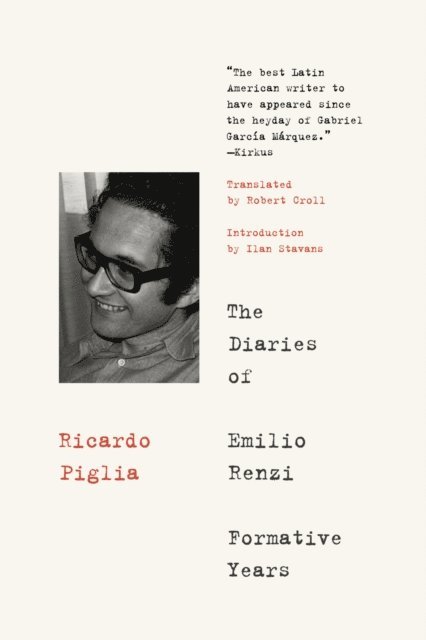
“In 1957, Argentinian writer Ricardo Piglia started to write what would become 327 notebooks filled with the thoughts of his alter ego, Emilio Renzi. Piglia’s final literary act before his death in January 2017 was to organize and publish these works as Renzi’s diaries. Formative Years, the first of three volumes, covers the years 1957 to 1967, detailing Renzi’s development into a central figure of Argentine literary culture. In epigrammatic diary entries filled with memorable observations, Piglia details Renzi’s political education, relationships, views on Argentinian politics, and experiences during this remarkably productive era of Latin American fiction. As a fictionalized autobiography, it is, like the work of Karl Ove Knausgaard, of My Struggle fame, part confession and part performance. Renzi meets and corresponds with literary luminaries like Borges, Cortázar, and Márquez, and offers insightful readings of Dostoevsky, Kafka, Faulkner, and Joyce. Ilan Stavans (Quixote: The Novel and the World, 2015) provides a wonderfully informative introduction. Fans of W.G. Sebald and Roberto Bolaño will find the first installment in Piglia’s trilogy to be a fascinating portrait of a writer’s life.”—Alexander Moran, Booklist
"Here through the Boom and Bolaño breech storms Ricardo Piglia, not just a great Latin American writer but a great writer of the American continent. Composed across his entire career, The Diaries of Emilio Renzi is Piglia''s secret story of his shadow self—a book of disquiet and love and literary obsession that blurs the distinctness of each and the other."—Hal Hlavinka, Community Bookstore (Brooklyn, NY)
“In this fictionalized autobiography, Piglia’s ability to succinctly criticize and contextualize major writers from Kafka to Flannery O’Connor is astounding, and the scattering of those insights throughout this diary are a joy to read. This book is essential reading for writers.”—Publishers Weekly
“The Diaries of Emilio Renzi is a rare glimpse into the heart of twentieth-century Latin American literature, with the inimitable Ricardo Piglia as tour guide. More than just a traditional diary, Renzi is an illuminating voyage into the hearts of books and writers and history. An inspiring work and an important achievement.”—Mark Haber, Brazos Bookstore (Houston, TX)
“The great Argentine writer. . . . In a career that spanned four decades, during which he became one of Latin America’s most distinctive literary voices.”—Alejandro Chacoff, The New Yorker
“The Diaries of Emilio Renzi continue to be a fascinating literary-autobiographical experiment . . . and, especially, a wonderful immersion in literature itself. Of particular interest in showing the transition of Latin American (and specifically Argentine) literature—no longer: ‘out of sync, behind, out of place’—Piglia''s range extends far beyond that too. Yes, most of this is presumably mainly of interest to the similarly literature-obsessed—but Piglia makes it hard to imagine who wouldn''t be.”— M. A. Orthofer, The Complete Review