Richard A. Hudson - Böcker
Visar alla böcker från författaren Richard A. Hudson. Handla med fri frakt och snabb leverans.
4 produkter
4 produkter
606 kr
Skickas inom 11-20 vardagar
For the past decade, the dominant transformational theory of syntax has produced the most interesting insights into syntactic properties. Over the same period another theory, systemic grammar, has been developed very quietly as an alternative to the transformational model. In this work Richard A. Hudson outlines "daughter-dependency theory," which is derived from systemic grammar, and offers empirical reasons for preferring it to any version of transformational grammar. The goal of daughter-dependency theory is the same as that of Chomskyan transformational grammar—to generate syntactic structures for all (and only) syntactically well-formed sentences that would relate to both the phonological and the semantic structures of the sentences. However, unlike transformational grammars, those based on daughter-dependency theory generate a single syntactic structure for each sentence. This structure incorporates all the kinds of information that are spread, in a transformational grammar, over to a series of structures (deep, surface, and intermediate). Instead of the combination of phrase-structure rules and transformations found in transformational grammars, daughter-dependency grammars contain rules with the following functions: classification, dependency-marking, or ordering. Hudson's strong arguments for a non-transformational grammar stress the capacity of daughter-dependency theory to reflect the facts of language structure and to capture generalizations that transformational models miss. An important attraction of Hudson's theory is that the syntax is more concrete, with no abstract underlying elements. In the appendixes, the author outlines a partial grammar for English and a small lexicon and distinguishes his theory from standard dependency theory. Hudson's provocative thesis is supported by his thorough knowledge of transformational grammar.
480 kr
Skickas inom 7-10 vardagar
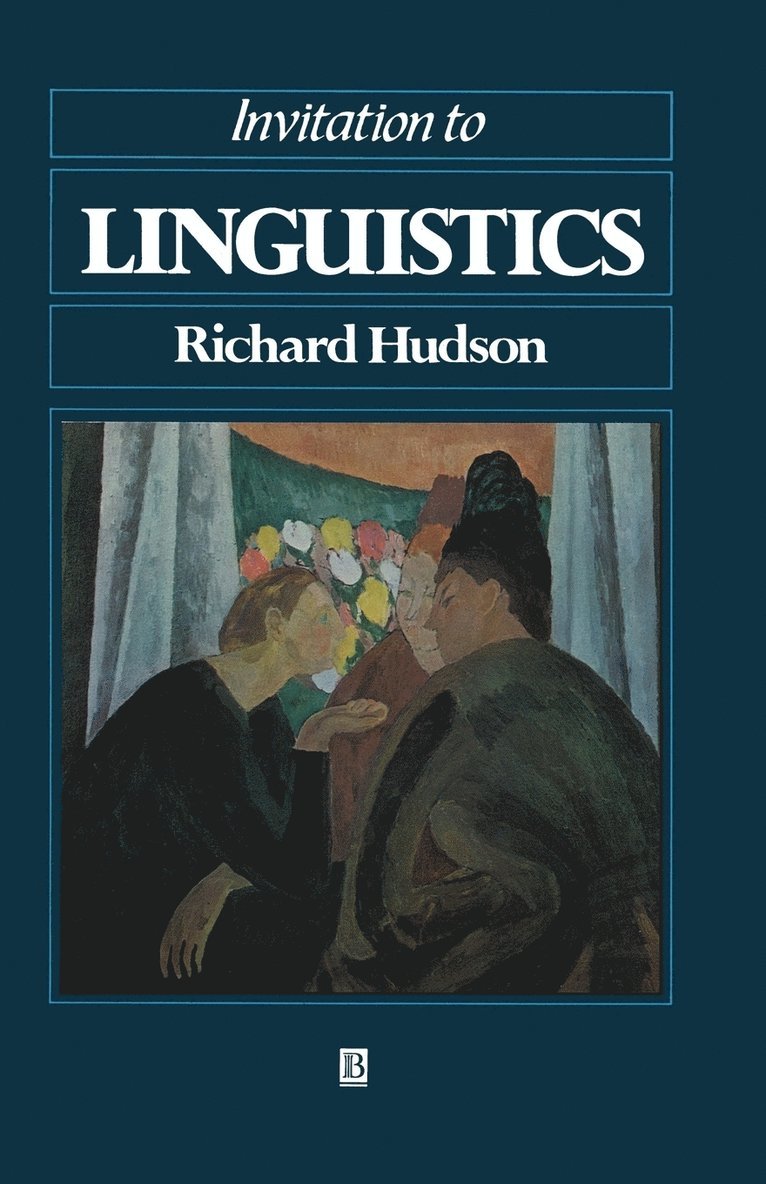
The study of language has come a long way since Samuel Johnson describe himself as 'maker of dictionaries -- harmless drudge'. The emphasis in modern linguistics is on descriptive investigations of the way the world speaks -- and why.In Invitation to Linguistics, Richard Hudson explains what the subject is, why it appeals, how it works, what issues it confronts and the practical impact it can have on our social and professional lives. He poses puzzles in Latin and Zulu, visits realms of linguistic exotica, delves into deep grammar, unravels the ambiguities of everyday sentences (like 'John took off Mary's coat') and asks how language began, if we can think without it, and if it is unique to humans anyway. He shows how the study of this wide-ranging subject can help society solve its problems of literacy and language learning, facilitate the treatment of speech pathologies, help us use computers more effectively -- and how it can broaden our outlook, wiping out out-dated prejudices against non-standard speech and minority languages. Wide-ranging, realistic and provoking, this is a book that students thinking of studying lingusitics, or just launched on their courses, will read for enjoyment as well as instruction: a combination that makes it ideal, too, for anyone interested in words -- from crossword fanatics to anthropologists.
2 291 kr
Skickas inom 10-15 vardagar
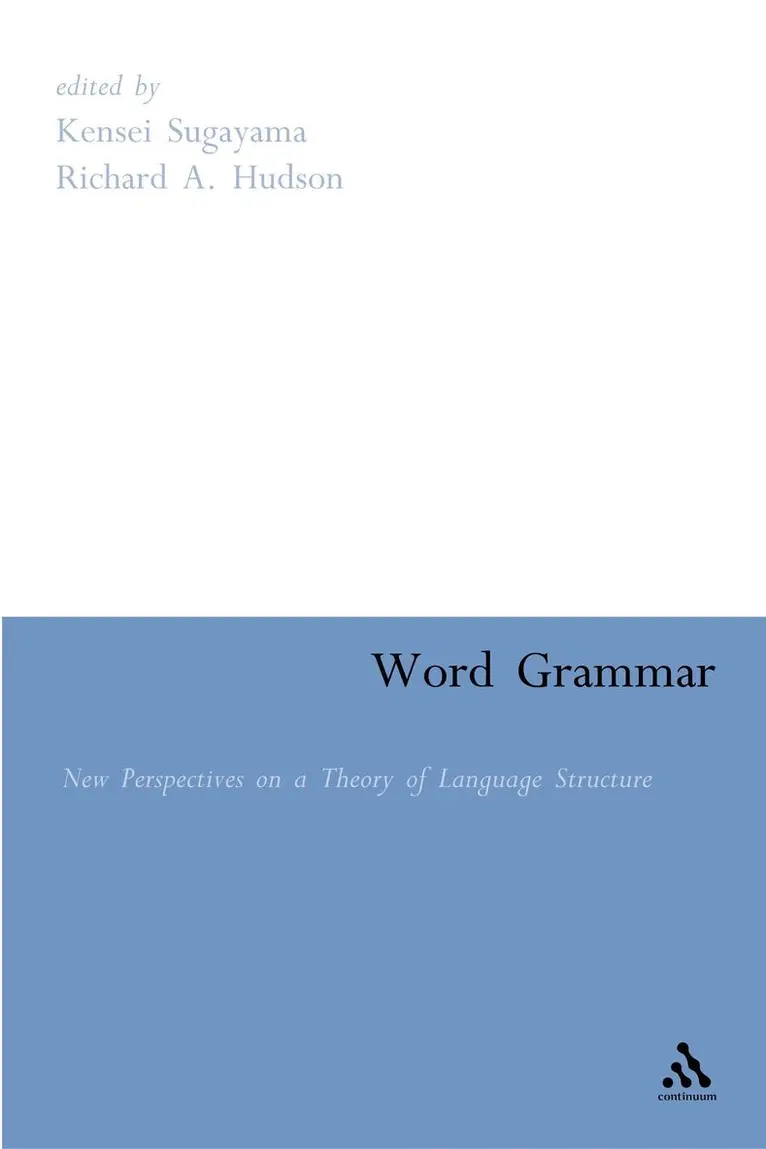
This book is an introduction to Word Grammar, a theory of language structure founded and developed by Dick Hudson. In this theory, language is a cognitive network - a network of concepts, words and meanings containing all the elements of a linguistic analysis. The theory of language is therefore embedded in a theory of knowledge, in which there are no boundaries between one form of knowledge and any other. Contributors to this volume are primarily Word Grammar grammarians from across the world. All the chapters here manifest theoretical potentialities of Word Grammar, exploring how powerful Word Grammar is to offer analysis for linguistic phenomena in various languages. The chapters come from varying perspectives and include work on a number of languages, including English, German, Japanese, Swahili, Turkish and Ancient Greek. Phenomena studied include verbal inflection, case agreement, extraction, construction and code-mixing. This new collection will be of interest to academics encountering Word Grammar for the first time, or for those who are already familiar with this theory and are interested in reading how it has evolved and what its future may hold.
612 kr
Skickas inom 10-15 vardagar
This book is an introduction to Word Grammar, a theory of language structure founded and developed by Dick Hudson. In this theory, language is a cognitive network - a network of concepts, words and meanings containing all the elements of a linguistic analysis. The theory of language is therefore embedded in a theory of knowledge, in which there are no boundaries between one form of knowledge and any other. The most controversial idea in Word Grammar syntax is that phrase structure is redundant, because all its work can be done by means of dependencies between individual words. Word-word dependency is therefore a key concept in Word Grammar, and the syntax and semantics of a sentence is built upon this foundation. Contributors to this volume are primarily Word Grammar grammarians from across the world. All the chapters here manifest theoretical potentialities of Word Grammar, exploring how powerful Word Grammar is to offer analysis for linguistic phenomena in various languages. The chapters come from varying perspectives and include work on a number of languages, including English, German, Japanese, Swahili, Turkish and Ancient Greek.Phenomena studied include verbal inflection, case agreement, extraction, construction and code-mixing.This collection will be of interest to academics encountering Word Grammar for the first time, or for those who are already familiar with this theory and are interested in reading how it has evolved and what its future may hold.