Richard Barlow - Böcker
Visar alla böcker från författaren Richard Barlow. Handla med fri frakt och snabb leverans.
4 produkter
4 produkter
622 kr
Skickas inom 10-15 vardagar
The Celtic Unconscious offers a vital new interpretation of modernist literature through an examination of James Joyce's employment of Scottish literature and philosophy, as well as a commentary on his portrayal of shared Irish and Scottish histories and cultures. Barlow also offers an innovative look at the strong influences that Joyce's predecessors had on his work, including James Macpherson, James Hogg, David Hume, Robert Burns, and Robert Louis Stevenson. The book draws upon all of Joyce's major texts but focuses mainly on Finnegans Wake in making three main, interrelated arguments: that Joyce applies what he sees as a specifically "Celtic" viewpoint to create the atmosphere of instability and skepticism of Finnegans Wake; that this reasoning is divided into contrasting elements, which reflect the deep religious and national divide of post-1922 Ireland, but which have their basis in Scottish literature; and finally, that despite the illustration of the contrasts and divisions of Scottish and Irish history, Scottish literature and philosophy are commissioned by Joyce as part of a program of artistic "decolonization" which is enacted in Finnegans Wake. The Celtic Unconscious is the first book-length study of the role of Scottish literature in Joyce's work and is a vital contribution to the fields of Irish and Scottish studies. This book will appeal to scholars and students of Joyce, and to students interested in Irish studies, Scottish studies, and English literature.
699 kr
Tillfälligt slut
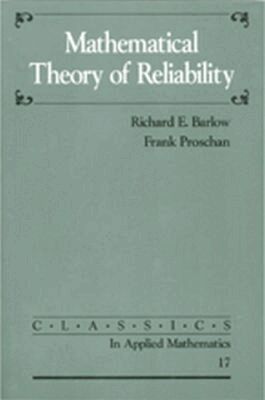
This monograph presents a survey of mathematical models useful in solving reliability problems. It includes a detailed discussion of life distributions corresponding to wearout and their use in determining maintenance policies, and covers important topics such as the theory of increasing (decreasing) failure rate distributions, optimum maintenance policies, and the theory of coherent systems. The emphasis throughout the book is on making minimal assumptions--and only those based on plausible physical considerations--so that the resulting mathematical deductions may be safely made about a large variety of commonly occurring reliability situations. The first part of the book is concerned with component reliability, while the second part covers system reliability, including problems that are as important today as they were in the 1960s.Mathematical reliability refers to a body of ideas, mathematical models, and methods directed toward the solution of problems in predicting, estimating, or optimizing the probability of survival, mean life, or, more generally, life distribution of components and systems. The enduring relevance of the subject of reliability and the continuing demand for a graduate-level book on this topic are the driving forces behind its republication. Mathematical Theory of Reliability now joins a growing list of volumes in SIAM's Classics series. Although contemporary reliability books are now available, few provide as mathematically rigorous a treatment of the required probability background as this one.
1 277 kr
Skickas
Finnegans Wake Human and Nonhuman Histories opens new ground by exploring the productive tension between anthropocentric and non-anthropocentric readings of James Joyce's final modernist masterpiece. Drawing on the most up-to-date theories and methodologies (the Anthropocene, new materialism, petroculture studies, the blue humanities, animal studies, ecofeminism, ecomedia), twelve leading Joyce scholars offer valuable new insights into the interwoven historical and planetary dimensions of Finnegans Wake. The volume's focus allows the contributors to read the Wake's nonhuman imaginary in original, often surprising comparative contexts (colonialism, the Irish Revival, the Free State's energy policies, the invention of television) and to spotlight enlightening nonhuman themes in Joyce's circular history (bogs, storms, rivers, bodily fluids, skin, wolves, mourning, DNA, atoms, labour, music). As these chapters show, a century later, Finnegans Wake remains a vibrant and vital text in which to interrogate the limits, exploitations and common plight of human and nonhuman life in the 21st-century.
491 kr
Skickas inom 3-6 vardagar
Finnegans Wake – Human and Nonhuman Histories opens new ground by exploring the productive tension between anthropocentric and non-anthropocentric readings of James Joyce’s final modernist masterpiece. Drawing on the most up-to-date theories and methodologies (the Anthropocene, new materialism, petroculture studies, the blue humanities, animal studies, ecofeminism, ecomedia), twelve leading Joyce scholars offer valuable new insights into the interwoven historical and planetary dimensions of Finnegans Wake. The volume’s focus allows the contributors to read the Wake’s nonhuman imaginary in original, often surprising comparative contexts (colonialism, the Irish Revival, the Free State’s energy policies, the invention of television) and to spotlight enlightening nonhuman themes in Joyce’s circular history (bogs, storms, rivers, bodily fluids, skin, wolves, mourning, DNA, atoms, labour, music). As these chapters show, a century later, Finnegans Wake remains a vibrant and vital text in which to interrogate the limits, exploitations and common plight of human and nonhuman life in the 21st-century.