Richard E. Heyman – författare
768 kr
Skickas inom 5-8 vardagar
849 kr
Läs direkt efter köp
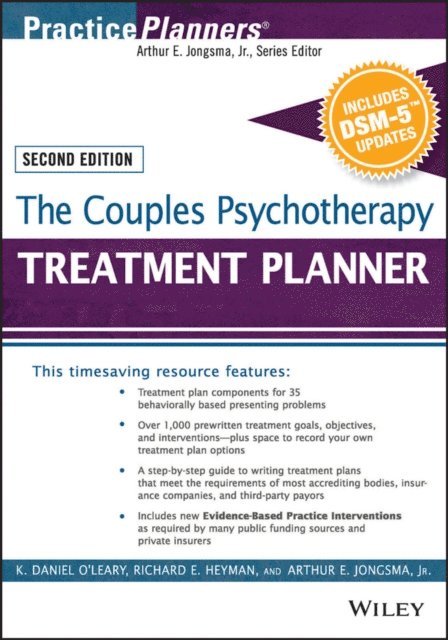
This timesaving resource features:
Treatment plan components for 35 behaviorally based presenting problems Over 1,000 prewritten treatment goals, objectives, and interventionsplus space to record your own treatment plan options A step-by-step guide to writing treatment plans that meet the requirements of most accrediting bodies, insurance companies, and third-party payors Includes new Evidence-Based Practice Interventions as required by many public funding sources and private insurersPracticePlanners® THE BESTSELLING TREATMENT PLANNING SYSTEM FOR MENTAL HEALTH PROFESSIONALS
The Couples Psychotherapy Treatment Planner, Second Edition provides all the elements necessary to quickly and easily develop formal treatment plans that satisfy the demands of HMOs, managed care companies, third-party payors, and state and federal agencies.
New edition features empirically supported, evidence-based treatment interventions New chapters on Internet sexual use, retirement, and parenthood strain Organized around 35 behaviorally based presenting problems including jealousy, midlife crisis, parenting conflicts, and sexual dysfunction Over 1,000 prewritten treatment goals, objectives, and interventionsplus space to record your own treatment plan options Easy-to-use reference format helps locate treatment plan components by behavioral problem Designed to correspond with The Couples Psychotherapy Progress Notes Planner, Second Edition and Couples Therapy Homework Planner, Second Edition Includes a sample treatment plan that conforms to the requirements of most third-party payors and accrediting agencies including CARF, The Joint Commission (TJC), COA, and the NCQAAdditional resources in the PracticePlanners® series: Progress Notes Planners contain complete, prewritten progress notes for each presenting problem in the companion Treatment Planners. Homework Planners feature behaviorally based, ready-to-use assignments to speed treatment and keep clients engaged between sessions.
For more information on our PracticePlanners®, including our full line of Treatment Planners, visit us on the Web at: www.wiley.com/practiceplanners
912 kr
Läs direkt efter köp
This timesaving resource features:
Treatment plan components for 35 behaviorally based presenting problems Over 1,000 prewritten treatment goals, objectives, and interventionsplus space to record your own treatment plan options A step-by-step guide to writing treatment plans that meet the requirements of most accrediting bodies, insurance companies, and third-party payors Includes new Evidence-Based Practice Interventions as required by many public funding sources and private insurersPracticePlanners® THE BESTSELLING TREATMENT PLANNING SYSTEM FOR MENTAL HEALTH PROFESSIONALS
The Couples Psychotherapy Treatment Planner, Second Edition provides all the elements necessary to quickly and easily develop formal treatment plans that satisfy the demands of HMOs, managed care companies, third-party payors, and state and federal agencies.
New edition features empirically supported, evidence-based treatment interventions New chapters on Internet sexual use, retirement, and parenthood strain Organized around 35 behaviorally based presenting problems including jealousy, midlife crisis, parenting conflicts, and sexual dysfunction Over 1,000 prewritten treatment goals, objectives, and interventionsplus space to record your own treatment plan options Easy-to-use reference format helps locate treatment plan components by behavioral problem Designed to correspond with The Couples Psychotherapy Progress Notes Planner, Second Edition and Couples Therapy Homework Planner, Second Edition Includes a sample treatment plan that conforms to the requirements of most third-party payors and accrediting agencies including CARF, The Joint Commission (TJC), COA, and the NCQAAdditional resources in the PracticePlanners® series: Progress Notes Planners contain complete, prewritten progress notes for each presenting problem in the companion Treatment Planners. Homework Planners feature behaviorally based, ready-to-use assignments to speed treatment and keep clients engaged between sessions.
For more information on our PracticePlanners®, including our full line of Treatment Planners, visit us on the Web at: www.wiley.com/practiceplanners
876 kr
Skickas inom 7-10 vardagar
1 230 kr
Läs direkt efter köp
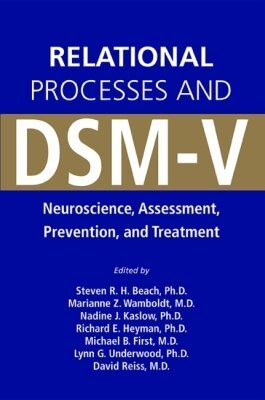
Seeking to integrate the large volume of clinical research on relational processes and mental health disorders with other scientific advances in psychiatry, Relational Processes and DSM-V builds on exciting advances in clinical research on troubled relationships. These advances included marked improvements in the assessment and epidemiology of troubled relationships as well the use of genetics, neuroscience, and immunology to explore the importance of close relationships in clinical practice. Advances in family-based intervention, and prevention are also highlighted to help practitioners and researchers find common ground and begin an empirically based discussion about the best way to revise the DSM. Given the overwhelming research showing that relationships play a role in regulating neurobiology and genetic expression and are critical for understanding schizophrenia, conduct disorder, and depression among other disorders, relational processes must be a part of any empirically based plan for revising psychiatric nosology in DSM-V.
The chapters in this book counter the perspective that we can safely discard the biopsychosocial model that has guided psychiatry in the past. The contributors examine the relevance of close relationships in such issues as the basic psychopathology of mental disorders, factors influencing maintenance and relapse, sources of burden for family members, and guiding family-based interventions. By tying relational processes to basic research on psychopathology, they demonstrate the value of integrating basic behavioral and brain research with a sophisticated understanding of the self-organizing and self-sustaining characteristics of relationships. Coverage includes: research linking relational processes to neuroscience, neurobiology, health outcomes, intervention research, prevention research, and genetics consideration of specific circumstances, such as promoting healthy parenting following divorce and relational processes in depressed Latino adolescents optimal approaches to the assessment of relational processes with clinical significance, such as child abuse, partner abuse, and expressed emotion. a simple introduction to the methodology of taxometrics, offering insight into whether key relational processes are distinct categories or continuously distributed variables an overview of the links between relational processes and psychiatric outcomes, providing a theoretical foundation for the discussion of links to psychopathology
Together, these contributions seek to develop a shared commitment among clinicians, researchers, and psychopathologists to take seriously the issue of relational processes as they relate to diagnoses within DSM-and to encourage mental health care workers at all levels to harness the generative and healing properties of intimate relationships and make them a focus of clinical practice. It is a book that will prove useful to all who are interested in integrating greater sensitivity to relational processes in their work.