Richard Milner - Böcker
Visar alla böcker från författaren Richard Milner. Handla med fri frakt och snabb leverans.
10 produkter
10 produkter
282 kr
Skickas inom 3-6 vardagar
Alfred Russel Wallace in Paradise
The Odyssey of a Victorian Evolutionist in His Own Words
Inbunden, Engelska, 2027
419 kr
Kommande
A breathtaking visual narrative of the legendary naturalist’s adventures and pioneering contributions to the life sciencesIn old age, Alfred Russel Wallace (1823–1913) became arguably the most famous scientist of his day. He and his senior colleague, Charles Darwin, had independently discovered the theory of evolution by natural selection, which they jointly published in 1858. Yet this genius’s legacy was overshadowed by Darwin’s for more than a century. Alfred Russel Wallace in Paradise paints an unprecedented portrait of the indefatigable explorer and hero of science whose self-effacing modesty contributed to his long obscurity.Wallace pioneered our understanding of the mechanisms of evolution, humanity’s place in nature, the worldwide distribution of plants and animals, and tribal cultures. Anthropologist Richard Milner scoured Wallace’s journals and papers to recount the naturalist’s voyages to the Amazon and Malay Archipelago and his return to England—entirely in Wallace’s own words—while tracing the origins of his ideas on evolution, biogeography, animal coloration, and sexual selection. Newly illustrated maps, personal letters, and recent photographs of wildlife and tropical ecosystems bring his travels and theories vividly to life.With sumptuous images by award-winning National Geographic photographer Tim Laman and other artists, Alfred Russel Wallace in Paradise is a visually spectacular account of Wallace’s journeys and his enduring insights into biodiversity and evolution.
438 kr
Skickas
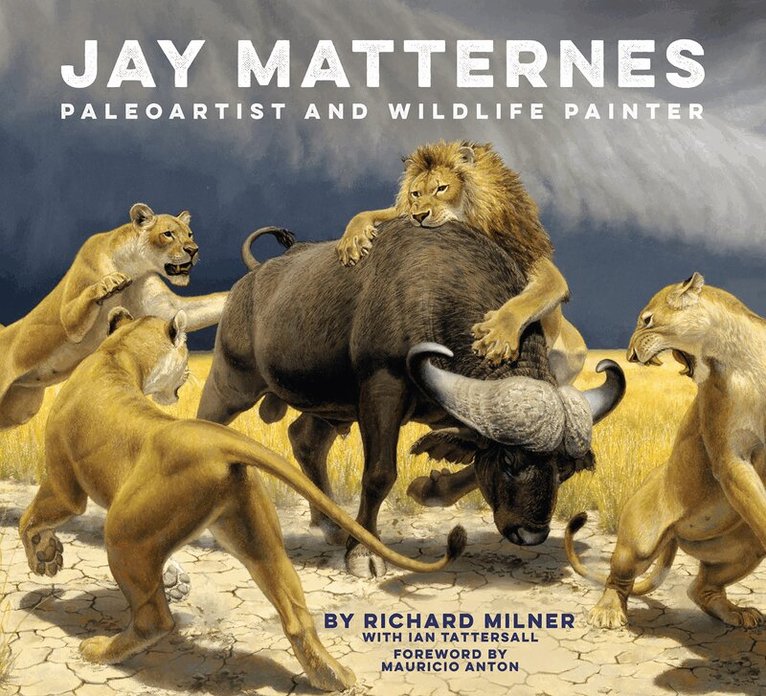
"In conclusion, I have nothing but praise for this book. The production values are top-notch and I am so pleased that Milner both took his time to write this book, and was able to see it through to completion together with Matternes." — The Inquisitive BiologistThe first career-spanning volume on Jay Matternes (b. 1933), whose scientific rigor and artistic skill set a new standard in natural history illustration.Millions have grown up inspired by Jay Matternes’ murals of extinct mammals at the Smithsonian’s National Museum of Natural History and the American Museum of Natural History. Others have savoured his depictions of human origins in such prestigious publications as Science, National Geographic, Scientific American, and Natural History. Matternes’ art has also graced popular books by such trailblazing wildlife scientists as Jane Goodall, Dian Fossey, and Louis Leakey.Now, for the first time, the entire scope of Matternes’ achievement is revealed in this full-colour retrospective, prepared with the artist’s full cooperation and featuring many works never before published. Here are his depictions of living species, whose anatomical accuracy and vivid detail owe much to Matternes’ lifelong devotion to painting from nature: the wildlife of Africa, the birds of America, chimpanzees and gorillas, and more. Here, too, is his paleoart, meticulously reconstructed from the fossil evidence and ranging from dinosaurs, through the rise of mammals, to our hominid ancestors — including Matternes’ groundbreaking reconstruction of the 4.4-million-year-old hominin Ardipithecus, on which he laboured in secrecy for more than a decade. The highly readable text includes, among other special features, selections from the artist’s 20-year correspondence with the late Dian Fossey.Jay Matternes: Paleoartist and Wildlife Painter will be an essential volume not only for aspiring illustrators and paleoartists, but for anyone with an interest in the natural world and how we visualise it.
489 kr
Skickas inom 3-6 vardagar
1 584 kr
Skickas inom 10-15 vardagar
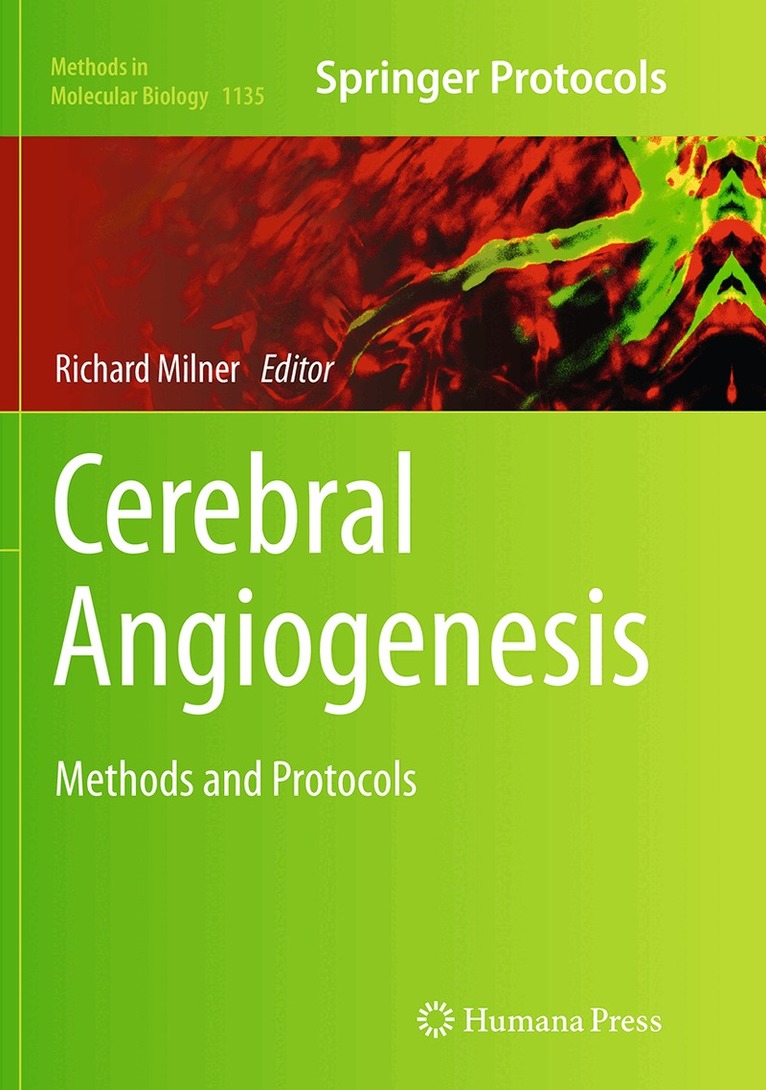
Providing a selection of the key techniques that are used in characterizing cerebral angiogenesis, Cerebral Angiogenesis: Methods and Protocols aims to define the cellular and molecular mechanisms underlying this important process. Divided into six parts, this detailed volume examines cerebral angiogenesis occurring in different scenarios, a variety of different models in which cerebral angiogenesis can be studied, methods to characterize and quantify angiogenic events as well as several different approaches to measure changes in cerebral blood flow, different approaches to investigate the role of specific candidate genes in cerebral angiogenesis, methods of therapeutically manipulating cerebral angiogenesis by gene delivery, and finally important approaches to examine cerebral angiogenic mechanisms in vitro. Written in the highly successful Methods in Molecular Biology series format, chapters include introductions to their specific topics, lists of the necessary materials and reagents, step-by-step, readily reproducible laboratory protocols, and tips on troubleshooting and avoiding known pitfalls. Comprehensive and decidedly practical, Cerebral Angiogenesis: Methods and Protocols should be a vital resource for all researchers, both those new to this field as well as those looking to use more specialized and sophisticated techniques to examine blood vessel growth in the brain.
1 175 kr
Skickas inom 10-15 vardagar
Providing a selection of the key techniques that are used in characterizing cerebral angiogenesis, Cerebral Angiogenesis: Methods and Protocols aims to define the cellular and molecular mechanisms underlying this important process. Divided into six parts, this detailed volume examines cerebral angiogenesis occurring in different scenarios, a variety of different models in which cerebral angiogenesis can be studied, methods to characterize and quantify angiogenic events as well as several different approaches to measure changes in cerebral blood flow, different approaches to investigate the role of specific candidate genes in cerebral angiogenesis, methods of therapeutically manipulating cerebral angiogenesis by gene delivery, and finally important approaches to examine cerebral angiogenic mechanisms in vitro. Written in the highly successful Methods in Molecular Biology series format, chapters include introductions to their specific topics, lists of the necessary materials and reagents, step-by-step, readily reproducible laboratory protocols, and tips on troubleshooting and avoiding known pitfalls. Comprehensive and decidedly practical, Cerebral Angiogenesis: Methods and Protocols should be a vital resource for all researchers, both those new to this field as well as those looking to use more specialized and sophisticated techniques to examine blood vessel growth in the brain.
1 794 kr
Skickas inom 10-15 vardagar
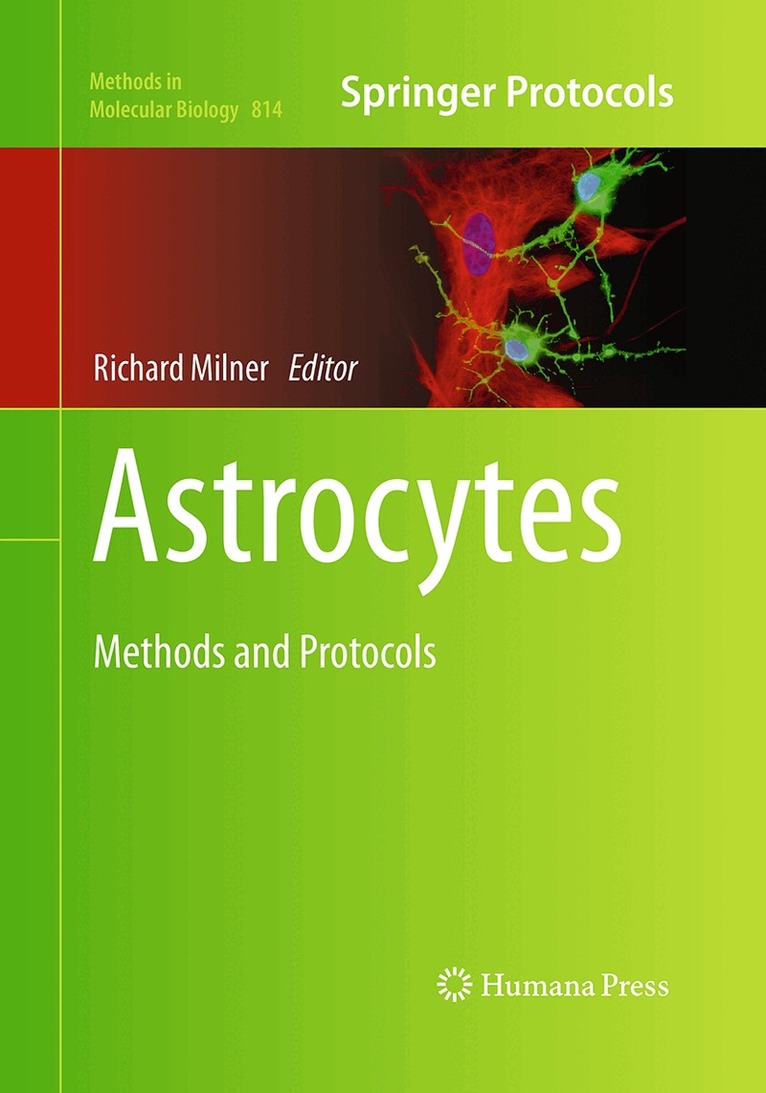
Ever since their discovery more than 150 years ago, astrocytes have proved to be something of an enigma. Only in the last 10-15 years has it become clear that astrocytes are multifunctional versatile cells that play key roles in a multitude of diverse processes in the CNS, including generation of neural stem cells, synaptogenesis, and regulation of the blood-brain barrier and neurovascular unit. Astrocytes: Methods and Protocols provides scientists with a comprehensive guide to many techniques used for astrocyte cell culture, as well as more specialized approaches for studying astrocyte functions, both in vitro and in vivo. Key cellular, molecular and biochemical techniques are used to study the many and varied functions of this fascinating cell. Written in the highly successful Methods in Molecular Biology™ series format, chapters include introductions to their respective topics, lists of the necessary materials and reagents, step-by-step, readily reproducible laboratory protocols, and key tips on troubleshooting and avoiding known pitfalls.
2 110 kr
Skickas inom 10-15 vardagar
Ever since their discovery more than 150 years ago, astrocytes have proved to be something of an enigma. Only in the last 10-15 years has it become clear that astrocytes are multifunctional versatile cells that play key roles in a multitude of diverse processes in the CNS, including generation of neural stem cells, synaptogenesis, and regulation of the blood-brain barrier and neurovascular unit. Astrocytes: Methods and Protocols provides scientists with a comprehensive guide to many techniques used for astrocyte cell culture, as well as more specialized approaches for studying astrocyte functions, both in vitro and in vivo. Key cellular, molecular and biochemical techniques are used to study the many and varied functions of this fascinating cell. Written in the highly successful Methods in Molecular Biology™ series format, chapters include introductions to their respective topics, lists of the necessary materials and reagents, step-by-step, readily reproducible laboratory protocols, and key tips on troubleshooting and avoiding known pitfalls.
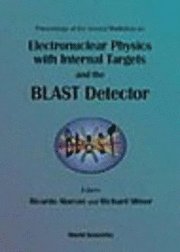
Electronuclear Physics With Internal Targets And The Blast Detector: Proceedings Of The Second Workshop
Inbunden, Engelska, 1999
2 255 kr
Tillfälligt slut
The Second Workshop on Electronuclear Physics with Internal Targets and the Bates Large Acceptance Spectrometer Toroid (BLAST) took place at the Massachusetts Institute of Technology in May 1998. A total of 75 physicists from 26 institutions located in seven countries participated in a lively meeting focused on the unique and important advantages of polarized gas targets internal to an electron storage ring in the study of hadron structure. This meeting has reaffirmed the contributions that BLAST will make in the area of few-body physics.The BLAST detector is designed to measure the spin-dependent electromagnetic response of light nuclei in the momentum transfer range up to 0.8 (GeV/c)2. It will use the 1 GeV longitudinally polarized beam of the Bates South Hall Ring and polarized internal targets. BLAST is scheduled to be completed in 2001.
712 kr
Skickas inom 3-6 vardagar
This book describes the story of how a collaboration of several hundred physicists from Europe and North America formed in 1988 to design, construct, install, commission and operate, for the years 1995-2007 the technically innovative HERMES experiment at the DESY laboratory in Hamburg, Germany to study the spin structure of the fundamental structure of matter. The authors begin by introducing the fascinating world of subatomic physics and relate their personal story of how the HERMES experiment came about. Guided by the exciting idea to use a new type of target internal to an electron storage ring, the HERMES collaboration was born to realize this innovative experimental approach at the new HERA accelerator at DESY. The book describes the technical design of HERMES; the successful effort to secure the necessary funds to construct the experiment in different countries; the fabrication of the different components by the different HERMES institutes; and the story of the installation and commissioning of HERMES in the East Hall of HERA in the hot summer of 1995. Until 2007, when the operation of HERA ceased, the collider ran typically about 9 months per year continuously, during which HERMES data taking shifts were manned to ensure that data of the highest quality were acquired. The book describes the HERMES scientific results, their considerable impact, how HERMES shaped an entire generation of young people into scientific leaders, and ends with a description of the twenty-first century picture of the proton that has subsequently been developed.The authors played a leading role within the HERMES collaboration. They describe, using non-technical language, the various phases of the thirteen years of running, the social life in such an international collaboration, and their personal reminiscences over several decades.