Richard S. Balkin - Böcker
Visar alla böcker från författaren Richard S. Balkin. Handla med fri frakt och snabb leverans.
8 produkter
8 produkter
Myths, Misconceptions, and Invalid Assumptions of Counseling and Psychotherapy
Inbunden, Engelska, 2020
382 kr
Skickas inom 5-8 vardagar
There are certain assumptions about the practice of counseling that are accepted as "truths," beliefs that are so pervasive that they remain unchallenged by almost all practitioners of all persuasions and approaches. In this book noted authors Jeffrey Kottler and Rick Balkin cover a wide range of myths, misconceptions, and assumptions that have remained unchallenged or that have little research to support their efficacy. Topics covered include the sacrosanct "50 minute hour," how basic research is conducted and whether the results inform actual practice, why progress made in therapy often doesn't last, what social justice actually means, and what makes someone an effective therapist. Each chapter describes an issue, explores the way it operates in daily practice, and then presents empirical evidence to question or challenge its current use. In cases where there is little or no definitive research to support or refute the procedure, belief, or practice the authors present some critical questions that will at the very least encourage counselors to reflect on what they do and why.
1 219 kr
Skickas inom 5-8 vardagar
Students often experience assessment courses, and subsequently the textbooks used for the course, as a statistics-heavy class accompanied by an encyclopedia of a variety of assessments. Assessment in Counseling alternatively emphasizes the skills used in assessment, thereby enabling students to apply these skills across a broad range of assessment instruments and strategies. Assessment, like most core areas of counseling, has a theoretical basis and a pertinent, practical component. However, this practical component often gets lost in the application of the skills and use of instruments that heavily rely on psychometric properties. Written in an accessible, conversational tone, this text focuses on the application of the theoretical and measurement concepts of assessment in counseling and introduces three case studies that are followed throughout the text. Additionally, instead of introducing readers to a plethora of instruments, the authors select seminal measures that students are likely to approach and use in the profession. Through the use of this text and course content, one will acquire the skills to search, select, and administer the type of assessment instruments that he/she deems helpful for their practice as a professional counselor, regardless of specialization. Ultimately, this textbook serves as an invaluable guide for administering, scoring, interpreting, and communicating assessment results.
337 kr
Skickas inom 5-8 vardagar
Our relationships enrich our lives. Strong bonds with family, friends, and colleagues make our lives full and vibrant, but they can also be a source of distress or even trauma. Few relationships are perfect, and we often find ourselves let down by even the people we count on most; learning to navigate the challenges is vital to protecting our health and wellbeing.In this book the author presents a model for forgiveness that addresses how we either repair relationships when someone has harmed us, or how we move forward when relationships are beyond repair. Repairing a relationship is not always practical. The model presented in this book can be helpful to promote self-healing and to either re-establish relationships with others or move forward when reconciliation is harmful or not possible. Practicing Forgiveness draws on the perspectives of counseling professionals from across the country to explore contextual and cultural aspects of forgiveness with stories, humor, clinical examples, research, and empirical findings, while also considering the influence of environment and religion. The forgiveness process is a universal one, and this book serves as a resource to anyone wishing to gain insight into their own personal journey.
515 kr
Skickas inom 5-8 vardagar
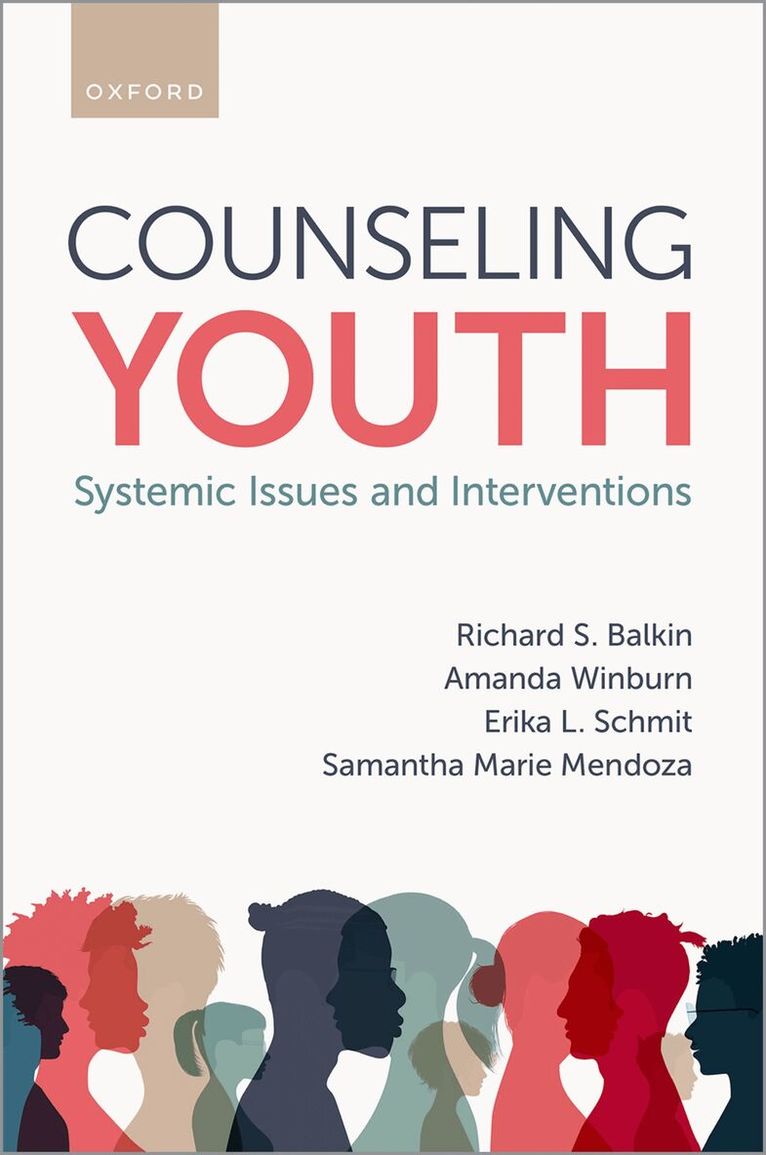
Counseling Youth: Systemic Issues and Interventions highlights the nature of counseling youth and implementing interventions from a systemic perspective. This systemic perspective focuses on the multitude of issues and systems that impact youth and mental health, such as academic progress and achievement; emotional and behavioral problems; and overall behaviors that impact physical and emotional well-being. As these aforementioned issues are addressed, highlighted are the roles of various systems, including schools, mental health facilities, medical facilities, juvenile justice systems, and refugee services, as well as services geared to special populations, such as LGBT+ youth and undocumented immigrant minors. Included in this text is a brief overview of child-adolescent development that then focuses on issues, policies, and services for counseling youth in schools, communities, and clinical settings. Central to this book are the issues that families, schools, and communities are having difficulty addressing, such as trauma, abuse, suicide, teen pregnancy, and antisocial behavior, and the key to addressing these issues by utilizing a variety of resources within the system and advocating for systemic change. Utilized is a multidimensional focus on development, issues, and strategies, providing an integrative approach so that clinicians (present and future) have an understanding of the theory, concerns, policies, and approaches for working youth. This book also utilizes a transtheoretical approach and attempts to provide an overview of approaches and interventions regardless of theoretical approach. Unlike books that focus on a singular model, this approach is to speak to a variety of individuals training to be clinicians from a variety of backgrounds (e.g., social work, marriage and family therapy, counseling, psychology).
963 kr
Skickas inom 5-8 vardagar
Assessment in Counseling takes a different approach to assessment courses, which students often experience as a statistics-heavy class accompanied by a wide variety of assessments. Richard S. Balkin and Gerald A. Juhnke emphasize the skills used in assessment and supports the use of these skills across a broad range of assessment instruments and strategies. Assessment, like more core areas of counseling, has a theoretical basis and a pertinent, practical component. However, this practical component often gets lost in the application of the skills and use of instructions that heavily rely on psychometric properties.Written in an accessible, conversational tone, the book focuses on the application of the theoretical and measurement concepts of assessment in counseling and introduces three case studies that are followed throughout the text. Instead of introducing readers to a plethora of instruments, Balkin and Juhnke have selected seminal measures that students are likely to come across and use in the profession. Through the use of this book and their course content, students will gain the skills to search, select, and administer the type of assessment instruments deemed helpful for their practice as a professional counselor, regardless of specialization. This new edition provides updates on the laws, codes, and instruments covered, the most recent application of measures and the psychometric properties associated with them, and additions on career assessment and personality. It also features a new chapter on environmental assessment that highlights data collection practices and the role of assessing, accommodating, and recommending levels of care. Ultimately, this textbook serves as a guide for administering, scoring, interpreting, and communicating assessment results.
299 kr
Skickas inom 5-8 vardagar
This engaging book not only offers step-by-step guidance on planning, writing, and defending a dissertation but also helps create a beginning-to-end process that is meaningful, rewarding, and exciting. Each chapter answers commonly asked questions, contains a checklist for each part of the dissertation, provides a summary of key points, and lists additional resources. Topics addressed include tips for staying motivated, time management, and self-care; selecting a dissertation committee and narrowing down the topic; writing a proposal; preparing the literature review; creating the problem statement, purpose statement, and research questions; understanding research methodology and ethics; collecting and analyzing data; presenting results; and best of all-publishing a dissertation.
424 kr
Skickas inom 5-8 vardagar
In this engaging book, Jeffrey Kottler and Richard Balkin address common misconceptions about what works in counseling and offer suggestions for building constructive counseling relationships and facilitating positive counseling outcomes. Key aspects of the client-counselor relationship are supported by interesting examples and stories integrated with clinically useful research on counseling results. Part 1 reviews basic assumptions about the nature of helping relationships and examines how and why they can empower client change efforts. Part 2 describes practical approaches to encourage client trust and growth, including chapters on the cultural and environmental context of relationships; the ways in which counseling is used to treat trauma; how exchanging stories solidifies and fortifies counseling relationships; and using creative and innovative techniques to enhance relationships. Part 3 discusses the influence of relationships on counselors' personal lives and explores how counselors are affected by their work, process disappointments and failures, and deal with personal conflicts.
652 kr
Skickas inom 5-8 vardagar
This widely adopted and accessible introductory text for counselors-in-training and emerging researchers provides a foundational understanding of the primary research methods used in counseling and how these concepts can be applied to research design. Writing in a clear and conversational tone, the authors emphasize the importance of ethics and multicultural issues in informing research, demonstrate a professional counselor identity within the framework of research, and outline specific evidence-based and empirically supported findings for counseling practice.The book contains four parts that explain the practitioner-scholar model and the research process, quantitative and qualitative research methodology and design, and research measurement and program evaluation. Key features include a discussion of the fundamentals of statistics, practical research design illustrations in each chapter, guidelines for the development of an initial study, and suggested activities that synthesize and apply chapter content.