Richard T Williams – författare
Visar alla böcker från författaren Richard T Williams. Handla med fri frakt och snabb leverans.
7 produkter
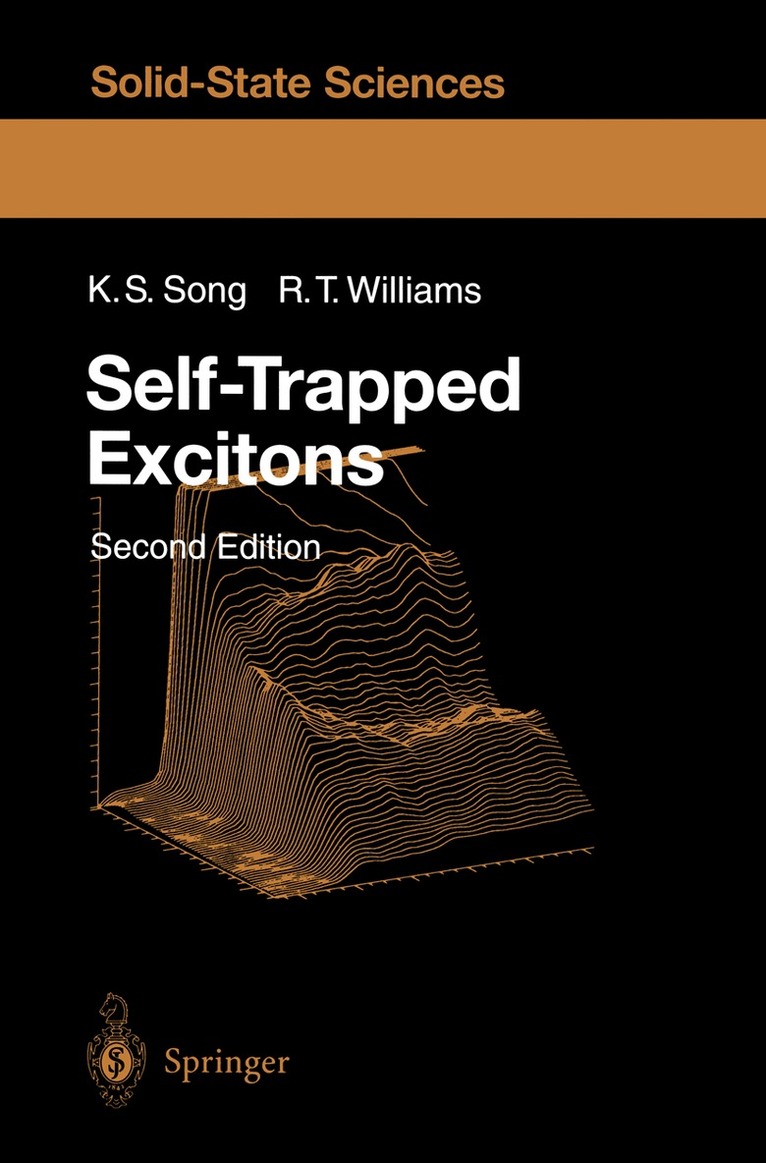
Self-Trapped Excitons
Av K.S. Song, Richard T. Williams m. fl.
Häftad, 1996
1534 kr
Lägg i varukorg
Self-Trapped Excitons discusses the structure and evolution of the self-trapped exciton (STE) in a wide range of materials. It includes a comprehensive review of experiments and extensive tables of data. Emphasis is given throughout to the unity of the basic physics underlying various …
Self-Trapped Excitons
Av Richard T. Williams, K.S. Song
E-bok, 2013
1906 kr
Lägg i varukorg
Self-Trapped Excitons discusses the structure and evolution of the self-trapped exciton (STE) in a wide range of materials. It includes a comprehensive review of experiments and extensive tables of data. Emphasis is given throughout to the unity of the basic physics underlying various …
Self-Trapped Excitons
Av Richard T. Williams, K.S. Song
E-bok, 2012
1174 kr
Lägg i varukorg
In crystals as diverse as sodium chloride, silicon dioxide,sold xenon, pyrene, arsenic triselenide, and silverchloride, the fundamental electronicexcitation (exciton) islocalized within its own lattice distortion field veryshortly after its creation. This book discusses thestructure if the …
Excitonic and Photonic Processes in Materials
Av Jai Singh, Richard T. Williams
Häftad, 2016
1098 kr
Lägg i varukorg
This book is expected to present state-of-the-art understanding of a selection of excitonic and photonic processes in useful materials from semiconductors to insulators to metal/insulator nanocomposites, both inorganic and organic. Among the featured applications are components of solar cells, …
Excitonic and Photonic Processes in Materials
Av Jai Singh, Richard T. Williams
Inbunden, 2014
1095 kr
Lägg i varukorg
This book is expected to present state-of-the-art understanding of a selection of excitonic and photonic processes in useful materials from semiconductors to insulators to metal/insulator nanocomposites, both inorganic and organic. Among the featured applications are components of solar cells, …
Excitonic and Photonic Processes in Materials
Av Richard T. Williams, Jai Singh
E-bok, 2014
1459 kr
Lägg i varukorg
This book is expected to present state-of-the-art understanding of a selection of excitonic and photonic processes in useful materials from semiconductors to insulators to metal/insulator nanocomposites, both inorganic and organic. Among the featured applications are components of solar cells, …