Rita Figueiras - Böcker
Visar alla böcker från författaren Rita Figueiras. Handla med fri frakt och snabb leverans.
3 produkter
3 produkter
724 kr
Skickas inom 10-15 vardagar
The western economic and financial crisis began with the collapse of Lehman Brothers in 2008 and led the European Union countries into recession. After this, governments started to implement austerity measures, such as cuts in public spending, including public subsidies and jobs, and rising prices. In this context, Europe started to experience a wave of protest movements. Individuals started to use the manifold interactive digital media environment to both fight against the austerity measures and find alternative ways of claiming their democratic rights. Inspired by the 2011 Arab Spring and the Occupy Wall Street movement in New York (USA), the Occupy LSX encampment in Central London (UK), The Outraged (Los Indignados)/ 15M encampment in Central Madrid (Spain), the Syntagma Square’s Outraged movement in Athens (Greece) and the March 12th Movement in Lisbon (Portugal), although short-lived, epitomize an emerging alternative politics and participation via the media. This wave has promoted a debate on how the realm of politics is changing, as citizens broaden their ideas of what political issues and participation mean.Beyond the Internet examines the technological dimension of the recent wave of protest movements in the United Kingdom, Spain, Portugal, Greece, and Ireland. Offering an opportunity to achieve a better understanding of the dynamics between society, politics and technology, this volume questions the essentialist attributes of the Internet that fuel the techno-centric discourse. The contributors illustrate how all these protest movements were active in the social media and garnered high levels of media attention and public visibility, in spite of their failure to achieve their political goals. As intra-elite dissent was pivotal in understanding the Arab uprisings, the coalition of national ruling elites with European institutions in terms of austerity strategy is essential in understanding the limits of media/technology power and, therefore, the dissociation between communication and representative power.
2 171 kr
Skickas inom 10-15 vardagar
The western economic and financial crisis began with the collapse of Lehman Brothers in 2008 and led the European Union countries into recession. After this, governments started to implement austerity measures, such as cuts in public spending, including public subsidies and jobs, and rising prices. In this context, Europe started to experience a wave of protest movements. Individuals started to use the manifold interactive digital media environment to both fight against the austerity measures and find alternative ways of claiming their democratic rights. Inspired by the 2011 Arab Spring and the Occupy Wall Street movement in New York (USA), the Occupy LSX encampment in Central London (UK), The Outraged (Los Indignados)/ 15M encampment in Central Madrid (Spain), the Syntagma Square’s Outraged movement in Athens (Greece) and the March 12th Movement in Lisbon (Portugal), although short-lived, epitomize an emerging alternative politics and participation via the media. This wave has promoted a debate on how the realm of politics is changing, as citizens broaden their ideas of what political issues and participation mean.Beyond the Internet examines the technological dimension of the recent wave of protest movements in the United Kingdom, Spain, Portugal, Greece, and Ireland. Offering an opportunity to achieve a better understanding of the dynamics between society, politics and technology, this volume questions the essentialist attributes of the Internet that fuel the techno-centric discourse. The contributors illustrate how all these protest movements were active in the social media and garnered high levels of media attention and public visibility, in spite of their failure to achieve their political goals. As intra-elite dissent was pivotal in understanding the Arab uprisings, the coalition of national ruling elites with European institutions in terms of austerity strategy is essential in understanding the limits of media/technology power and, therefore, the dissociation between communication and representative power.
129 kr
Skickas inom 5-8 vardagar
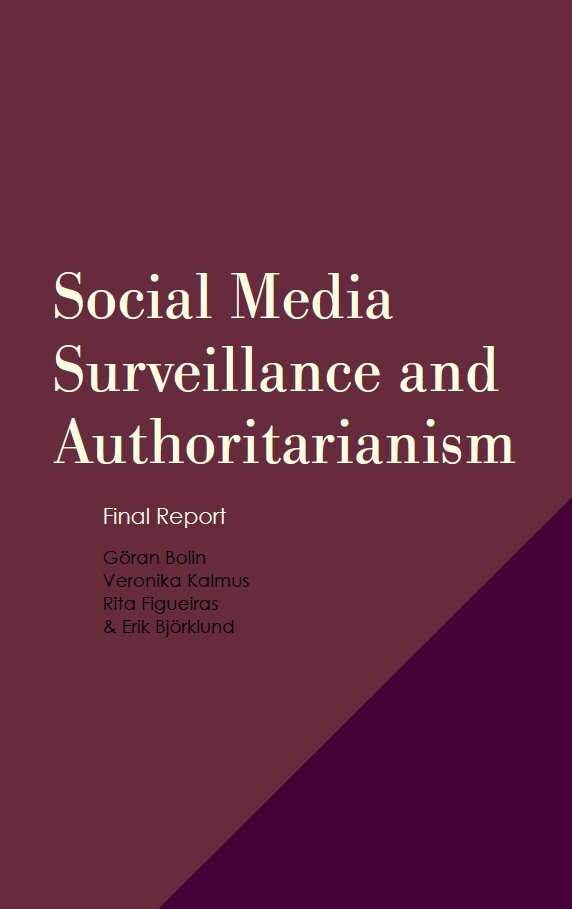
What are the attitudes of online media users to the vast collection of personal data held by commercial platform companies? Do previous experiences of state surveillance have an impact on these attitudes? Do they differ for those brought up in the surveillance regime of Estonia during the Soviet Union era, or who experienced the surveillance apparatus in Portugal under authoritarian dictatorship? Do Swedish media users without authoritarian surveillance experiences differ in their attitudes to commercial surveillance? These questions are discussed in this final report from the project Social Media Surveillance and Authoritarianism (Riksbankens Jubileumsfond, 2020–2023), a three-country comparative study (Estonia, Portugal, Sweden). The project aimed to analyse the role of past experiences of state surveillance on attitudes to dataveillance, that is, the commercial surveillance stemming from online media that is at the heart of data capitalism. The report accounts for the aims, objectives, theoretical and methodological points of departure and and presents empirical examples of the results.