Ritesh Modi – författare
Visar alla böcker från författaren Ritesh Modi. Handla med fri frakt och snabb leverans.
13 produkter
13 produkter
E-bok
Engelska, 2026191 kr
Läs direkt efter köp
Everyone has an opinion about Bitcoin. Almost no one can explain it.*Twenty-One Million* fixes that - not with a lecture, but with a story. Four colleagues at a staid insurance company are handed a thankless assignment: decide, in one page, whether the firm should touch Bitcoin. Margaret, who runs risk and trusts no one with money after being burned once, fully intends to write *no*. To do it honestly, she has to understand the thing first — and so, one Thursday at a time, in the worst conference room in the building, she and three equally skeptical colleagues take Bitcoin apart on a whiteboard and try to break every piece.They start where everyone's confusion starts ("e;what *is* a coin?"e;) and end up somewhere they never expected: convinced that a ledger no one controls is harder to cheat than the bank down the street. Along the way the book quietly teaches the whole machine - keys and signatures, the chain, mining, why nobody can print more, how to actually buy and hold it without losing everything, and how to spot the scams built to take it from you.It is the rare explainer that respects you enough to be honest about the costs as well as the magic. If you've read three articles about Bitcoin and still couldn't say what it really *is*, start here.Written by Ritesh Modi - a longtime blockchain educator and author of two books on smart-contract programming - whose philosophy is simple and severe: make a hard thing clear without making it any smaller than the truth allows.
Häftad, Engelska, 2017
507 kr
Skickas inom 10-15 vardagar
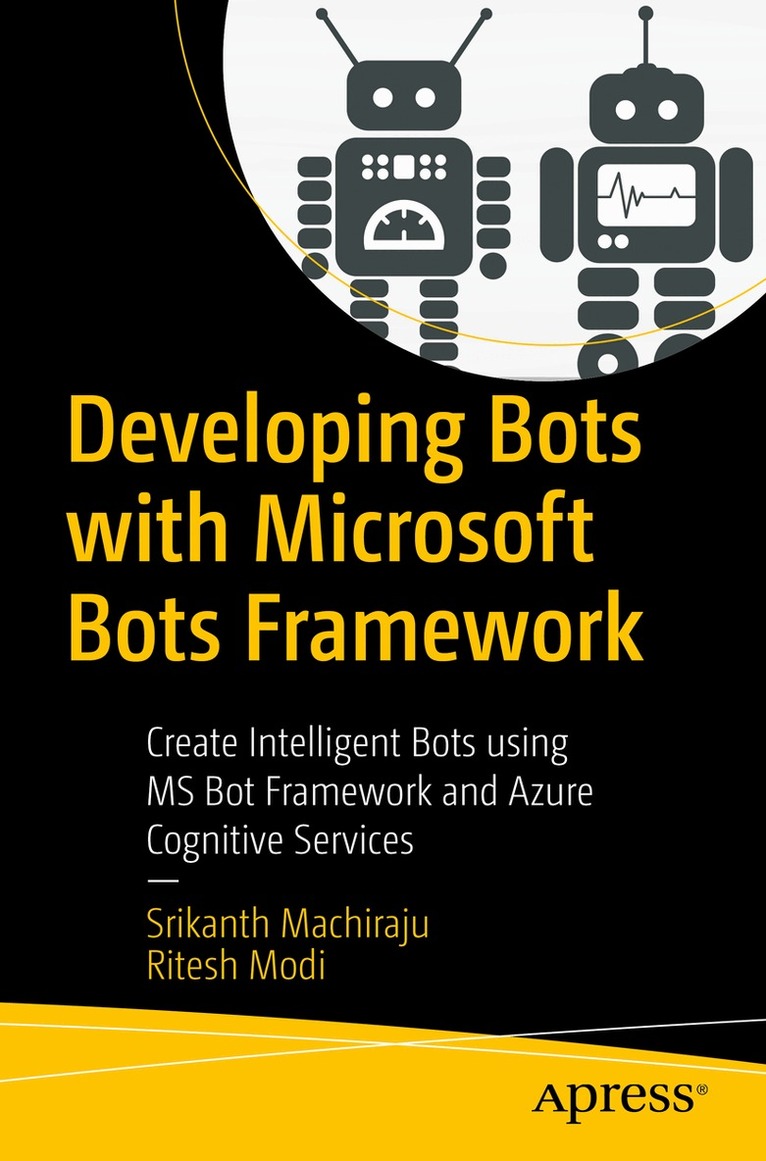
Develop Intelligent Bots using Microsoft Bot framework (C# and Node.js), Visual Studio Enterprise & Code, MicrosoftAzure and Cognitive Services. This book shows you how to develop great Bots, publish to Azure and register with Bot portal so that customers canconnect and communicate using famous communication channels like Skype, Slack, Web and Facebook. You'll also learn how to build intelligence into Bots using Azure Cognitive Services like LUIS, OCR, Speech to Text and Web Search.Bots are the new face of user experience. Conversational User Interface provides many options to make userexperience richer, innovative and engaging with email, text, buttons or voice as the medium for communication.Modern line of business applications can be replaced or associated with Intelligent Bots that can use data/historycombined with Machine Intelligence to make user experience inclusive and exciting.With Developing Bots with Microsoft Bots Framework, you'll see just how simple Bot building can be.What You'll LearnBuild Bots using MS Bot framework on Windows and Non-Windows platformsPublish your Bot to the cloud in minutesCreate rich communication platforms between your application and users Apply Artificial Intelligence and Machine Learning to your applicationsWho This Book Is ForDevelopers and Architects who design and build modern applications or communication platforms using MS stack or open source technologies. Business Analysts and UX Specialists interested in designing and building trendy user interfaces/platforms using Bots and Azure ML
E-bok
Engelska, 2017629 kr
Läs direkt efter köp
Develop Intelligent Bots using Microsoft Bot framework (C# and Node.js), Visual Studio Enterprise & Code, MicrosoftAzure and Cognitive Services. This book shows you how to develop great Bots, publish to Azure and register with Bot portal so that customers canconnect and communicate using famous communication channels like Skype, Slack, Web and Facebook. You''ll also learn how to build intelligence into Bots using Azure Cognitive Services like LUIS, OCR, Speech to Text and Web Search.Bots are the new face of user experience. Conversational User Interface provides many options to make userexperience richer, innovative and engaging with email, text, buttons or voice as the medium for communication.Modern line of business applications can be replaced or associated with Intelligent Bots that can use data/historycombined with Machine Intelligence to make user experience inclusive and exciting.With Developing Bots with Microsoft Bots Framework, you''ll see just how simple Bot building can be.What You''ll LearnBuild Bots using MS Bot framework on Windows and Non-Windows platformsPublish your Bot to the cloud in minutesCreate rich communication platforms between your application and users Apply Artificial Intelligence and Machine Learning to your applicationsWho This Book Is ForDevelopers and Architects who design and build modern applications or communication platforms using MS stack or open source technologies. Business Analysts and UX Specialists interested in designing and building trendy user interfaces/platforms using Bots and Azure ML
Häftad, Engelska, 2021
619 kr
Skickas inom 10-15 vardagar
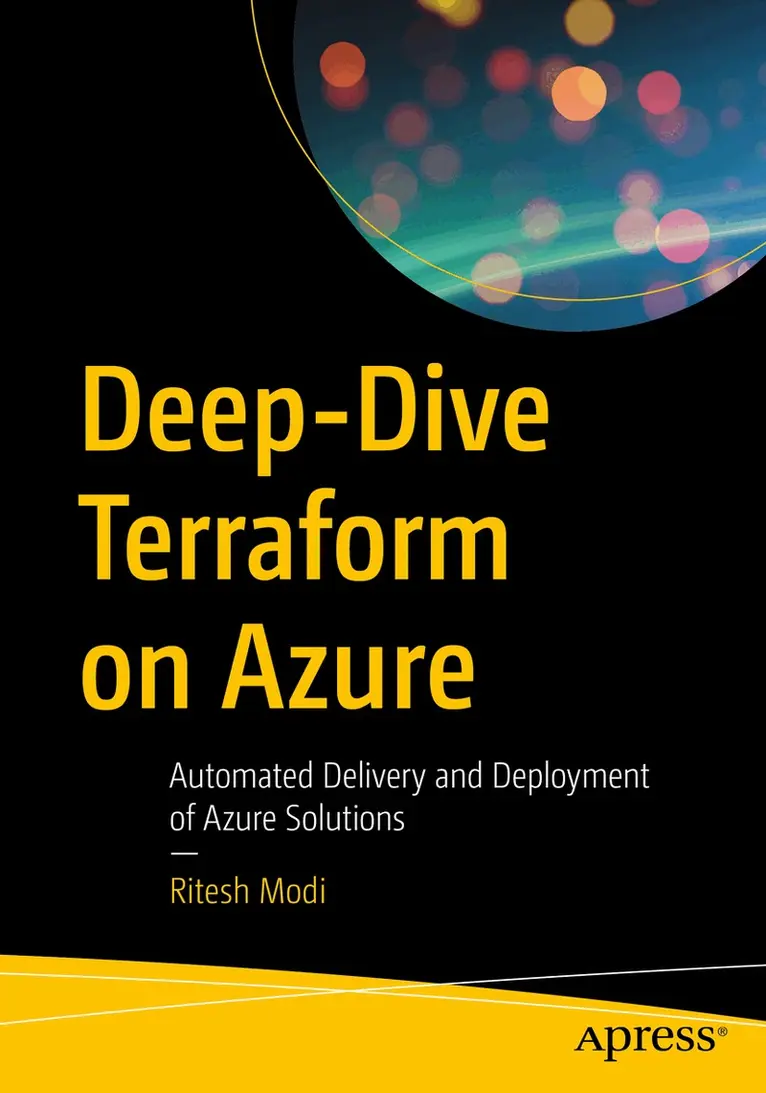
Get started with the foundations of Infrastructure as Code and learn how Terraform can automate the deployment and management of resources on Azure. This book covers all of the software engineering practices related to Terraform and Infrastructure as Code with Azure as a cloud provider.The book starts with an introduction to Infrastructure as Code and covers basic concepts, principles, and tools, followed by an overview of Azure and Terraform that shows you how Terraform can be used to provision and manage Azure resources. You will get started writing multiple Terraform scripts and explore its various concepts. Author Ritesh Modi takes a deep dive into Terraform and teaches you about deployment and multiple resource creation using loops. Writing a reusable script using modules is discussed as well as management and administration of secrets, sensitive data, and passwords within Terraform code. You will learn to store and version Terraform scripts and know how Terraform is used in Azure DevOps pipelines. And you will write unit and integration tests for Terraform and learn its best practices. The book also highlights and walks through the Terraform Azure Provider and shows you a simple way to create a new Terraform provider.After reading this book, you will be able to write quality Terraform scripts that are secure by design, modular, and reusable in Azure.What Will You LearnUnderstand implementation within infrastructure and application deploymentsProvision resources in Azure using TerraformUse unit and integration testingExplore concepts such as local vs remote, importing state, workspaces, and backends Who This Book Is ForSoftware engineers, DevOps professionals, and technology architects
896 kr
Läs direkt efter köp
Get started with the foundations of Infrastructure as Code and learn how Terraform can automate the deployment and management of resources on Azure. This book covers all of the software engineering practices related to Terraform and Infrastructure as Code with Azure as a cloud provider.The book starts with an introduction to Infrastructure as Code and covers basic concepts, principles, and tools, followed by an overview of Azure and Terraform that shows you how Terraform can be used to provision and manage Azure resources. You will get started writing multiple Terraform scripts and explore its various concepts. Author Ritesh Modi takes a deep dive into Terraform and teaches you about deployment and multiple resource creation using loops. Writing a reusable script using modules is discussed as well as management and administration of secrets, sensitive data, and passwords within Terraform code. You will learn to store and version Terraform scripts and know how Terraform is used in Azure DevOps pipelines. And you will write unit and integration tests for Terraform and learn its best practices. The book also highlights and walks through the Terraform Azure Provider and shows you a simple way to create a new Terraform provider.After reading this book, you will be able to write quality Terraform scripts that are secure by design, modular, and reusable in Azure.What Will You LearnUnderstand implementation within infrastructure and application deploymentsProvision resources in Azure using TerraformUse unit and integration testingExplore concepts such as local vs remote, importing state, workspaces, and backends Who This Book Is ForSoftware engineers, DevOps professionals, and technology architects
Häftad, Engelska, 2017
840 kr
Skickas inom 5-8 vardagar
Häftad, Engelska, 2017
628 kr
Skickas inom 5-8 vardagar
Your one stop guide to making the most out of Azure CloudAbout This Book• Get familiar with the different design patterns available in Microsoft Azure• Develop Azure cloud architecture and a pipeline management system• Get to know the security best practices for your Azure deploymentWho This Book Is ForIf you are Cloud Architects, DevOps Engineers, or developers who want to learn key architectural aspects of the Azure Cloud platform, then this book is for you. Prior basic knowledge of the Azure Cloud platform is good to have.What You Will Learn• Familiarize yourself with the components of the Azure Cloud platform• Understand the cloud design patterns• Use enterprise security guidelines for your Azure deployment• Design and implement Serverless solutions• See Cloud architecture and the deployment pipeline• Understand cost management for Azure solutionsIn DetailOver the years, Azure cloud services has grown quickly, and the number of organizations adopting Azure for their cloud services is also gradually increasing. Leading industry giants are finding that Azure fulfills their extensive cloud requirements.This book will guide you through all the important and tough decision-making aspects involved in architecturing a Azure public cloud for your organization. The book starts with an extensive introduction to all the categories of designs available with Azure. These design patterns focus on different aspects of cloud such as high availability, data management, and so on.Gradually, we move on to various aspects such as building your cloud structure and architecture. It will also include a brief description about different types of services provided by Azure, such as Azure functions and Azure Analytics, which can prove beneficial for an organization. This book will cover each and every aspect and function required to develop a Azure cloud based on your organizational requirements.By the end of this book, you will be in a position to develop a full-fledged Azure cloud.Style and approachThis hands-on guide to the Azure Cloud platform covers different architectural concepts and implementations necessary for any enterprise scale deployment.
Häftad, Engelska, 2018
503 kr
Skickas inom 5-8 vardagar
Häftad, Engelska, 2019
628 kr
Skickas inom 5-8 vardagar
Create advanced data and integrated solutions using Azure Event Grid, functions, and containersKey FeaturesGet familiar with the different design patterns available in Microsoft AzureDevelop Azure cloud architecture and a pipeline management systemGet to know the security best practices for your Azure deploymentBook DescriptionOver the years, Azure cloud services have grown quickly, and the number of organizations adopting Azure for their cloud services is also gradually increasing. Leading industry giants are finding that Azure fulfills their extensive cloud requirements.Azure for Architects – Second Edition starts with an extensive introduction to major designing and architectural aspects available with Azure. These design patterns focus on different aspects of the cloud, such as high availability, security, and scalability. Gradually, we move on to other aspects, such as ARM template modular design and deployments.This is the age of microservices and serverless is the preferred implementation mechanism for them. This book covers the entire serverless stack available in Azure including Azure Event Grid, Azure Functions, and Azure Logic Apps. New and advance features like durable functions are discussed at length. A complete integration solution using these serverless technologies is also part of the book. A complete chapter discusses all possible options related to containers in Azure including Azure Kubernetes services, Azure Container Instances and Registry, and Web App for Containers.Data management and integration is an integral part of this book that discusses options for implementing OLTP solutions using Azure SQL, Big Data solutions using Azure Data factory and Data Lake Storage, eventing solutions using stream analytics, and Event Hubs. This book will provide insights into Azure governance features such as tagging, RBAC, cost management, and policies.By the end of this book, you will be able to develop a full-?edged Azure cloud solution that is Enterprise class and future-ready.What you will learnCreate an end-to-end integration solution using Azure Serverless StackLearn Big Data solutions and OLTP–based applications on AzureUnderstand DevOps implementations using Azure DevOpsArchitect solutions comprised of multiple resources in AzureDevelop modular ARM templatesDevelop Governance on Azure using locks, RBAC, policies, tags and costLearn ways to build data solutions on AzureUnderstand the various options related to containers including Azure Kubernetes ServicesWho this book is forIf you are Cloud Architects, DevOps Engineers, or developers who want to learn key architectural aspects of the Azure Cloud platform, then this book is for you. Prior basic knowledge of the Azure Cloud platform is good to have.
Häftad, Engelska, 2019
455 kr
Skickas inom 5-8 vardagar
Compose and decompose ARM templates and use advanced concepts like looping, conditions, dependencies, PowerShell and Desired State Configuration.Key FeaturesDesign, implement, and unit test ARM templatesDevelop and deploy ARM templates following security best practicesBook DescriptionAzure Resource Manager (ARM) templates are declarations of Azure resources in the JSON format to provision and maintain them using infrastructure as code. This book gives practical solutions and examples for provisioning and managing various Azure services using ARM templates.The book starts with an understanding of infrastructure as code, a refresher on JSON, and then moves on to explain the fundamental concepts of ARM templates. Important concepts like iteration, conditional evaluation, security, usage of expressions, and functions will be covered in detail. You will use linked and nested templates to create modular ARM templates. You will see how to create multiple instances of the same resources, how to nest and link templates, and how to establish dependencies between them. You will also learn about implementing design patterns, secure template design, the unit testing of ARM templates, and adopting best practices.By the end of this book, you will understand the entire life cycle of ARM templates and their testing, and be able to author them for complex deployments.What you will learnUnderstand the foundations of ARM templates including nested and linked templatesDesign, create, and unit test ARM templates using best practicesLearn about conditional deployments, looping, Custom Script Extensions using PowerShell, Bash, and DSCImplement design patterns related to ARM templatesRun post-deployment PowerShell and Desired State Configuration scriptsCreate solutions and deploy them on Azure using ARM templatesWho this book is forThis books is for developers, DevOps engineers, and architects who have experience in Azure.
Häftad, Engelska, 2022
534 kr
Skickas inom 5-8 vardagar
A comprehensive guide sprinkled with lots of hands-on code samples to get you up and running with Solidity and writing your smart contracts on Blockchain and EthereumKey FeaturesLearn proven smart contract implementation challenges and solve them using SolidityGo deeper into Solidity to write effective upgradable and maintainable smart contracts using best practicesGet to grips with the latest version of Solidity with updated codes and examplesBook DescriptionSolidity is a high-level language for writing smart contracts, and the syntax has large similarities with JavaScript, thereby making it easier for developers to learn, design, compile, and deploy smart contracts on large blockchain ecosystems including Ethereum and Polygon among others. This book guides you in understanding Solidity programming from scratch.The book starts with step-by-step instructions for the installation of multiple tools and private blockchain, along with foundational concepts such as variables, data types, and programming constructs. You’ll then explore contracts based on an object-oriented paradigm, including the usage of constructors, interfaces, libraries, and abstract contracts. The following chapters help you get to grips with testing and debugging smart contracts. As you advance, you’ll learn about advanced concepts like assembly programming, advanced interfaces, usage of recovery, and error handling using try-catch blocks. You’ll also explore multiple design patterns for smart contracts alongside developing secure smart contracts, as well as gain a solid understanding of writing upgradable smart concepts and data modeling. Finally, you’ll discover how to create your own ERC20 and NFT tokens from scratch.By the end of this book, you will be able to write, deploy, and test smart contracts in Ethereum.What you will learnWrite efficient, effective, and secure smart contractsCode, compile, and test smart contracts in an object-oriented wayImplement assembly code in SolidityAdopt upgradable and haltable ownership and security design patternsUnderstand exception handling and debugging in SolidityCreate new ERC20 and NFT tokens from the ground upWho this book is forThis Ethereum book is primarily aimed at beginners who want to get started with Solidity Programming for developing an Ethereum smart contract. No prior knowledge of EVM is required, but knowing the basics of any programming language will help you follow along.
Häftad, Engelska, 2020
732 kr
Skickas inom 5-8 vardagar
Build and design multiple types of applications that are cross-language, platform, and cost-effective by understanding core Azure principles and foundational concepts Key FeaturesGet familiar with the different design patterns available in Microsoft AzureDevelop Azure cloud architecture and a pipeline management systemGet to know the security best practices for your Azure deploymentBook DescriptionThanks to its support for high availability, scalability, security, performance, and disaster recovery, Azure has been widely adopted to create and deploy different types of application with ease. Updated for the latest developments, this third edition of Azure for Architects helps you get to grips with the core concepts of designing serverless architecture, including containers, Kubernetes deployments, and big data solutions.You'll learn how to architect solutions such as serverless functions, you'll discover deployment patterns for containers and Kubernetes, and you'll explore large-scale big data processing using Spark and Databricks. As you advance, you'll implement DevOps using Azure DevOps, work with intelligent solutions using Azure Cognitive Services, and integrate security, high availability, and scalability into each solution. Finally, you'll delve into Azure security concepts such as OAuth, OpenConnect, and managed identities.By the end of this book, you'll have gained the confidence to design intelligent Azure solutions based on containers and serverless functions.What you will learnUnderstand the components of the Azure cloud platformUse cloud design patternsUse enterprise security guidelines for your Azure deploymentDesign and implement serverless and integration solutionsBuild efficient data solutions on AzureUnderstand container services on AzureWho this book is forIf you are a cloud architect, DevOps engineer, or a developer looking to learn about the key architectural aspects of the Azure cloud platform, this book is for you. A basic understanding of the Azure cloud platform will help you grasp the concepts covered in this book more effectively.
E-bok
Engelska, 2026123 kr
Läs direkt efter köp
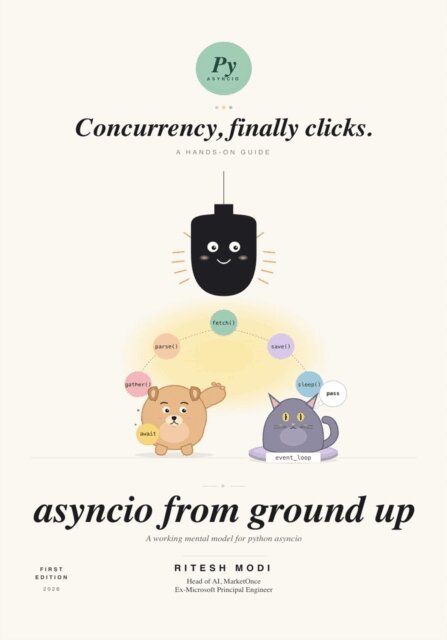
You have probably tried asyncio once and given up. You may have searched "e;python asyncio tutorial"e; and bounced off three of them. You may have copied an async def from somewhere without understanding why. You may have closed a code review the moment await appeared on the screen. None of those experiences is unusual, and none of them is your fault. The reason most readers find asyncio confusing is that the topic is taught keywords-first. The first page of a typical tutorial introduces async def, the second introduces await, and the reader is expected to imagine the runtime underneath. A keyword without a runtime is a name without a thing. The reader, fairly, gives up. After a few rounds of giving up, async code becomes "e;the topic I avoid"e;, and the avoidance hardens into a wall. This book is that wall coming down. Chapter 3 builds a working event loop in thirty lines of plain Python — no asyncio import in sight. Chapters 4 and 5 introduce async, await, and asyncio.run as labels for parts of a runtime you have already watched run. Every chapter after that adds one polished piece of the real asyncio module on top of a model you understand from the inside, because you wrote it. Across thirteen chapters, a single CLI script evolves from a blocking version that freezes for twelve seconds into a production-shaped program with structured concurrency, timeouts, traceable logs, cancellation, and graceful shutdown. A parallel-running example (tcpcheck.py) demonstrates that the model is portable: the same primitives, the same speedup, on raw TCP instead of HTTP. By the closing chapter, you can read async Python without flinching, write your own with confidence, and recognize when asyncio is the wrong tool and reach for the right one instead. If you are afraid of async and await, this is the book for you. The technology is small. The barrier is the order in which it has been taught to you. We are about to do it the other way around.