Robert A. Schneider - Böcker
Visar alla böcker från författaren Robert A. Schneider. Handla med fri frakt och snabb leverans.
6 produkter
6 produkter
483 kr
Skickas inom 5-8 vardagar
Dignified Retreat is a panoramic study of the vibrant literary and intellectual culture that emerged in early seventeenth-century France following the devastating Wars of Religion. This was a period that not only witnessed the recovery of the country following these wars, and the emergence of a strong, 'absolutist' monarchy under the Bourbons, but also the rise and refinement of the French language and the development of a literary culture that would soon be known as French classicism. Casting his net over a wide range of writers and intellectuals, Robert A. Schneider has assembled a roster of more than 100 men and women of letters, those constituting what he calls the 'generation of 1630'. While diverse, and indeed divided between those who hewed to traditional humanism and others more attuned to 'modern' linguistic and literary developments, this cohort largely shared a commitment to a cultural renewal of France, its rise to prominence in the geopolitical arena of Europe, and the emergence of a strong centralized monarchy. They depended on both the traditional aristocracy and the king's powerful minister, Cardinal Richelieu. But despite this dependency, these writers and intellectuals maintained a degree of independence and, more significantly, were the prime movers in crucial cultural developments that are too often identified with royal initiatives. For example, the author demonstrates that the Académie française, founded in 1635 by Richelieu, often considered formative in French cultural history, was actually more the result of the creative initiatives of these men of letters, which the savvy Cardinal only managed to co-opt and turn to the purposes of the crown.
2 321 kr
Skickas inom 5-8 vardagar
Dignified Retreat is a panoramic study of the vibrant literary and intellectual culture that emerged in early seventeenth-century France following the devastating Wars of Religion. This was a period that not only witnessed the recovery of the country following these wars, and the emergence of a strong, 'absolutist' monarchy under the Bourbons, but also the rise and refinement of the French language and the development of a literary culture that would soon be known as French classicism. Casting his net over a wide range of writers and intellectuals, Robert A. Schneider has assembled a roster of more than 100 men and women of letters, those constituting what he calls the 'generation of 1630'. While diverse, and indeed divided between those who hewed to traditional humanism and others more attuned to 'modern' linguistic and literary developments, this cohort largely shared a commitment to a cultural renewal of France, its rise to prominence in the geopolitical arena of Europe, and the emergence of a strong centralized monarchy. They depended on both the traditional aristocracy and the king's powerful minister, Cardinal Richelieu. But despite this dependency, these writers and intellectuals maintained a degree of independence and, more significantly, were the prime movers in crucial cultural developments that are too often identified with royal initiatives. For example, the author demonstrates that the Académie française, founded in 1635 by Richelieu, often considered formative in French cultural history, was actually more the result of the creative initiatives of these men of letters, which the savvy Cardinal only managed to co-opt and turn to the purposes of the crown.
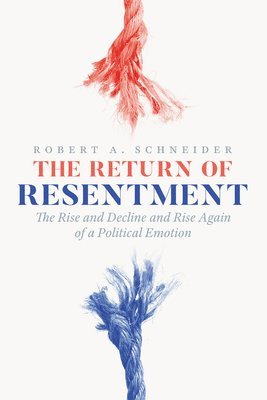
Return of Resentment
The Rise and Decline and Rise Again of a Political Emotion
Inbunden, Engelska, 2023
235 kr
Skickas inom 7-10 vardagar
Charts the long history of resentment, from its emergence to its establishment as the word of the moment. The term “resentment,” often casually paired with words like “hatred,” “rage,” and “fear,” has dominated US news analysis since November 2016. Despite its increased use, this word seems to defy easy categorization. Does “resentment” describe many interlocking sentiments, or is it just another way of saying “anger”? Does it suggest an irrational grievance, as opposed to a legitimate callout of injustice? Does it imply political leanings, or is it nonpartisan by nature? In The Return of Resentment, Robert A. Schneider explores these questions and more, moving from eighteenth-century Britain to the aftermath of the French Revolution to social movements throughout the twentieth century. Drawing on a wide range of writers, thinkers, and historical experiences, Schneider illustrates how resentment has morphed across time, coming to express a collective sentiment felt by people and movements across the political spectrum. In this history, we discover resentment’s modernity and its ambiguity—how it can be used to dismiss legitimate critique and explain away violence, but also convey a moral stance that demands recognition. Schneider anatomizes the many ways resentment has been used to label present-day movements, from followers of Trump and supporters of Brexit to radical Islamicists and proponents of identity politics. Addressing our contemporary political situation in a novel way, The Return of Resentment challenges us to think critically about the roles different emotions play in politics.
Return of Resentment
The Rise and Decline and Rise Again of a Political Emotion
Häftad, Engelska, 2025
203 kr
Skickas inom 7-10 vardagar
Charts the long history of resentment, from its emergence to its establishment as the word of the moment. The term “resentment,” often casually paired with words like “hatred,” “rage,” and “fear,” has dominated US news analysis since November 2016. Despite its increased use, this word seems to defy easy categorization. Does “resentment” describe many interlocking sentiments, or is it just another way of saying “anger”? Does it suggest an irrational grievance, as opposed to a legitimate callout of injustice? Does it imply political leanings, or is it nonpartisan by nature? In The Return of Resentment, Robert A. Schneider explores these questions and more, moving from eighteenth-century Britain to the aftermath of the French Revolution to social movements throughout the twentieth century. Drawing on a wide range of writers, thinkers, and historical experiences, Schneider illustrates how resentment has morphed across time, coming to express a collective sentiment felt by people and movements across the political spectrum. In this history, we discover resentment’s modernity and its ambiguity—how it can be used to dismiss legitimate critique and explain away violence, but also convey a moral stance that demands recognition. Schneider anatomizes the many ways resentment has been used to label present-day movements, from followers of Trump and supporters of Brexit to radical Islamicists and proponents of identity politics. Addressing our contemporary political situation in a novel way, The Return of Resentment challenges us to think critically about the roles different emotions play in politics.
742 kr
Skickas inom 10-15 vardagar
Basic Statistics for Social Workers covers descriptive and inferential statistics at an introductory level. Using examples from social work, the text covers single-subject analysis, as well as multiple regression. The mathematics is presented in a simple user-friendly manner.
501 kr
Skickas inom 10-15 vardagar
Basic Statistics for Social Workers, now in a revised edition, was developed by Schneider after teaching statistics to undergraduate and graduate social work students for over ten years. The statistical concepts that are necessary for students to know are covered, ranging from simple descriptive statistics such as crosstabs and tabular data up to a limited discussion of multiple regression. The text is written simply for students who may not have a strong quantitative background. The text is simple enough that with the practice problems and perhaps a little consultation a motivated student could self-teach the content.