
Häftad, Engelska, 2023
172 kr
Skickas inom 5-8 vardagar
172 kr
Skickas inom 5-8 vardagar
90 kr
Läs direkt efter köp
297 kr
Skickas inom 5-8 vardagar
44 kr
Läs direkt efter köp
Everyone still remembers March of 2020 and the Coronavirus pandemic, right? California was shutdown like Blockbuster Video, and while spending time researching watching daytime TV, I noticed several ads promoting, "Latuda". What is Latuda used for? I wondered. Why so many commercials? And most important, how much does it cost? The answer, the drug costs around $1,500 for a 30-day supply. What is Latuda? It is a medication like Lithium and it is used to treat people with bipolar disorder.
A little later that same day, I happened to be doom-scrolling on Twitter, and I saw a video of the actor Sir Patrick Stewart reading a Shakespeare sonnet. After listening to the woe and despair of the "real" author, I joked, "Wow. It sounds like old Shakey could have used Latuda!"
Then I realized: what if it were true? What if it was not a joke? What if the "real" author of the Shakespeare canon DID need Latuda? What if he exhibited signs of bipolar disorder in his plays, sonnets and poems? Would not this mental disorder be like the "smoking gun" proving who was the "real" author of Shakespeare once and for all? Currently bipolar disorder affects about 2.6% of the population in the USA, but back in the time of Shakespeare it might have been lower. Let''s say it was only 1% of the population in the 1500-1600''s. That means 99% of the population did NOT have bipolar disorder!
So that is what "Shakey''s Madness" is about: first looking for someone who showed symptoms of bipolar affective disorder. Matching that person up with the symptoms found in the plays, sonnets and poems of the "real" author.
Here is what Shakey''s Madness hopes to answer:
1. Why did he do it? If the "real" author was a nobleman, why would he give away his masterpieces to a commoner?
2. If William Shakespeare acted as a front for a nobleman, wouldn''t there need to be a massive conspiracy to hide the secret?
3. Is there proof in the author''s style, brilliance and personal imprimatur?
WHAT PEOPLE ARE SAYING
Here is what people who have read "Shakey''s Madness" have said:
· I thought Shakespeare was old and boring, but this book is remarkably interesting, and I could not put it down.· Well-written with a lot of factual information to back up the claims which is great! "Even if I may not totally buy what you are selling, you did a good job presenting your argument and I appreciated the kindness you showed to people with BD. My aunt has BD." "I loved your college story of rewriting Shakespeare''s Sonnet 116 and then getting a note to see your instructor. My heart was pounding reading it! LOL"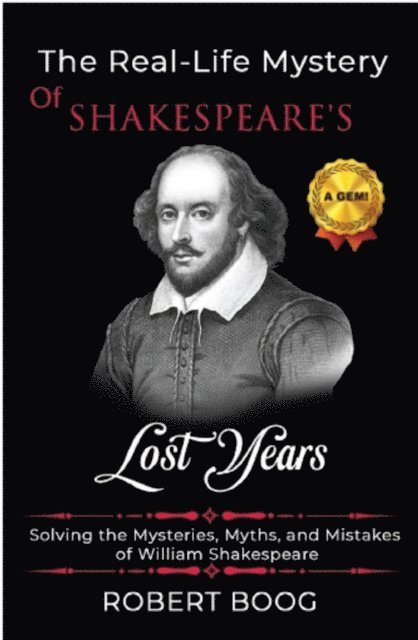
136 kr
Läs direkt efter köp
The Real-Life Mystery of William Shakespeare starts out in the year 1588 and moves forward and backward as it tries to solve the mystery of Shakespeare''s whereabouts. It is thoroughly enjoyable, incredibly informative, and a well-researched book about William Shakespeare''s lost years. If you thought you knew everything there is to know about Shakespeare, then you will enjoy this book. It is full of fresh thoughts and creative ideas. For example, why does the book start off in the year 1588? What happened then that was so critical to knowing about Shakespeare? You will find out. The summaries at the end of each chapter are incredibly helpful, and I can see students working on projects finding them to be very useful. The humor present throughout the work makes it a really enjoyable read.
Why Another Book on Shakespeare? Isn''t He a Bit Over-rated?
Sometimes you will hear students say, "Shakespeare is overrated" or "Why can''t the words be put into modern English?" Yet, most likely, students have also heard about the Italian renaissance. They might know Leonardo da Vinci, Galileo, Michelangelo, Titian, and Raphael. They were all part of the Italian Renaissance that happened in Europe between the years 1300 and 1600. The word "renaissance" means "rebirth" so between the years 1300 to 1600 a new way of thinking about the world replaced the old one. Question: why wasn''t anyone from England a part of the renaissance? Answer: One Englishman actually DID travel to Italy in the late 1500''s. Believe it or not, this man spoke fluent Italian and lived in Italy for over a year. He experienced the Italian renaissance first-hand and even stayed at the house of the painter Titian for two weeks. He wrote at least 13 plays that take place in Italy and changed the vocabulary of English with many Italian words. For example, he changed the Italian word "bandito" into the English "bandit".
And when you listen to the old English in Shakespeare''s plays, it all seems authentic. The words of his characters ring true. Watching Shakespeare''s plays you can almost imagine what it must have been like to have lived in Italy during the time of the Renaissance. For this reason, knowing more about the "real" William Shakespeare and where he went during his "lost" years is important. But for over 400 years, his whereabouts have remained a mystery -- that is, until now!