Robert Buckman - Böcker
Visar alla böcker från författaren Robert Buckman. Handla med fri frakt och snabb leverans.
6 produkter
6 produkter
554 kr
Skickas inom 3-6 vardagar
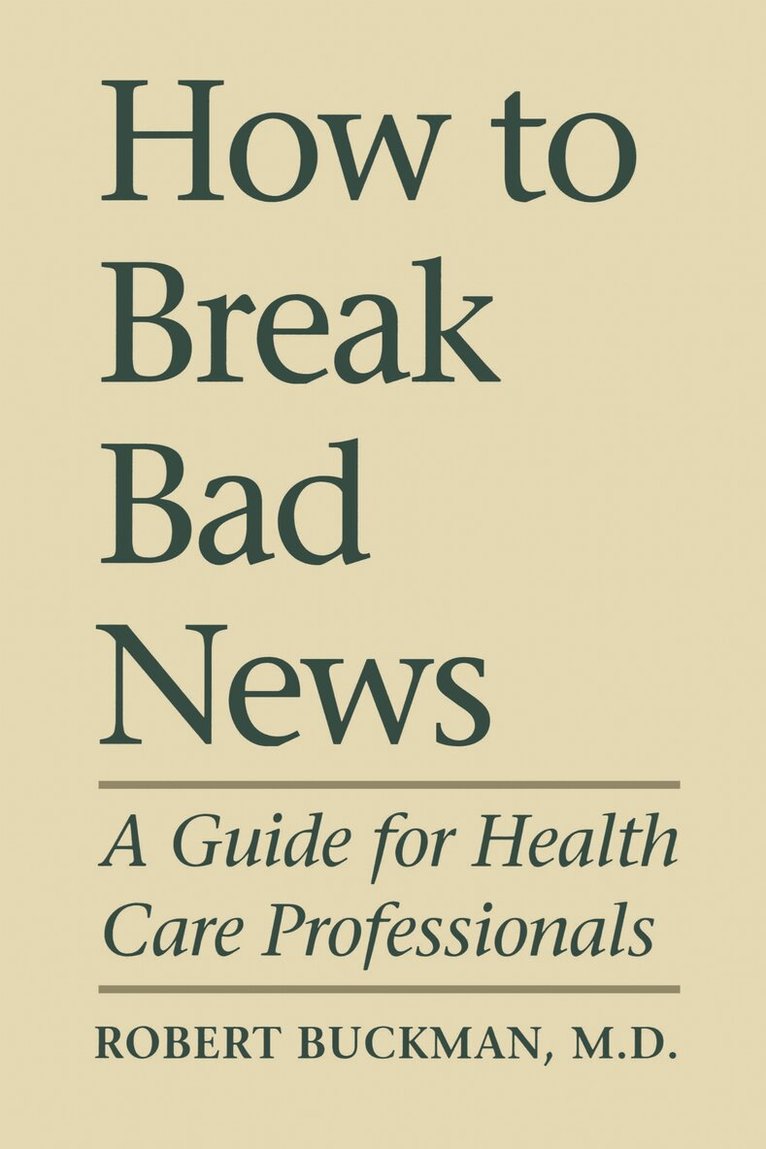
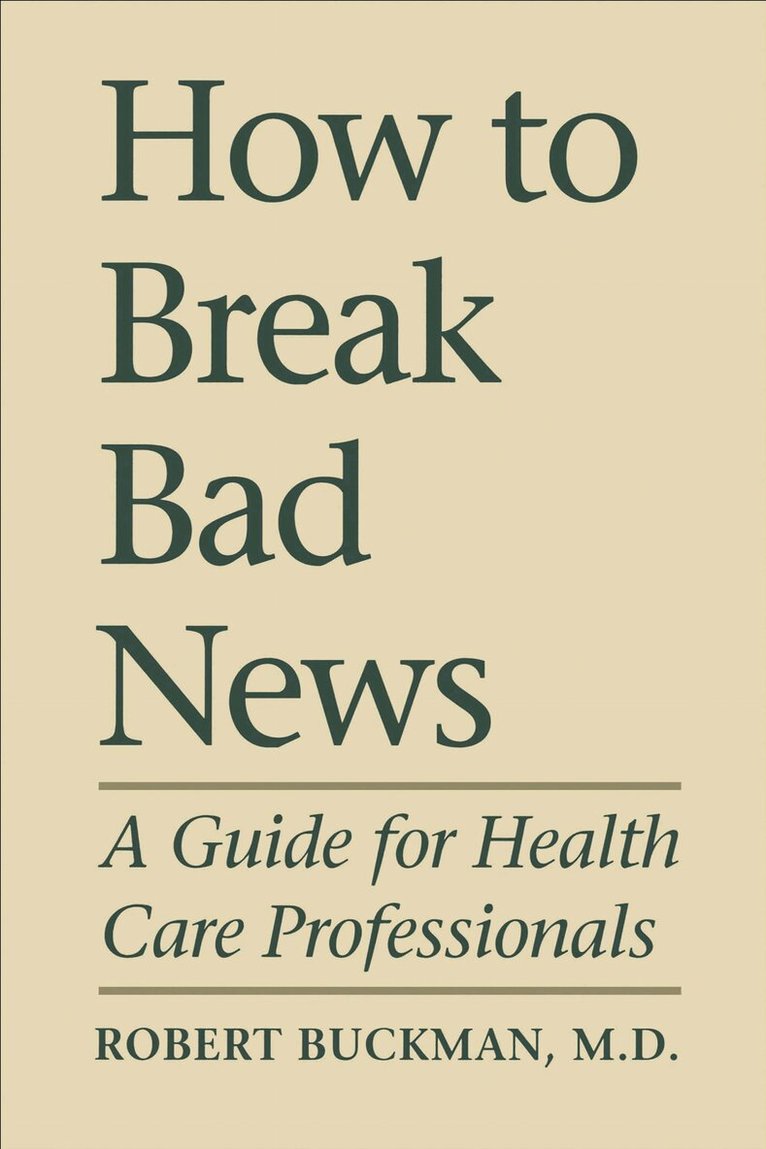
Based on Buckman's award-winning training videos and Kason's courses on interviewing skills for medical students, this volume is an indispensable aid for doctors, nurses, psychotherapists, social workers, and all those in related fields.For many health care professionals and social service providers, the hardest part of the job is breaking bad news. The news may be about a condition that is life-threatening (such as cancer or AIDS), disabling (such as multiple sclerosis or rheumatoid arthritis), or embarrassing (such as genital herpes). To date medical education has done little to train practitioners in coping with such situations. With this guide Robert Buckman and Yvonne Kason provide help.Using plain, intelligible language they outline the basic principles of breaking bad new and present a technique, or protocol, that can be easily learned. It draws on listening and interviewing skills that consider such factors as how much the patient knows and/or wants to know; how to identify the patient's agenda and understanding, and how to respond to his or her feelings about the information. They also discuss reactions of family and friends and of other members of the health care team.
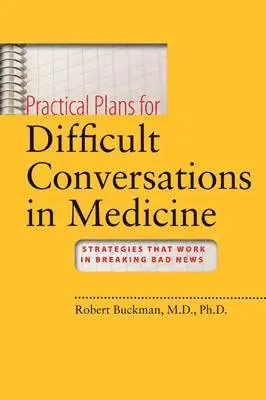
Practical Plans for Difficult Conversations in Medicine
Strategies That Work in Breaking Bad News
Inbunden, Engelska, 2010
658 kr
Skickas inom 7-10 vardagar
Although they receive extensive clinical training, medical practitioners are given little or no instruction about the best way to break bad news. In this book and DVD set, Robert Buckman, author of How to Break Bad News, offers solid, practical, and practicable guidelines for such conversations as the diagnosis of a serious or fatal illness, the death of a loved one in the hospital, or a disclosure of medical error. This is a book about communication techniques that work in everyday clinical practice. It is not a series of prefabricated scripts but a collection of strategies and approaches that any clinician can use to effectively communicate with patients. Using basic, honest communication tools, Buckman shows doctors how to approach conversations dealing with the most sensitive medical topics. He explains what to anticipate in various situations and provides guidance on keeping the discussion as constructive as possible. For each of several scenarios, Buckman supplies alternative responses, indicating which can work best and why. Each protocol is given an acronym to provide a mnemonic aid to help clinicians respond quickly and effectively.The accompanying DVD illustrates the protocols with recordings of unscripted and unrehearsed conversations with standardized patients, showing how the strategies can actually work in real situations in a realistic time frame. Based on sound, proven strategies and peppered throughout with illustrative examples, Practical Plans for Difficult Conversations in Medicine provides the tools and knowledge necessary to start and sustain a genuine conversation at a moment when the first thought is "I have no idea what to say now."
Practical Plans for Difficult Conversations in Medicine
Strategies That Work in Breaking Bad News
Häftad, Engelska, 2010
322 kr
Tillfälligt slut
Although they receive extensive clinical training, medical practitioners are given little or no instruction about the best way to break bad news. In this book and DVD set, Robert Buckman, author of How to Break Bad News, offers solid, practical, and practicable guidelines for such conversations as the diagnosis of a serious or fatal illness, the death of a loved one in the hospital, or a disclosure of medical error. This is a book about communication techniques that work in everyday clinical practice. It is not a series of prefabricated scripts but a collection of strategies and approaches that any clinician can use to effectively communicate with patients. Using basic, honest communication tools, Buckman shows doctors how to approach conversations dealing with the most sensitive medical topics. He explains what to anticipate in various situations and provides guidance on keeping the discussion as constructive as possible. For each of several scenarios, Buckman supplies alternative responses, indicating which can work best and why. Each protocol is given an acronym to provide a mnemonic aid to help clinicians respond quickly and effectively.The accompanying DVD illustrates the protocols with recordings of unscripted and unrehearsed conversations with standardized patients, showing how the strategies can actually work in real situations in a realistic time frame. Based on sound, proven strategies and peppered throughout with illustrative examples, Practical Plans for Difficult Conversations in Medicine provides the tools and knowledge necessary to start and sustain a genuine conversation at a moment when the first thought is "I have no idea what to say now."
336 kr
Skickas inom 7-10 vardagar
For many health care professionals and social service providers, the hardest part of the job is breaking bad news. The news may be about a condition that is life-threatening (such as cancer or AIDS), disabling (such as multiple sclerosis or rheumatoid arthritis), or embarrassing (such as genital herpes). To date medical education has done little to train practitioners in coping with such situations. With this guide Robert Buckman and Yvonne Kason provide help.Using plain, intelligible language they outline the basic principles of breaking bad new and present a technique, or protocol, that can be easily learned. It draws on listening and interviewing skills that consider such factors as how much the patient knows and/or wants to know; how to identify the patient's agenda and understanding, and how to respond to his or her feelings about the information. They also discuss reactions of family and friends and of other members of the health care team.Based on Buckman's award-winning training videos and Kason's courses on interviewing skills for medical students, this volume is an indispensable aid for doctors, nurses, psychotherapists, social workers, and all those in related fields.
430 kr
Skickas inom 3-6 vardagar
255 kr
Tillfälligt slut
In this provocative and stimulating study of the connection between belief and behavior, Dr. Robert Buckman begins by reviewing the history of religious belief, showing the many shared themes among religions of diverse cultures. He then explains little-publicized data from neuroscience on the limbic system and the right-hand temporal lobe of the brain, which when stimulated consistently produces deep-seated spiritual feelings. Recent experiments reveal that this portion of the brain may underlie the development of many common religious beliefs, and perhaps the more aggressive and destructive behaviors associated with some of them. Buckman also summarizes evidence regarding pheromones and their effect on the limbic system, as a possible mechanism for certain types of crowd behavior, whether in a religious or secular context.Finally, considering the long historical relationship between religion and ethics, Buckman asks whether we can develop better, nontheistic belief systems that avoid the destructive aspects of traditional religious beliefs. He then describes ways in which we can become aware of, and perhaps, correct our "limbic urges" when they threaten to lead to destructive behavior. This ambitious work, covering important areas of social anthropology, comparative religion, neurology, and psychology, provides many insights into the mechanisms of belief.