Robert D. Hill - Böcker
Visar alla böcker från författaren Robert D. Hill. Handla med fri frakt och snabb leverans.
6 produkter
6 produkter
742 kr
Skickas inom 5-8 vardagar
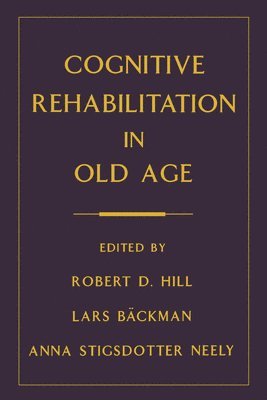
Cognitive deficits are part of the normal ageing process and are exacerbated by various diseases that affect adults in old age, such as dementia, depression, and stroke. A significant scientific and social effort has been expended to evaluate whether cognitive deficits can be remedied through systematic interventions. The editors, as well as the chapter authors, represent a variety of viewpoints that span theory as well as practice. Overall, they aim to address concepts in cognitive rehabilitation that are useful in intervention research -- research which examines problems and issues in normal and pathological aging -- and focusing on the application of cognitive training strategies in natural settings. Thus, the book is grounded in contemporary theory in cognitive ageing and is applicable to both the practicing clinician as well as the researcher.It is organized into four sections. The first highlights prominent theoretical principles; the second looks at cognitive rehabilitation strategies in normal ageing; the third examines the interplay between lifestyle patterns and cognitive function through applying a broad definition of lifestyle choices; and the fourth focuses on rehabilitation strategies that address issues in pathological (or diseased) ageing.
844 kr
Skickas inom 3-6 vardagar
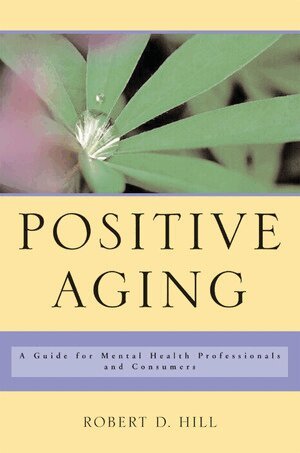
Retirement, senility, disability, and death were all notions previously associated with growing old.Today, with the average life span of men and women in the United States exceeding 76 years, the words successful, optimal, and positive dominate the lexicon of scientists and, increasingly, the general public. We not only plan to live longer, but expect to enjoy a superior standard of physical and emotional health for longer than any previous generation. Leading an active and purposeful life no longer stops at the outdated 65-year mark of retirement, but continues well into what was once termed "old age." With these changing attitudes comes the need for new conceptualizations of what it means to grow old.In a groundbreaking book, Robert Hill, a psychologist, professor, and leading researcher in geriatric care, rethinks the traditional ideas we have of aging by offering us a new framework from which to understand the nature of growing old. Positive Aging offers a more innovative model of old age that focuses on achieving and fostering a positive mindset. In doing so, Hill not only explores the social and psychological trends of aging in the 21st century, but offers an illuminating examination of how advances in the science of gerontology influence the phenomenology of growing old.Written for all those concerned about their own course of aging as well as the practitioner who provides mental health services to older adults, Positive Aging begins with a review of the term "aging" itself, its history and its changing meaning. Hill then delves into the many lifestyle choices we can make to improve our happiness as we grow older. Traditional theories of adult development and how Positive Aging plays into them are examined; successful, normal, impaired, and diseased trajectories of age-related decline are defined and explored; and useful strategies are provided for coping with common old-age issues—including cognitive deficits, depression, anxiety, and psychological barriers to happiness. Hill also covers important late-life concerns such as the role Positive Aging plays in physical disability, caregiving, grief, bereavement, death, and spirituality and meaning-based counseling. Along the way, poignant case studies help elucidate and contextualize the arguments, and keep the discussion rooted in very tangible, human terms.Ushering in an era of new understanding of what it means to grow older, Positive Aging is an enlightening guidebook for consumers navigating such uncertain, and often worrisome terrain, as well as an invaluable resource for clinicians working with this growing population. By combining a novel approach to human aging in the contemporary world with specific suggestions and ideas to optimize that process, this book promises to help all of us cope with the vicissitudes of growing older to continue to get the most out of living.
184 kr
Tillfälligt slut
A practical companion to Robert Hill’s Positive Aging: A Guide for Mental Health Professionals and Consumers, Seven Strategies for Positive Aging presents essential tactics that encourage the development of positive aging skills. In Positive Aging, Dr. Hill challenged traditional conceptions about aging and offered a new theoretical framework for understanding the nature of aging. He argued that “Positive Agers” can be found everywhere, and come from all walks of life. They find satisfaction in life regardless of their personal circumstances. By adopting affirmative lifestyle choices and positive spirituality, they are able to age well.In his new book, Robert Hill explains how anyone can adopt and develop positive aging skills. Dr. Hill has drawn upon the theoretical perspective first presented in Positive Aging to develop practical exercises and techniques that are easily accessible to the reader interested in discovering how best to adapt to the aging process. The reader will discover meaning through lifespan learning, learn how to transform age-related decline, and find out how to employ the principles of continuity in order to feel good about oneself, even during challenging times. The reader will also learn how to apply “meaning-centered” techniques of belonging, altruism, gratitude, and forgiveness in his or her own life, in order to enhance emotional health. These techniques are organized into seven distinct chapters: Learning, Meaning, Wisdom, Belonging, Helping, Gratitude, and Forgiveness.
598 kr
Skickas inom 10-15 vardagar
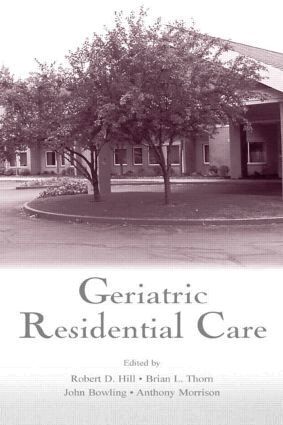
This book's main goal is to examine the concept of residential care from a psychological perspective. The chapter authors espouse a psychological approach to long-term residential care and an effort is made throughout the text to present a model of care that encompasses the whole individual. Since psychologists are being increasingly asked to provide consultation to long-term residential care facilities, the need for psychologically-based care models has become apparent. This text offers assistance in developing and maintaining residential care environments that maximize quality of life and personal well-being in the presence of declining physical and emotional resources that are associated with the vicissitudes of living into advanced aging. Geriatric Residential Care is divided into four parts. Part I addresses psychological and social issues facing the frail elderly who are candidates for, or are living in residential care settings. Part II addresses issues in the assessment of individuals in residential care. Part III highlights the design and execution of intervention strategies in residential care. Part IV addresses how organizational aspects of residential care contexts can optimize the quality and meaningfulness of care.
373 kr
Skickas inom 10-15 vardagar
This book's main goal is to examine the concept of residential care from a psychological perspective. The chapter authors espouse a psychological approach to long-term residential care and an effort is made throughout the text to present a model of care that encompasses the whole individual. Since psychologists are being increasingly asked to provide consultation to long-term residential care facilities, the need for psychologically-based care models has become apparent. This text offers assistance in developing and maintaining residential care environments that maximize quality of life and personal well-being in the presence of declining physical and emotional resources that are associated with the vicissitudes of living into advanced aging. Geriatric Residential Care is divided into four parts. Part I addresses psychological and social issues facing the frail elderly who are candidates for, or are living in residential care settings. Part II addresses issues in the assessment of individuals in residential care. Part III highlights the design and execution of intervention strategies in residential care. Part IV addresses how organizational aspects of residential care contexts can optimize the quality and meaningfulness of care.
Engaging Older Adults with Modern Technology
Internet Use and Information Access Needs
Inbunden, Engelska, 2012
2 248 kr
Skickas inom 5-8 vardagar