Häftad, Engelska, 1995
884 kr
Skickas inom 10-15 vardagar
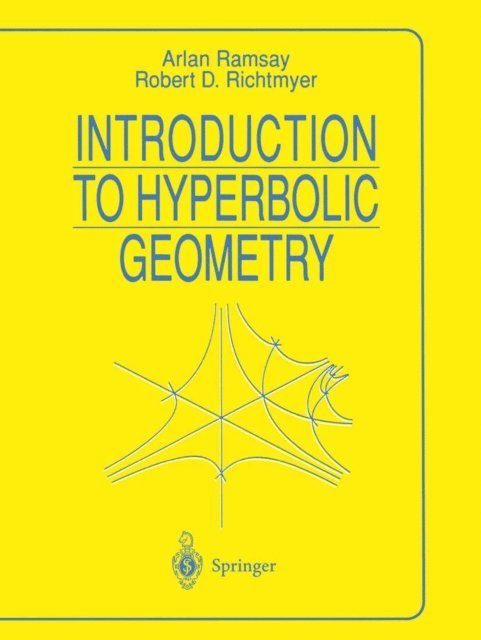
This book is an introduction to hyperbolic and differential geometry that provides material in the early chapters that can serve as a textbook for a standard upper division course on hyperbolic geometry. For that material, the students need to be familiar with calculus and linear algebra and willing to accept one advanced theorem from analysis without proof. The book goes well beyond the standard course in later chapters, and there is enough material for an honors course, or for supplementary reading. Indeed, parts of the book have been used for both kinds of courses. Even some of what is in the early chapters would surely not be nec essary for a standard course. For example, detailed proofs are given of the Jordan Curve Theorem for Polygons and of the decomposability of poly gons into triangles, These proofs are included for the sake of completeness, but the results themselves are so believable that most students should skip the proofs on a first reading. The axioms used are modern in character and more "user friendly" than the traditional ones. The familiar real number system is used as an in gredient rather than appearing as a result of the axioms. However, it should not be thought that the geometric treatment is in terms of models: this is an axiomatic approach that is just more convenient than the traditional ones.